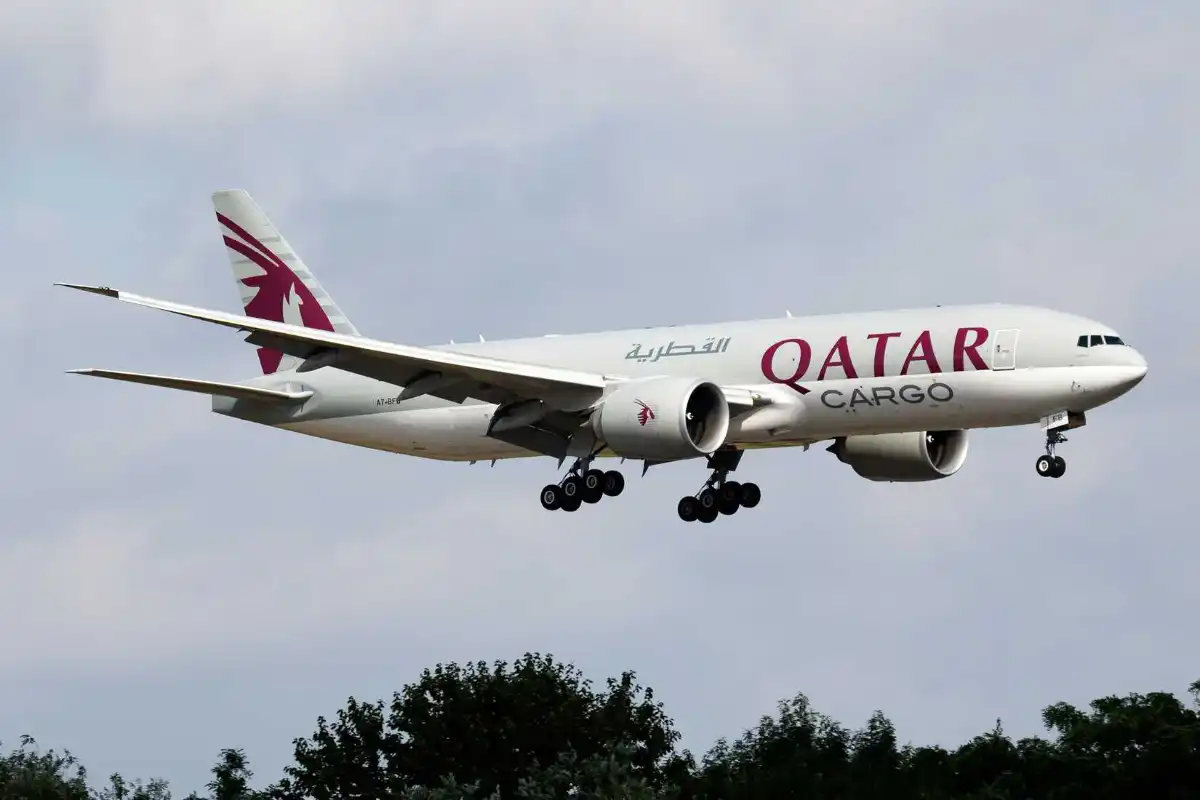
A dramatic flyover involving a Qatar Airways Cargo-bound Boeing 777-200 freighter has sparked widespread concern after video footage revealed the aircraft’s right wing appeared to come perilously close to the ground during a low-altitude pass over a private Texas airport. The incident, which occurred on June 24, has raised serious questions about operational judgment, flight safety, and the risks associated with ceremonial flyovers involving large commercial aircraft.
A Routine Ferry Flight Turns Into a High-Risk Demonstration
The aircraft involved, registered N705DN, was conducting a ferry flight from Grissom Aeroplex in Indiana to Perot Field Fort Worth Alliance Airport in Texas. Before reaching its destination, however, the crew made a planned detour to Horseshoe Bay Resort Jet Center (DZB), the home base of aircraft owner Jetran, a Texas-based aviation leasing and asset management company.
The purpose of the flyover was symbolic. The aircraft had recently completed its transformation from a passenger jet into a dedicated cargo aircraft and was preparing for delivery to Qatar Airways Cargo. The low pass was intended as a farewell salute before the jet entered commercial freight service.
What was meant to be a celebratory moment quickly became a controversial aviation event.
By the time video footage surfaced online, aviation enthusiasts and professional pilots alike were questioning how such a maneuver was conducted so close to the ground with a widebody aircraft weighing hundreds of thousands of pounds.
Video Footage Captures a Narrow Escape
The most alarming aspect of the incident occurred as the Boeing 777 began a right banking maneuver at the lowest point of its pass. Footage shows the aircraft flying extraordinarily low over the runway environment before rolling gently to the right.
Observers noted that the aircraft’s right wingtip appeared to come within mere feet—and potentially only inches—of striking the ground.
For a jet with a wingspan exceeding 212 feet (64.8 meters), even a modest bank angle at low altitude significantly reduces wingtip clearance. Aviation experts have pointed out that a slight gust of wind, momentary turbulence, or a minor control input could have resulted in catastrophic consequences.
While the aircraft ultimately avoided contact and continued its flight without incident, the margin for error appeared exceptionally small. The images quickly circulated throughout aviation communities, with many describing the maneuver as unnecessary and reckless.
Flight Data Suggests Extremely Low Altitude
Flight tracking data provides additional context regarding the event. According to publicly available ADS-B information, the aircraft descended to a recorded altitude of approximately 950 feet above mean sea level during the pass.
When local airport elevation and atmospheric pressure conditions are taken into account, analysts estimated that the aircraft may have been operating at an altitude effectively near runway level during portions of the maneuver.
This assessment aligns with what is visible in the video footage, where the massive freighter appears far lower than what would typically be expected during a ceremonial flyover.
Following the pass, the aircraft climbed away normally and proceeded to Fort Worth Alliance Airport, where it landed safely shortly before 3:00 p.m. local time.
Why Banking at Low Altitude Is Particularly Dangerous
Low passes themselves are not uncommon in aviation. They are occasionally performed during aircraft deliveries, retirement ceremonies, military demonstrations, and special commemorative events. However, aviation safety standards emphasize maintaining adequate clearance margins and avoiding aggressive maneuvers close to terrain.
The danger increases substantially when an aircraft begins turning at very low altitude.
As an aircraft banks, one wing descends while the other rises. On a large aircraft such as the Boeing 777, even a shallow bank can dramatically reduce the distance between a wingtip and the ground. Any unexpected environmental factor can further reduce that margin.
Horseshoe Bay Airport’s surroundings add another layer of concern. The facility serves primarily private and business aviation traffic and sits adjacent to residential developments. A loss of control or wing strike in such an area could have produced consequences extending far beyond the aircraft itself.
Historical Examples Show the Risks of Ceremonial Flyovers
Aviation history contains several reminders of the dangers associated with low-altitude demonstrations.
One of the most notable examples occurred in 1988 when Air France Flight 296, an Airbus A320 participating in a ceremonial flyover during the Habsheim Air Show, crashed after descending too low. The aircraft struck trees beyond the runway and resulted in fatalities.
More recently, a veteran Icelandair captain faced scrutiny after allegedly conducting an unauthorized low-altitude flyover over his hometown during a farewell flight. Although that event ended safely, it highlighted the ongoing tension between symbolic aviation traditions and strict operational safety standards.
The Texas incident involving N705DN is likely to reignite discussions regarding whether such demonstrations remain appropriate in modern commercial aviation.
The Aircraft Behind the Incident
The aircraft at the center of the controversy has a unique history. N705DN is a 17-year-old Boeing 777-200LR that originally entered service with Delta Air Lines in 2009 as a long-haul passenger aircraft capable of carrying nearly 300 travelers.
Following its retirement during the pandemic-era downturn, the jet was stored in Victorville, California, before being acquired by Jetran.
The aircraft later became the prototype for Mammoth Freighters’ 777-200LRMF passenger-to-freighter conversion program. Conversion work began in 2022 and concluded in 2025, transforming the former airliner into a long-range cargo platform.
The jet now wears Qatar Airways Cargo livery and represents one of the first aircraft in a program that has already attracted significant industry interest. Qatar Airways is expected to receive multiple converted freighters as part of its fleet expansion strategy, while other customers include major logistics operators such as DHL and Ethiopian Airlines.
Investigation Likely to Follow
Although the flight concluded safely, the footage has generated enough attention that regulatory scrutiny appears almost inevitable. Aviation authorities routinely review incidents involving unusually low passes, particularly when video evidence suggests potential safety violations.
Investigators will likely examine flight data, crew authorization, operational procedures, and the circumstances surrounding the maneuver. The focus will be on determining whether the flight remained within approved safety parameters and whether any regulations were breached.
For now, the Boeing 777 escaped unharmed. Yet the images from Horseshoe Bay serve as a powerful reminder that even experienced crews operating advanced aircraft can find themselves only inches away from disaster when safety margins become razor thin.