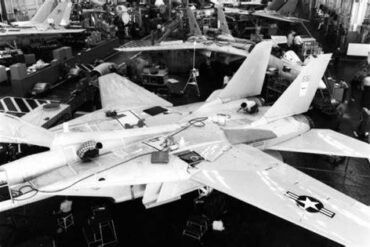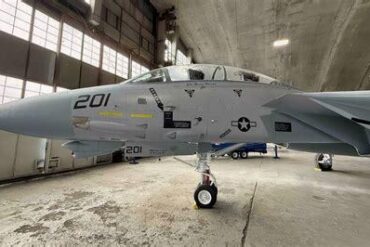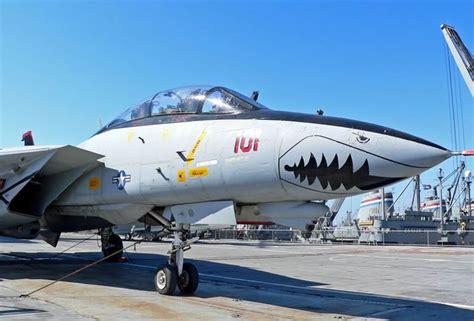
The Grumman F-14 Tomcat remains one of the most iconic carrier-based fighter jets ever built, a legacy symbol of American air superiority forged in the crucible of Cold War strategy. With its sweeping wings, massive radar, and long-range intercept capabilities, the Tomcat served a clear and urgent role: neutralizing Soviet bombers before they could threaten U.S. carrier strike groups. Now, nearly twenty years after its retirement, global tensions and advanced standoff threats have resurrected the strategic rationale that once made the F-14 indispensable.
The Return of Long-Range Threats in the Pacific Theater
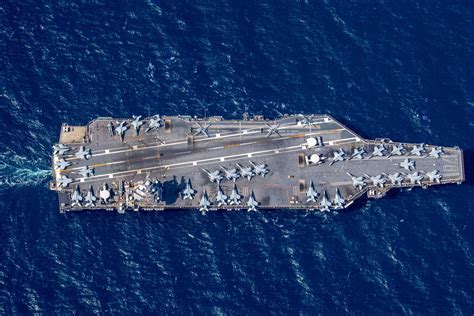
Today’s security environment increasingly mirrors the conditions that birthed the Tomcat. The U.S. Navy faces rising challenges from China’s and Russia’s development of advanced long-range cruise missiles, hypersonic weapons, and stealth platforms, threatening carrier groups from hundreds of miles away. This echoes the Cold War scenario where Soviet Tu-22M bombers armed with anti-ship missiles drove the need for a fast, powerful interceptor that could engage threats beyond the visible horizon. The F-14’s core mission—fleet defense at range—has regained relevance, even if its airframe cannot return.
What the F-14 Offered That Still Matters Today
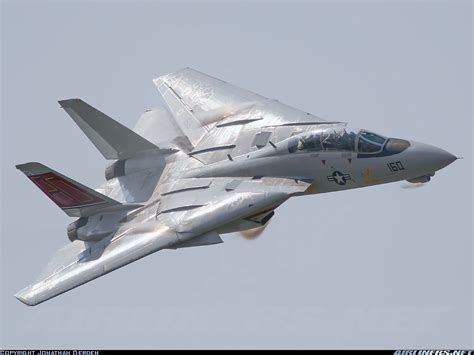
The F-14 Tomcat was more than a fighter—it was a strategic asset. With its AN/AWG-9 radar, capable of tracking up to 24 targets and guiding six AIM-54 Phoenix missiles simultaneously at over 100 miles, the Tomcat was designed to dominate the battlespace well before enemy aircraft could enter weapon range. Its twin-crew configuration (pilot and Radar Intercept Officer) allowed unparalleled situational awareness and division of labor in high-threat environments. Variable-sweep wings offered aerodynamic versatility, enabling the aircraft to loiter at low speeds or dash at Mach 2.34—a speed no current carrier-based fighter achieves.
By contrast, today’s Super Hornets and F-35Cs bring advanced sensor fusion, stealth, and networked warfare capabilities, but lack the Tomcat’s combination of raw speed, range, and missile loadout. In essence, while current fighters are optimized for multi-role efficiency and survivability, none embody the Tomcat’s singular focus on high-speed intercept and missile superiority.
Modern Fighters Are Capable—But Not Tomcat Replacements
The F/A-18E/F Super Hornet and F-35C Lightning II are the workhorses of today’s carrier aviation. The Super Hornet is optimized for cost-effective multirole operations, with minimal maintenance needs. The F-35C, with its low observable design and AN/APG-81 AESA radar, excels in precision strike and network warfare. Yet, neither of these aircraft matches the Tomcat’s ability to loiter far from the carrier with a heavy air-to-air payload, independently engage multiple targets at extreme ranges, or execute high-speed fleet defense.
In fact, modern naval air strategy now relies on distributed systems: E-2D Hawkeyes for early warning, F-35s for detection and coordination, and Super Hornets for missile delivery. This layered approach works—but it introduces complexity and coordination demands that a single Tomcat-style interceptor could simplify.
Operational Limitations That Ended the Tomcat Era
Despite its strengths, the F-14 was ultimately retired due to unsustainable operational costs. By the 2000s, the aircraft required 40–60 hours of maintenance for each flight hour. The complex swing-wing mechanism, aging avionics, and lack of standardization with newer platforms led to soaring support costs—double that of the Super Hornet. Moreover, the end of the Cold War removed the immediate threat the Tomcat was designed to counter, and Navy doctrine shifted toward multirole flexibility and efficiency.
The Tomcat’s retirement, however, left a void that has not been fully addressed. While the newer platforms bring stealth and digital warfare capabilities, none replicate the long-range defensive reach once provided by a single aircraft. Today’s distributed approach is sophisticated—but potentially brittle under high saturation attack scenarios, particularly in the Pacific, where distances and threat ranges vastly exceed Cold War European theater norms.
Could a Modernized Tomcat Concept Fill the Gap?
Resurrecting the original F-14 is neither technically feasible nor cost-effective. However, the philosophy behind its design—range, radar power, missile capacity, and interception speed—is more relevant than ever. Concepts such as the ASF-14 and future carrier-based variants of the Next Generation Air Dominance (NGAD) program echo the Tomcat’s spirit. These hypothetical aircraft would focus on fleet defense at distance, carrying advanced long-range air-to-air weapons like future derivatives of the AIM-260 or advanced hypersonic interceptors.
A modern Tomcat-style aircraft would not merely replicate past technology but integrate 21st-century advancements: stealth shaping, AESA radar, integrated electronic warfare, and AI-assisted crew operations. A two-seat configuration could return, enabling effective management of complex sensors, communications, and multiple weapons engagements in dense airspace. The Navy’s future may depend on a new class of long-range, high-endurance interceptors, forged not in nostalgia, but in strategic necessity.
Iran’s Tomcats: A Case Study in Necessity, Not Viability
Iran’s continued operation of its dwindling F-14 fleet provides a curious case study. After acquiring 79 Tomcats before the 1979 revolution, Iran was cut off from official support and has since relied on reverse engineering, black-market sourcing, and domestic improvisation to keep 20–25 aircraft flying. Missiles like the Sedjil and Fakour-90 emerged as Iranian attempts to replicate or modify the Phoenix missile system.
While impressive in its ingenuity, Iran’s experience underscores the difficulty of sustaining the Tomcat platform without extensive industrial backing. The destruction of two Iranian F-14s during a 2025 Israeli airstrike highlighted the aging fleet’s vulnerability and the limitations of maintaining obsolete designs under combat conditions. The U.S. Navy cannot, and should not, emulate this approach—but it can learn from it.
The Future: Not the Tomcat, But Its Heir
The F-14 Tomcat cannot return, but its mission profile absolutely should. As peer adversaries field high-speed, long-range strike systems, the need for a carrier-based interceptor with extended range, endurance, and missile firepower becomes undeniable. Whether through a dedicated NGAD variant, an evolved Super Hornet “missile truck,” or a new two-seat long-range fighter, the future of naval air power may begin to resemble its past.
In this emerging era of distributed maritime operations, vast distances, and high-volume threats, the design logic that gave birth to the Tomcat feels not outdated, but prophetic. The Navy’s next great fighter may not bear the name Tomcat—but it will, in every meaningful way, carry its DNA.