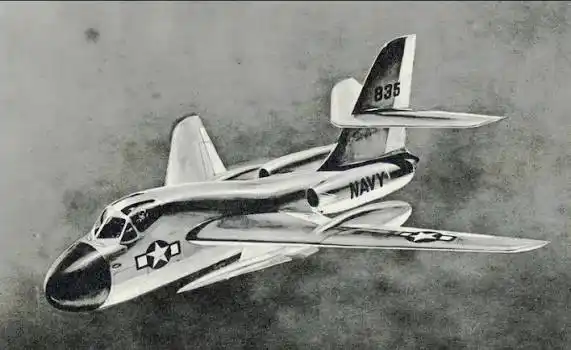
The Grumman F-14 Tomcat became one of the most recognizable fighter jets in naval aviation history, combining long-range interception, advanced radar technology, and devastating missile capability into a single carrier-based platform. Yet the aircraft that ultimately protected US Navy carrier groups during the Cold War was not born from a clean-sheet design. Hidden behind the Tomcat’s legendary reputation was a forgotten aircraft concept that never reached the prototype stage: the Douglas F6D Missileer.
The Missileer was a strange aircraft for its time. It was not designed to win close-range dogfights, break speed records, or perform traditional fighter missions. Instead, it was envisioned as a flying missile battery, a long-endurance interceptor designed to sit far from a carrier battle group and destroy Soviet bombers before they could launch devastating anti-ship missiles. Although the F6D was canceled before construction began, many of its core ideas survived and eventually evolved into the technology that defined the F-14 Tomcat.
During the Cold War, the US Navy faced a rapidly changing threat environment. Soviet naval aviation was developing increasingly capable long-range bombers, including aircraft such as the Tupolev Tu-22M Backfire and later the Tupolev Tu-160 Blackjack, which were designed to attack American carrier groups from hundreds of miles away. These aircraft could carry powerful anti-ship missiles, allowing Soviet forces to threaten US naval formations without ever entering the defensive range of conventional fighters.
The Navy’s answer was to create a layered defense system. Carrier groups would rely on radar networks, surface-to-air missiles, fighter aircraft, and dedicated interceptors working together to create a protective shield around the fleet. The outermost layer required an aircraft capable of detecting enemy bombers at extreme distances and destroying them before they could launch their weapons.
This requirement produced one of the most unusual aircraft proposals of the era: the Douglas F6D Missileer.
The F6D Missileer: The Navy Jet Designed as a Flying Missile Battery
In 1959, while the F-4 Phantom II was still under development, the US Navy began searching for a new approach to fleet air defense. Traditional fighter concepts focused heavily on speed and maneuverability, but naval planners believed future conflicts would be dominated by long-range missiles rather than classic air combat.
The F6D Missileer represented a completely different philosophy. Instead of chasing enemy aircraft in a high-speed engagement, it would act as a heavily armed airborne interceptor platform. Its mission was simple: remain on patrol for hours, detect incoming Soviet bombers, and launch long-range missiles before the enemy aircraft could threaten the fleet.
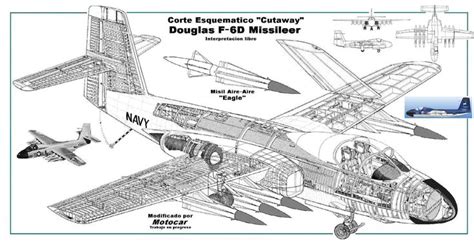
The aircraft would have been powered by two Pratt & Whitney TF30-P-2 turbofan engines, each producing approximately 10,000 pounds of thrust. Unlike many contemporary fighters, these engines lacked afterburners because the Navy prioritized endurance over raw speed. The design goal was to keep the aircraft airborne for up to six hours, allowing it to maintain a continuous defensive barrier around carrier formations.
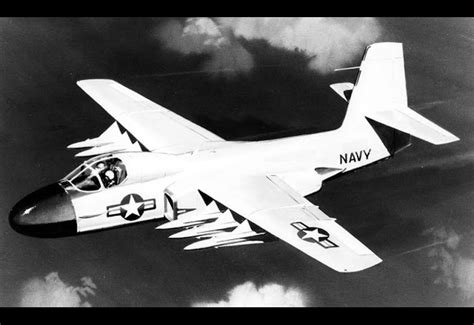
The Missileer’s most important feature was not its airframe but its weapon system. It was planned to carry the advanced Hughes AN/ASG-18 fire-control radar and six Bendix XAAM-10 Eagle air-to-air missiles. These missiles were among the most ambitious weapons projects of the era, designed to reach approximately Mach 4 and engage targets at distances of around 80 miles (129 km).
In theory, the F6D would operate almost like an airborne surface-to-air missile battery. Its radar would identify approaching bombers from long distances, its computer would guide the aircraft into position, and its Eagle missiles would destroy enemy aircraft before they could launch their own weapons.
However, the aircraft’s biggest strength was also considered its greatest weakness.
The Missileer was slow compared with emerging supersonic fighters. Once it fired its missiles, it would have limited ability to defend itself against enemy fighters. Critics argued that a large, specialized interceptor without strong self-defense capabilities could become vulnerable in a rapidly changing combat environment.
In December 1961, Secretary of Defense Robert McNamara canceled both the F6D Missileer and the XAAM-10 Eagle missile program. The aircraft never flew, never reached prototype construction, and disappeared into aviation history.
But the ideas behind it were far from dead.
How the Failed Missileer Program Created the Technology Behind the F-14 Tomcat
The cancellation of the F6D Missileer did not end the Navy’s search for a long-range fleet defense aircraft. Instead, its mission requirements evolved into another major program: the General Dynamics–Grumman F-111B.
The F-111B was developed as a carrier-based interceptor version of the Air Force’s F-111 program. Unlike the Missileer, it introduced advanced features such as variable-sweep wings and a more powerful airframe. The aircraft was intended to combine long-range interception capability with carrier operations.
At the center of the F-111B’s mission was the same technological vision that had shaped the Missileer: detect enemy bombers far away, engage them beyond visual range, and protect the fleet before hostile aircraft could launch attacks.
The aircraft carried the developing AN/AWG-9 radar system and was designed around the new AIM-54 Phoenix missile. These systems represented a direct continuation of the Missileer concept, but with far greater capability.
However, the F-111B struggled to meet Navy requirements. Its size and weight created serious problems for carrier operations. Although it possessed impressive range and missile capability, pilots and engineers found that its handling characteristics were unsuitable for demanding aircraft carrier environments.
The Navy needed an aircraft that could do more than intercept. It needed a fighter capable of fleet defense, air superiority, and combat operations against a variety of threats.
The F-111B program was canceled in 1968.
Yet once again, the technology survived.
The Navy transferred the AN/AWG-9 radar and AIM-54 Phoenix missile concepts to Grumman, which used them as the foundation for a new aircraft design. That aircraft became the F-14 Tomcat.
The F-14 Tomcat: The Missileer Concept Finally Takes Flight
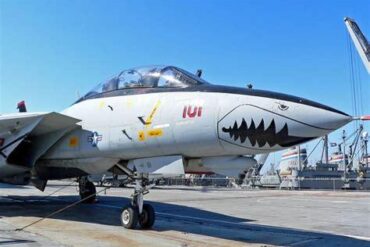
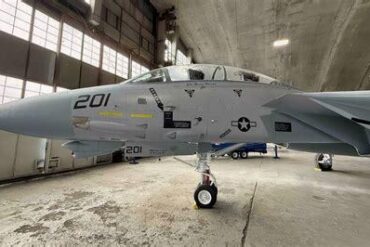
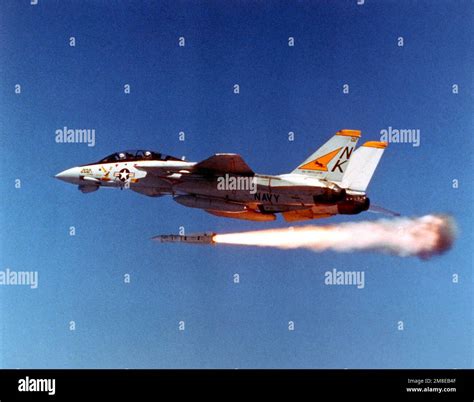
When the first F-14A Tomcats entered US Navy service in 1972, they represented the successful realization of a dream that had begun with the canceled F6D Missileer more than a decade earlier.
The Tomcat preserved the original concept of a long-range fleet interceptor but transformed it into a much more capable fighter. Instead of being a slow missile carrier, the F-14 combined advanced radar, long-range missiles, high-speed performance, and exceptional maneuverability.
Its centerpiece was the AN/AWG-9 radar system, a powerful radar capable of tracking multiple targets at extreme distances. The system could generate up to 24 target tracks simultaneously and allow the aircraft to engage several threats at once.
The F-14’s primary weapon was the AIM-54 Phoenix missile, which gave the Navy an unprecedented ability to attack enemy aircraft from beyond visual range. The missile could reach approximately 100 nautical miles in early versions, with later variants improving range and reliability.
The aircraft’s performance also solved one of the Missileer’s biggest problems. The Tomcat was not simply a missile platform. Equipped with powerful engines and a variable-sweep wing design, it could fight effectively against enemy fighters.
Later F-14B and F-14D variants received General Electric F110-GE-400 afterburning turbofan engines, producing roughly 27,000 to 29,000 pounds of thrust per engine with afterburner. These upgrades gave the Tomcat significantly improved acceleration and combat performance.
With a combat radius of approximately 400 to 500 nautical miles, the F-14 could operate far from the carrier and maintain the outer defensive zone originally envisioned for the Missileer.
The aircraft had finally achieved what the earlier Douglas design could not.
The F-14 Tomcat Proved the Fleet Defense Concept in Combat
The F-14’s capabilities were not only theoretical. During the Cold War, it became a critical component of US naval strategy and demonstrated its effectiveness in real-world confrontations.
One of the most famous examples occurred during the Gulf of Sidra incident in 1981. Two F-14s from Fighter Squadron 41, operating from the aircraft carrier USS Nimitz, intercepted two Libyan Su-22 fighters over the Mediterranean.
The encounter escalated when one Libyan aircraft launched a missile at the American formation. The F-14s successfully avoided the attack and responded by destroying both Libyan aircraft with AIM-9 Sidewinder missiles. The engagement lasted approximately one minute and demonstrated the Tomcat’s ability to operate in dangerous airspace while maintaining control of the situation.
Although the Gulf of Sidra engagement involved short-range weapons rather than Phoenix missiles, it highlighted the aircraft’s broader mission: protecting naval forces through superior detection, response, and combat capability.
The Tomcat later became famous for its role in US carrier operations, where its combination of range, radar power, and missile capability made it one of the most feared aircraft of the Cold War era.
The Forgotten Legacy of the F6D Missileer
The Douglas F6D Missileer remains one of the most fascinating “what if” aircraft in aviation history. It never flew, never entered production, and never became part of a carrier air wing. Yet its influence can be seen throughout the development of the F-14 Tomcat.
The Missileer introduced a revolutionary idea: future naval air defense would depend on long-range detection and missile engagement rather than traditional fighter interception. While the original aircraft design proved impractical, the strategic thinking behind it was correct.
The F-14 Tomcat became the aircraft that finally delivered that vision. It combined the Missileer’s long-range interception philosophy with the speed, agility, and versatility required for real combat.
In many ways, the F6D Missileer was the aircraft that disappeared so the F-14 could exist. It was a failed project that succeeded through its legacy, a canceled Navy jet that never left the drawing board but quietly shaped one of the most iconic fighters ever built.