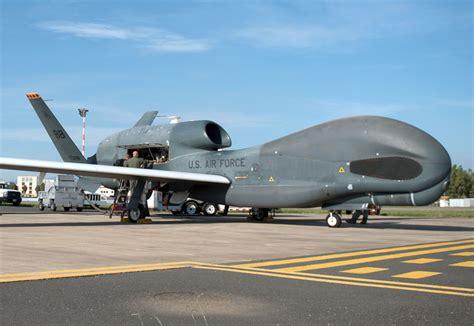
The RQ-4 Global Hawk stands as one of the most advanced high-altitude, long-endurance (HALE) unmanned aerial vehicles (UAVs) ever developed. Designed and manufactured by Northrop Grumman, this formidable reconnaissance aircraft has redefined how strategic intelligence, surveillance, and reconnaissance (ISR) missions are conducted. With its origins in a late-1990s DARPA initiative and fielded under the U.S. Air Force, the Global Hawk is emblematic of the fusion between aerospace engineering and tactical military necessity.
Unlike traditional manned reconnaissance platforms, the RQ-4 Global Hawk offers sustained, wide-area surveillance over vast geographic expanses without risking pilot lives. It has played a pivotal role across multiple theaters, from Afghanistan to Iraq, and even in domestic and scientific missions under NASA. Its capability to loiter for over 30 hours at altitudes exceeding 60,000 feet, all while transmitting high-resolution sensor data, sets a benchmark in unmanned surveillance.
Development Origins and Design Evolution
The development of the RQ-4 began in response to a requirement for a long-endurance ISR aircraft that could operate at extreme altitudes for extended periods. Originally, DARPA selected the RQ-4 over the stealthier RQ-3 DarkStar in the 1990s due to its superior range and payload capacity. The aircraft took its maiden flight on 28 February 1998, and after rigorous trials—including in Afghanistan during early operations—seven prototypes demonstrated its combat utility.
The program evolved in stages:
- Block 10 (RQ-4A): Initial production run with nine units; two went to the U.S. Navy for maritime trials.
- Block 20 (RQ-4B): Featured a stretched fuselage and wingspan, increasing the payload to 3,000 lb (1,360 kg). This version rolled out on 25 August 2006 and flew for the first time in March 2007.
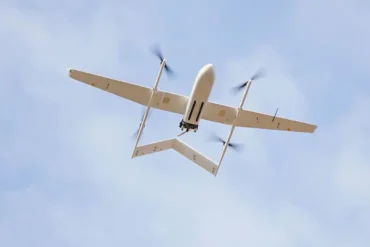
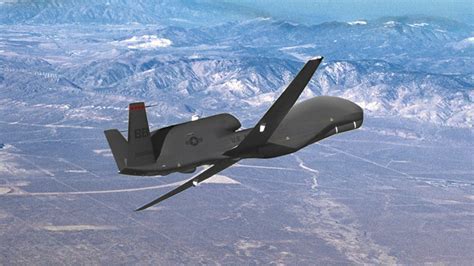
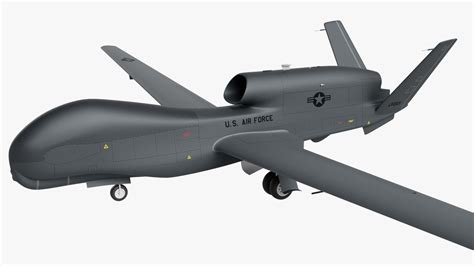
A defining feature of the RQ-4 is its high-aspect-ratio wing and V-tail configuration, which support ultra-long flight durations. Powered by a Rolls-Royce AE3007 turbofan engine generating 7,050 lbf of thrust, the UAV exhibits exceptional fuel efficiency at high altitudes.
Sensor Suite and Surveillance Capabilities
The aircraft’s onboard sensors are what truly distinguish the RQ-4 in the reconnaissance domain. Its payload includes:
- HISAR Synthetic Aperture Radar (SAR) with Moving Target Indicator (MTI)
- Electro-Optical/Infrared (EO/IR) gimbaled camera with 30 cm resolution from 20 km altitude
- MP-RTIP AESA radar for high-resolution ground imaging
- Garmin GSX-70 weather radar, installed by 2019 for atmospheric monitoring
These systems enable real-time transmission of intelligence data to ground stations thousands of miles away, greatly enhancing situational awareness and target acquisition capabilities.
Operational Use and Deployment History
Since entering service in November 2001, the Global Hawk has proven indispensable. The U.S. Air Force deployed it in both Afghanistan and Iraq, where it provided overwatch and force protection. By 2010, the aircraft had logged over 30,000 combat flight hours, with some sorties lasting up to 32.5 hours.
From 2017, the Air Force began training enlisted airmen as pilots for the Global Hawk program, emphasizing the maturation of UAV operation as a core military skill. In Operation Inherent Resolve, the RQ-4 delivered long-duration ISR support, playing a critical role in mission planning and strike coordination.
The NASA variant has contributed significantly to atmospheric science. Two early prototypes transferred to NASA in 2007 were employed in missions such as the Genesis and Rapid Intensification Processes (GRIP) study, focusing on hurricane dynamics.
Variants: From Triton to Euro Hawk
One of the most successful adaptations of the Global Hawk platform is the MQ-4C Triton, developed for maritime patrol under the U.S. Navy’s Broad Area Maritime Surveillance (BAMS) program. Featuring reinforced wings for sea-level operations, it has undertaken missions like RIMPAC and earned the Navy’s trust as a premier long-range maritime asset.
In contrast, the Euro Hawk—a collaboration between Northrop Grumman and EADS—was less fortunate. Based on the Block 20/30/40 architecture, it incorporated advanced SIGINT pods. Despite setting endurance records, the program was canceled in 2013 due to regulatory non-compliance with civilian airspace standards.
Cost Dynamics and Procurement Changes
The RQ-4’s path has not been free of controversy. While its initial 1994 cost was estimated at $10 million, by 2001 that figure had surged to $60.9 million—and by 2013, a staggering $131.4 million per unit. Despite cost per flight hour dropping from $40,600 in 2010 to $18,900 by 2013, the program faced Nunn-McCurdy breach scrutiny and adjustments to procurement plans.
Initially, the Air Force planned to purchase 63 aircraft, but this was later cut to 45. Production of the Block 30 was halted in 2012, though orders for Block 40 increased as focus shifted to more sophisticated ISR needs. Presently, the fleet is scheduled for retirement by 2027, although delays are possible given its mission-critical capabilities.
Innovation with Payloads and System Integrations
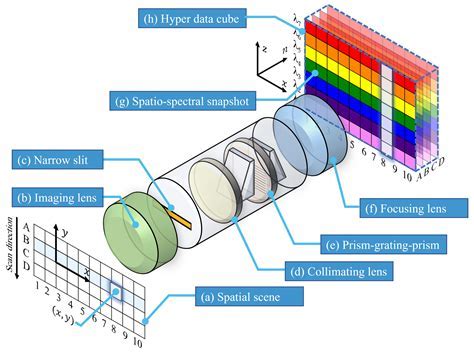
The Global Hawk’s adaptability is further demonstrated by its compatibility with various sensor payloads. Through a Universal Payload Adapter (UPA) introduced in 2015, it can carry:
- U-2 Optical Bar Camera (OBC)
- SYERS-2B/C electro-optical sensors
- MS-177 multispectral imaging systems
- AN/ALR-89 self-protection suite by Raytheon
This versatility ensures mission flexibility and extends the UAV’s relevance in an evolving battlefield.
Range Hawk and Hypersonic Test Missions
A notable recent innovation is the Range Hawk concept, managed by the Test Resource Management Center (TRMC). This initiative aims to use converted Block 20 and 30 aircraft for hypersonic missile tracking missions by 2024. In 2023, the Range Hawk program supported 10 hypersonic test flights, underlining its role in next-generation weapons development.
Global Users and Strategic Footprint
Beyond the U.S., the RQ-4 is operated by NATO, with five Block 40 aircraft based in Sigonella, Italy, since 2019. The South Korean Air Force also entered the fold with a $657 million procurement contract for four Block 30 aircraft, demonstrating the Global Hawk’s growing footprint in East Asia.
Despite global interest, the platform’s export is tightly regulated due to MTCR Category I status, and approval is limited to close allies.
Incidents and Controversies
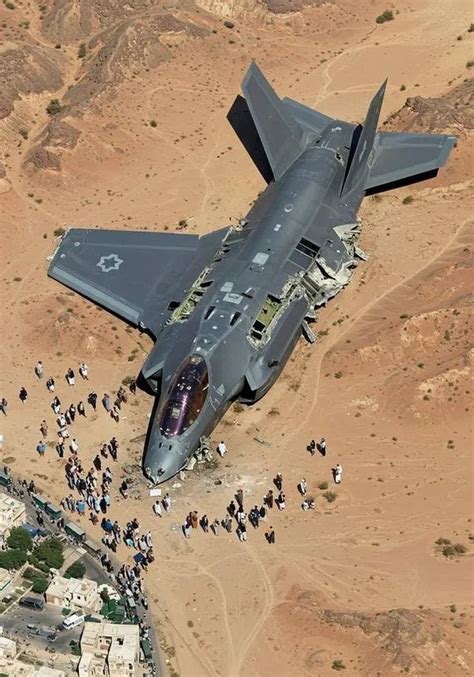
The most high-profile incident occurred on 19 June 2019, when an RQ-4A BAMS-D variant was shot down by Iran near the Strait of Hormuz. Iran claimed the UAV violated its airspace, a claim denied by the U.S., which asserted the drone was flying 18 nautical miles from Iranian territory. This incident highlighted the geopolitical risks associated with high-stakes ISR missions.
Conclusion: Legacy and Future Trajectory
The RQ-4 Global Hawk represents a monumental leap in unmanned ISR operations. Its long-range capabilities, modular sensor suite, and autonomous mission execution have solidified its place in modern military doctrine. As we edge closer to a future dominated by autonomous systems and AI-enhanced ISR, the RQ-4 remains a foundational model for what unmanned airpower can achieve.
While questions about cost, survivability in contested airspace, and retirement loom large, its legacy as the pinnacle of strategic UAV reconnaissance is already cemented. The RQ-4 has not just watched history—it has helped shape it, one high-altitude orbit at a time.