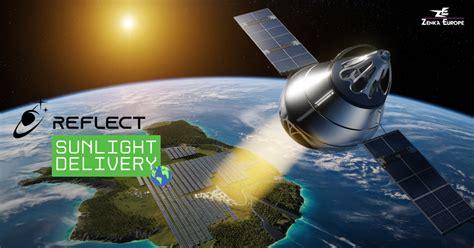
Reflect Orbital has reached a major milestone in its ambitious plan to redirect sunlight from space after receiving approval to launch its first experimental mirrored satellite, Earendil-1. The startup’s concept involves deploying orbital mirrors capable of reflecting sunlight toward specific areas on Earth after sunset, creating artificial illumination for industries that traditionally depend on daylight conditions.
The approval represents an important step for space-based sunlight redirection technology, a field that has attracted both excitement and concern. While Reflect Orbital believes its satellites could improve productivity in construction, agriculture, energy generation, and emergency response, critics warn that large-scale deployment could create unexpected effects for astronomy, wildlife, and the nighttime environment.
How Reflect Orbital’s Sunlight Reflection Satellite Will Work
The core idea behind Reflect Orbital’s technology is relatively simple: use large reflective surfaces in orbit to capture sunlight and redirect it toward selected locations on Earth. Unlike traditional lighting systems that generate artificial light from electricity, the company’s satellites would use the Sun’s existing energy and deliver it to areas that need additional illumination.
Reflect Orbital says its satellites will provide a controllable beam of reflected sunlight that can be adjusted in brightness and direction. The company claims the illumination can range from the intensity of a bright full moon to levels approaching direct midday sunlight. The reflected light would also be concentrated within a defined service area, potentially covering locations as small as approximately 5 kilometers (3.1 miles).
The startup envisions several commercial applications. Construction companies could use additional nighttime illumination to extend working hours, while farmers could potentially use reflected sunlight to lengthen growing periods in certain regions. Solar energy operators may also benefit if the technology can provide extra sunlight exposure to photovoltaic facilities during early morning or evening periods.
Search and rescue organizations represent another possible application. Reflect Orbital suggests that emergency teams could use targeted illumination to support operations during nighttime conditions, helping improve visibility in remote areas.
Reflect Orbital’s Ambitious Satellite Expansion Plans
The company’s long-term vision extends far beyond a single spacecraft. Reflect Orbital plans to launch two satellites by the end of 2026 and eventually expand its network to more than 1,000 satellites by 2028. Over the following decade, the startup has outlined an even more ambitious goal of operating a constellation exceeding 50,000 satellites.
Such a large-scale network would represent one of the biggest satellite deployments ever proposed. For comparison, Earth’s orbital environment already contains thousands of active satellites from companies including commercial communications providers and scientific organizations. Adding tens of thousands of reflective spacecraft would dramatically change the appearance and activity level of low Earth orbit.
Reflect Orbital argues that its technology could create a new category of orbital infrastructure, allowing sunlight to become a service delivered from space. However, the proposed scale has also intensified concerns about orbital congestion, space sustainability, and the long-term management of artificial objects around Earth.
Astronomers Raise Concerns Over Reflected Sunlight Risks
Before the Federal Communications Commission approval, the American Astronomical Society (AAS) expressed concerns about the possible effects of reflective satellites on scientific observations. Astronomers warned that bright reflected sunlight could interfere with telescope operations and potentially damage sensitive observations.
One major concern is accidental exposure. If a telescope operator or researcher points equipment toward an active reflective satellite at the wrong moment, concentrated sunlight could create dangerous brightness levels. The AAS also argued that additional artificial light sources in orbit could reduce the scientific value of astronomical research conducted from Earth-based observatories.
The organization highlighted that federally funded astronomy facilities could experience reduced effectiveness if satellite reflections become increasingly common. With more commercial companies seeking to expand satellite networks, researchers worry that the night sky may become increasingly difficult to study.
However, Reflect Orbital has responded by pointing to the FCC’s assessment that the probability of serious harm to telescope users is extremely low. The regulator concluded that allowing companies to test innovative space technologies provided benefits that outweighed the limited risks associated with the current single-satellite approval.
Regulatory Challenges Surrounding Space-Based Sunlight Reflection
The approval of Earendil-1 has also exposed broader questions about how emerging space technologies should be regulated. The FCC’s authority primarily covers radiofrequency spectrum and communication systems, meaning it does not directly oversee the environmental impact of a solar reflector operating in orbit.
This regulatory gap has attracted criticism from organizations focused on protecting the night sky. DarkSky International acknowledged that the current approval applies only to one satellite, but argued that future large-scale deployments require clearer oversight frameworks.
The debate highlights a growing challenge in the space industry: innovation is moving faster than existing regulations. As companies develop new orbital technologies, governments must balance commercial progress with scientific, environmental, and safety considerations.

Reflect Orbital’s Plans to Reduce Environmental and Safety Concerns
Reflect Orbital has outlined several measures designed to reduce possible disruptions caused by its mirrored satellites. The company says it will seek approval from local authorities before directing sunlight toward specific areas and will avoid sensitive locations such as astronomical observatories and protected wildlife habitats.
The startup also plans to publish operational information in advance, allowing researchers and observers to predict satellite activity. This approach could help astronomers avoid accidental telescope exposure and prepare for possible observations disruptions.
Despite these efforts, critics remain concerned about the consequences of deploying thousands of reflective satellites. The environmental impact of creating artificial nighttime illumination, the effects on wildlife behavior, and the long-term sustainability of orbital operations remain important questions.
The Future of Orbital Light Technology
Reflect Orbital’s mirrored satellite project represents a bold experiment in transforming sunlight into an on-demand resource. If successful, the technology could introduce new possibilities for industries that rely on extended daylight conditions and demonstrate another way humans can use space-based infrastructure.
At the same time, the project reflects a larger conversation about the future of Earth’s orbital environment. As companies pursue increasingly ambitious satellite networks, balancing technological advancement with responsible space management will become essential.
The launch of Earendil-1 will serve as an early test of whether reflected sunlight from orbit can become a practical tool or whether the challenges surrounding astronomy, regulation, and environmental protection will limit widespread adoption.