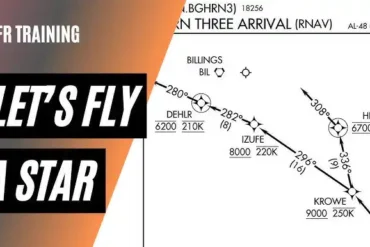
Standard Instrument Departure Routes (SIDs) and Standard Arrival Routes (STARs) are essential components of air traffic management. A SID is a designated route that guides aircraft from take-off to their en-route phase. Conversely, a STAR directs planes from the en-route phase to an initial approach fix during landing. These routes help manage air traffic efficiently, ensuring safety for aircraft taking off and landing at the same or nearby airports. SIDs and STARs reduce the risk of conflicting traffic through specific routings, altitude levels, speed limits, and checkpoints.
Pilots must follow the published speed restrictions associated with SIDs and STARs, unless a controller explicitly cancels or modifies them. Some restrictions are crucial for maintaining adherence to RNAV procedures, such as maximum speeds tied to a constant radius arc. Each runway typically has multiple SIDs and STARs to minimize delays and maintain a direct flight path.
Effective communication between air traffic control (ATC) and pilots is vital, which is where SID/STAR phraseology comes into play. This standardized language simplifies the transmission of clearance information, making it easier for both parties to understand complex instructions. However, inconsistencies in practice have emerged over time, leading to potential misunderstandings. This discrepancy poses a safety risk that needs addressing.
In June 2016, the International Civil Aviation Organization (ICAO) introduced Amendment 7-A to PANS-ATM, which took effect on November 10, 2016. This amendment provided harmonized phraseologies for standard clearances for both arriving and departing aircraft, including those on SIDs and STARs. Pilots and controllers can refer to this updated phraseology to enhance safety and clarity in communications.