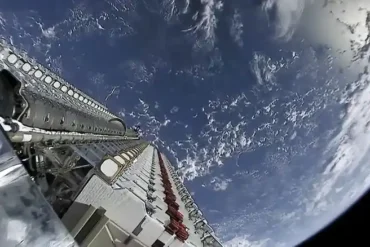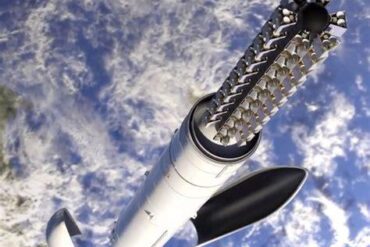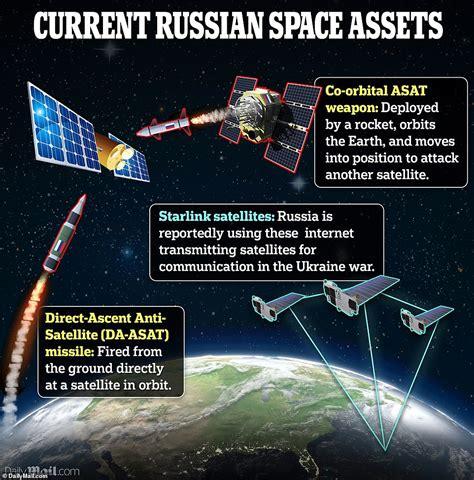
Space has long been regarded as humanity’s final frontier—an untouchable expanse that fosters innovation, discovery, and now, global connectivity. But a looming threat may soon transform Earth’s orbit into a dangerous warzone. At the heart of this growing tension is Elon Musk’s Starlink satellite constellation, a project that has rapidly expanded to over 8,000 satellites, providing essential internet services to countries like Ukraine and Lebanon. Now, that vital infrastructure could be at risk.
Russia’s Alleged Countermeasure: A Cloud of Destruction
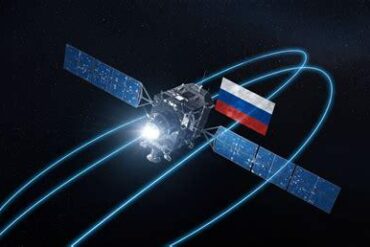
Reports from the Associated Press suggest that Russia is allegedly developing a new anti-satellite system—one that doesn’t rely on precision strikes or lasers, but instead, unleashes a cloud of metallic pellets into Earth’s low orbit. These pellets, if deployed, would collide with satellites indiscriminately, turning orbit into a chaotic debris field. While Starlink may be the intended target due to its support for Ukrainian communication infrastructure, such a strategy holds no allegiance and offers no guarantees. The space debris would threaten every satellite in its path, including Russian ones.

This strategy draws parallels to the feared Kessler Syndrome, a theoretical cascade of collisions where one satellite’s destruction leads to another and another—multiplying debris exponentially. In this scenario, Starlink’s low-Earth orbit infrastructure becomes particularly vulnerable, given its density and volume.
Collateral Damage Beyond Starlink
The repercussions of a pellet-cloud weapon would be devastating on a global scale. Starlink is not a geopolitical pawn used solely for Ukraine’s benefit. It is an integral part of emergency communications, rural connectivity, and disaster recovery in multiple countries. From small island nations to remote mountainous regions, Starlink provides what terrestrial infrastructure cannot. Disabling or damaging the constellation could strip entire populations of digital access, worsening inequality and cutting off critical aid in times of crisis.

Ironically, Russia itself would suffer from such a plan. The pellet cloud would not discriminate, affecting all satellites within its orbit range—whether for navigation, military intelligence, or civilian communication. It would place Russia’s own orbital assets in jeopardy, rendering the tactic a self-inflicted wound cloaked as strategic maneuvering.
The Escalating Problem of Orbital Debris
Even without hostile intent, orbital congestion is already a critical challenge. Thousands of inoperative satellites remain adrift, and new ones are launched almost daily. These dead satellites eventually enter deorbit phases, plummeting back toward Earth, often burning up in the atmosphere, but occasionally surviving reentry. The addition of metallic debris launched intentionally would drastically increase collision probabilities, accelerating the onset of orbital zones becoming completely unusable for decades.
Scientific and Diplomatic Alarm Bells
The international community has long warned against weaponizing space. The 1967 Outer Space Treaty prohibits placing weapons of mass destruction in orbit, but leaves gray areas exploited by modern technologies. If Russia proceeds with this alleged plan, it may trigger international condemnation, and could set off a wave of militarization and preemptive space defense developments by other nations. More debris means more danger to astronauts aboard the ISS, satellites offering GPS and weather monitoring, and scientific missions that rely on uninterrupted orbital pathways.

While the reports are yet to be verified, the possibility alone is enough to unsettle the global scientific and tech communities. Humanity’s growing dependence on space infrastructure means that any disruption—intentional or accidental—carries extraordinary consequences. If action is not taken to prevent this course, the fallout could alter the future of space exploration, communication, and defense permanently.