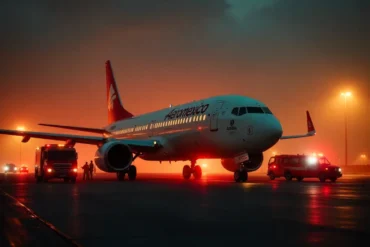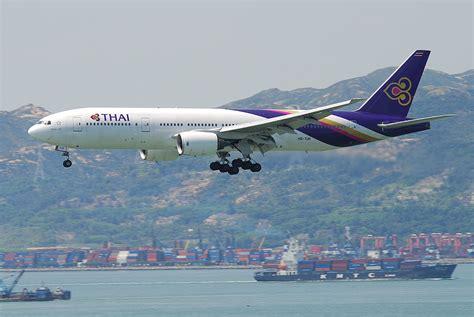
A Thai Airways International flight en route to Frankfurt, Germany was forced to make an emergency landing at Suvarnabhumi Airport in Samut Prakan, Thailand, after experiencing a technical issue shortly after takeoff. The incident, which involved the mid-air dumping of aviation fuel, drew widespread attention both on the ground and online, as concerned residents in nearby provinces captured dramatic visuals of the aircraft circling overhead.
Initial Departure and Flight Details
Flight TG 922, operated by a Boeing 777-300ER, departed Bangkok’s Suvarnabhumi Airport at 12:25 PM local time on Sunday, bound for Frankfurt. The scheduled arrival in Germany was set for 9:00 PM local time, marking what should have been a routine intercontinental journey.
However, mere moments into its ascent, the aircraft began to exhibit abnormal behavior, prompting flight crew to initiate standard safety protocols. Eyewitnesses from Samut Sakhon, a province located west of Bangkok, reported seeing the plane circling at low altitude while releasing long white trails of aviation fuel—a rare but necessary maneuver in preparation for an emergency landing.
The Cause: Landing Gear Malfunction
According to internal sources close to the airline, the emergency was triggered when the main landing gear cover failed to fully retract. This mechanical failure may seem minor on the surface but has serious implications for aerodynamic efficiency and overall flight safety.
The main gear fairings, often referred to as gear doors, are crucial for reducing drag during flight. When these fail to close, the aircraft’s fuel consumption increases significantly, and aerodynamic instability becomes a growing concern, especially during long-haul operations.
Rather than proceed with the transcontinental flight under compromised conditions, the flight crew made the prudent decision to return to Suvarnabhumi for maintenance. The decision was guided by both safety regulations and operational best practices.
Fuel Dumping: A Necessary Safety Procedure
While visually alarming to the public, the act of fuel dumping is a routine procedure in aviation under certain emergency scenarios. Aircraft like the Boeing 777-300ER, which are designed for long-haul flights, take off with fuel loads near their Maximum Takeoff Weight (MTOW). However, the Maximum Landing Weight (MLW) is often significantly lower.
To safely land without risking structural damage, the flight must lighten its load. In this case, the crew chose to circle for approximately 1 hour and 47 minutes, discharging fuel before landing at 2:12 PM. Observers noted the aircraft circled between three and six times, a process that was well documented by locals using mobile phones.
Landing and Immediate Aftermath
The aircraft landed without further incident and was taxied to Bay 120 at Suvarnabhumi Airport, where a full technical inspection was conducted. Thai Airways’ maintenance team acted swiftly to resolve the gear cover issue, ensuring the aircraft met all safety standards before being cleared for flight.
After thorough checks and confirmation of airworthiness, TG 922 departed once again at 3:20 PM, arriving in Frankfurt at 9:56 PM local time, slightly later than originally planned but safely and without further complications.
Was It Truly an Emergency? A Look into Aviation Terminology
A lively debate emerged online regarding the classification of the incident. Aviation professionals and enthusiasts weighed in across forums and social media platforms, with many arguing that while the event was serious, it may not meet the strictest definition of an “emergency landing.”
In aviation terminology, an emergency landing typically involves a declared mayday, coordination with air traffic control, and the presence of emergency response units like fire trucks and ambulances on standby. However, the International Civil Aviation Organization (ICAO) allows for a broader interpretation, which includes precautionary returns due to potential mechanical issues.
Thus, even without visible flames, smoke, or loss of control, the incident qualified under the umbrella of an emergency landing, particularly given the need for a fuel dump and mechanical inspection.
Pilot Response and Crew Performance
What stood out during this incident was the calm and professional conduct of the Thai Airways flight crew. Aviation is a discipline where training, preparation, and presence of mind determine outcomes, and the TG 922 team adhered strictly to standard procedures.
Their actions included:
- Immediate recognition of the gear door anomaly
- Communication with ground control
- Proper fuel dumping procedures over a safe area
- A controlled and smooth return to Suvarnabhumi
Their performance underscores the rigorous training undertaken by Thai Airways pilots and reinforces the airline’s commitment to safety above all else.
Public Reaction and Social Media Buzz
As with many modern incidents, much of the world learned about TG 922’s troubles through social media platforms and forums like Reddit. Multiple threads discussed the technical implications, with aviation enthusiasts dissecting each available detail—from fuel load logistics to gear door mechanics.
The comments ranged from commendations of the flight crew to technical breakdowns of the 777-300ER’s specifications. Some users also highlighted similar cases from global aviation, making comparisons to incidents involving Jeju Air and theorizing about systemic issues with aircraft maintenance, particularly among Boeing models.
Maintenance Protocol and Fleet Implications
Post-landing, the Boeing 777-300ER underwent an expedited yet thorough examination by Thai Airways’ engineering division. While the exact cause of the gear cover malfunction has not been made public, it is expected that a detailed maintenance report will be submitted to both Thailand’s Civil Aviation Authority (CAAT) and Boeing.
It remains unclear if similar aircraft in the fleet will undergo targeted inspections, though such incidents often lead to fleet-wide advisories and preemptive maintenance actions to ensure no other units present the same vulnerability.
Historical Context: Not the First Incident of Its Kind
Emergency landings due to gear issues are not unheard of. In 2005, a JetBlue Airbus A320 made headlines when its nose gear twisted sideways mid-flight. The crew, like that of TG 922, executed a successful landing without injuries. More recently, gear-related issues have troubled regional carriers and prompted further investigation into component durability and inspection protocols.
The 777 series, while generally regarded as one of the most reliable long-haul aircraft, is not exempt from mechanical anomalies. However, its robust systems, combined with experienced crew response, often turn potentially dangerous situations into well-managed aviation events.
The Bigger Picture: Safety and Trust in Aviation
Events like the TG 922 emergency landing serve as case studies in modern aviation safety. They reinforce the industry’s philosophy: better to land early than push on under risk. In an era where public trust in aviation is shaped not just by performance but also by perception, every successful resolution of a mechanical issue is a quiet victory for global air travel.
Passengers aboard TG 922 were understandably delayed, but they were informed, protected, and ultimately delivered safely. For the airline, the incident may carry short-term scrutiny, but the long-term takeaway is a positive affirmation of proactive safety culture.
Conclusion: A Model Response to an Unexpected Challenge
The incident involving Thai Airways Flight TG 922 highlights the critical importance of vigilance, training, and decision-making in aviation. What could have escalated into a severe crisis was effectively neutralized through adherence to protocol, underscoring why Thai Airways continues to be regarded as one of the region’s most dependable carriers.
As aviation grows more complex and traffic volumes increase, incidents like this reaffirm that while mechanical issues are inevitable, the right response makes all the difference.