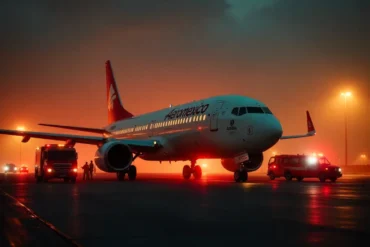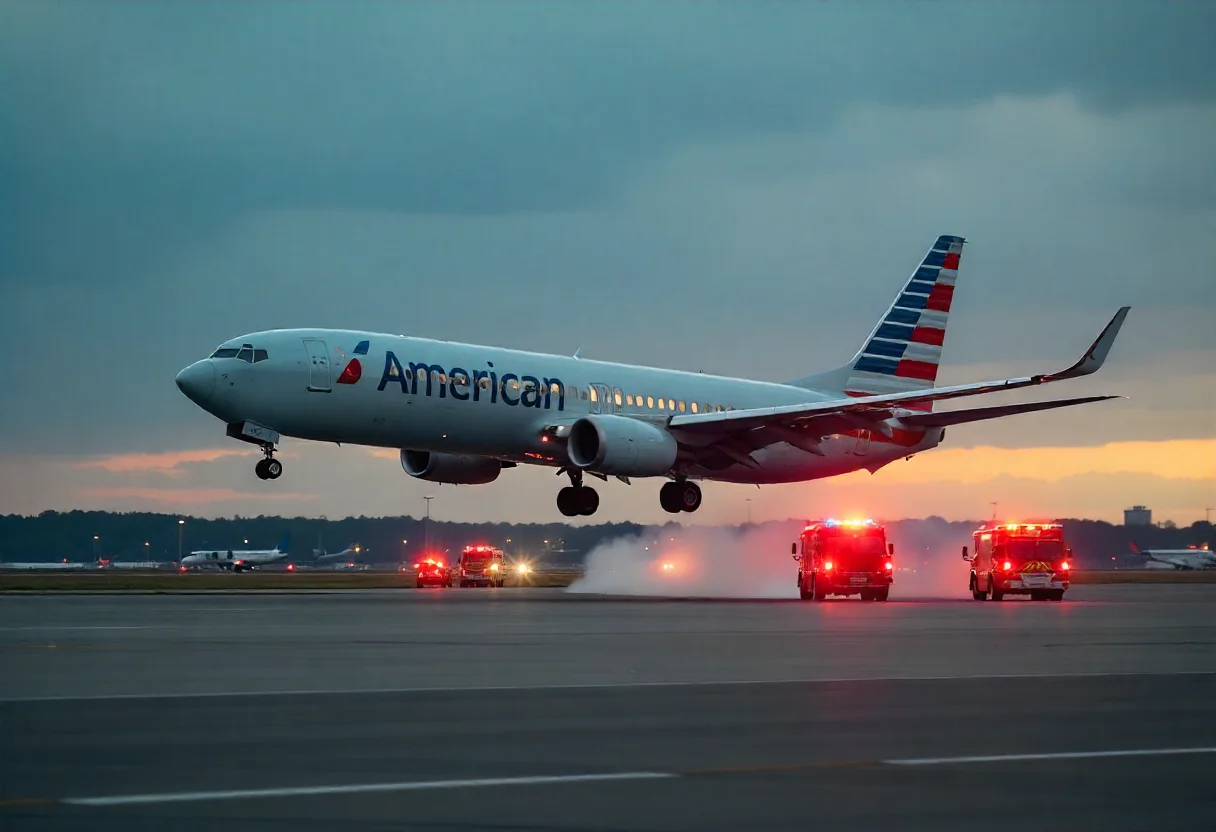
Passengers aboard American Airlines Flight AA311 faced a harrowing evening on July 25, 2025, as their seemingly routine journey from Chicago O’Hare International Airport (ORD) to Washington Reagan National Airport (DCA) spiraled into a complex emergency involving two mid-flight diversions. What began as a standard commercial flight aboard a Boeing 737-800 turned into a high-alert scenario that culminated in an emergency landing at Washington Dulles International Airport (IAD), showcasing the critical importance of aviation safety systems and real-time decision-making.
Severe Weather Forces Initial Reroute to Charlotte
Flight AA311, operating under tail number N815NN, departed Chicago at 19:22 UTC with 154 passengers and crew on board. The aircraft was expected to land at Washington Reagan, but as it traversed the mid-Atlantic corridor, it encountered severe convective weather, a common summer risk heightened by increasingly erratic climate patterns.
Unable to continue safely toward its destination, the flight crew coordinated with air traffic control and diverted to Charlotte Douglas International Airport (CLT). While weather-related diversions are standard procedures, particularly in storm-prone zones during late summer, this early deviation signaled the beginning of a challenging night for both crew and passengers.
Upon landing in Charlotte, the aircraft was refueled, re-checked, and cleared for takeoff once conditions along the Washington corridor improved. The Boeing 737-800 took off again at 23:15 UTC, aiming for a delayed arrival at Reagan National. Passengers, though delayed, remained calm, unaware that the more serious challenge was yet to come.
Hydraulic Failure Sparks Emergency Diversion to Dulles
As AA311 neared Washington Reagan, the cockpit received a critical system alert indicating a malfunction. Initially flagged as a generic fault, further investigation by the flight crew confirmed a hydraulic system failure—a high-priority issue affecting core flight control functions including brake systems, landing gear operation, and flap deployment.
Faced with the dual pressure of limited fuel—1 hour and 34 minutes remaining—and a mechanical failure, the pilots made the calculated decision to declare an emergency and divert once more, this time to Washington Dulles International Airport (IAD). Dulles was selected over Reagan due to its longer runways, better instrument landing capabilities, and enhanced emergency response infrastructure.
Air Traffic Controllers Coordinate Precision Response
ATC teams immediately provided priority routing, and emergency crews on the ground at Dulles were placed on high alert. The crew of AA311 requested Runway 19L and a long final approach, granting them time to troubleshoot and configure the aircraft manually. With redundant safety checklists underway, they prepared for a landing that could have been compromised by failed hydraulic assistance.
The Instrument Landing System (ILS) approach, favored under low-control scenarios, was utilized. Despite the elevated risk, the aircraft touched down without incident, thanks to rigorous crew training and the Boeing 737’s robust design protocols. However, due to the hydraulic issue, manual intervention was required post-landing, including the installation of gear pins by maintenance crews to secure the landing gear.
The aircraft remained parked on the runway for 24 minutes, during which time all standard procedures were followed to ensure the safety of those onboard. After ground clearance was obtained, passengers were allowed to disembark safely with no injuries reported.
Flight Safety Protocols in Focus Amid Industry Pressure
This incident exemplified airline emergency protocol functioning as designed, yet it also highlighted the growing strain on aviation operations in 2025. With U.S. domestic travel approaching pre-pandemic levels, airlines like American are operating at near-capacity, often with limited room for mechanical or weather-related errors.
The Boeing 737-800, one of the most widely used aircraft types in the world and a staple of American Airlines’ fleet, has a strong reliability record. However, with many of these jets entering mid-to-late service life, systems such as hydraulics, avionics, and electrical control units require more frequent scrutiny. As aircraft age, the balance between maintenance cost, fleet renewal, and operational efficiency becomes harder to maintain.
FAA investigators are closely monitoring the details of the AA311 incident, particularly because it occurred on the densely trafficked ORD–DCA corridor. Any anomaly involving critical systems such as hydraulics prompts mandatory reporting, potential fleet-wide checks, and procedural reviews.
Weather and Operational Complexity Increase Risk Factors
In 2025, the frequency of mid-flight diversions has risen. A combination of climate-induced weather volatility, airspace congestion, and tight turnaround schedules has made routine commercial flights more vulnerable. While not every disruption is life-threatening, incidents like that of AA311 reveal how multiple small stressors—weather, aged systems, capacity demands—can converge to create a high-risk situation.
Experts warn that as climate change accelerates the development of supercell storms and unpredictable turbulence patterns, flights in regions like the Northeast and mid-Atlantic could see more delays and emergency landings. Airlines are being advised to increase weather pattern modeling, invest in real-time analytics, and recalibrate buffer times between flights to preserve operational resilience.
Passenger Reactions and Brand Trust at Stake
While American Airlines has confirmed the safety of all onboard, the broader implications extend into customer experience and brand reputation. Passengers took to social media to express a range of emotions—from praise for the professionalism of the flight crew to frustration over the cascading delays and lack of real-time updates.
One traveler tweeted, “We diverted twice. First weather, then something with the plane. The crew was solid, but I wish we had more info.” Such commentary reflects the critical need for transparent, prompt communication during irregular operations. Airlines today face heightened scrutiny not only on technical execution, but also on how they communicate during crises.
As AA311 becomes a case study, airline executives will likely face internal reviews to evaluate the efficiency of response teams, the functionality of aircraft systems, and the timeliness of customer communications. In an age where even minor delays can go viral, the ability to control the narrative becomes as important as managing the technical emergency.
FAA Oversight and Ongoing Investigation
The Federal Aviation Administration (FAA) has already initiated a post-incident inspection of aircraft N815NN and is collaborating with American’s maintenance teams to analyze the cause of the hydraulic failure. While no preliminary conclusions have been released, the agency emphasized that no system fault leading to loss of control occurred, and emergency redundancies functioned correctly.
This detailed examination is standard in events involving system alerts that require unscheduled diversions, especially when they affect critical components. FAA sources suggest the agency may also request fleet-wide checks if a root mechanical cause is identified. This kind of oversight ensures both regulatory transparency and operational learning, essential for preventing future incidents.
Industry Implications and Lessons Learned
The July 25 AA311 episode stands as a sobering reminder of the challenges that accompany high-density air traffic, aging fleets, and volatile weather. While the zero-injury outcome reaffirms the robustness of modern aviation safety protocols, it also spotlights where systemic improvements are necessary.
The lessons are clear:
- Invest in fleet modernization to phase out aging aircraft with higher risk profiles.
- Enhance crew training for dual-failure scenarios.
- Improve real-time passenger communication, especially during multi-stage disruptions.
- Adapt scheduling and maintenance strategies to align with climate-induced variability.
With travel demand showing no signs of slowing, airlines, regulators, and manufacturers must work in lockstep to ensure safety remains non-negotiable—even when operations are stretched to the limit.

In the end, the successful emergency landing of Flight AA311 was a testament to aviation professionalism, but also a wake-up call. As skies grow more crowded and conditions more unpredictable, maintaining that safety record will require continuous adaptation, vigilant oversight, and a commitment to putting passengers first—even when the unexpected takes control.