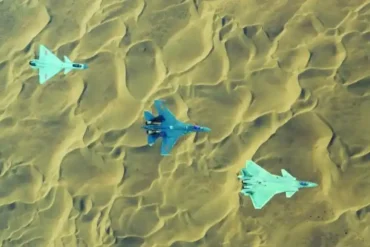
Forty years ago, while the world fixated on stealth aircraft slipping invisibly through hostile skies, a far stranger experiment was unfolding quietly at sea. Hidden inside a massive barge in San Francisco Bay, engineers were constructing a warship that looked less like a destroyer and more like a grounded fighter jet. This vessel, later known as the IX-529 Sea Shadow, was never meant to patrol oceans or fire missiles in anger. It existed to answer a single, radical question: could the principles of airborne stealth work on water.
The fascination with stealth during the late Cold War was not cosmetic. Radar detection had become the defining factor in modern warfare, and the United States was investing enormous resources into shaping vehicles that could confuse, deflect, or absorb enemy signals. Aircraft like the F-117 Nighthawk proved that faceted surfaces and precise angles could dramatically reduce radar signatures. What remained untested was whether saltwater, waves, and constant exposure to the elements would render those same ideas useless at sea.
That uncertainty is what makes the Sea Shadow so compelling today. Even by modern standards, its angular silhouette feels futuristic, almost unreal, as if it belongs to a speculative novel rather than naval history. Yet every sharp edge and sloped panel had a measurable purpose, calculated to scatter radar energy away from Soviet X-band satellites that once swept the oceans from orbit.
A Warship Born From Skunk Works Thinking
The intellectual spark behind the Sea Shadow came from Lockheed’s Skunk Works, the legendary division responsible for America’s most secretive aircraft. Ben Rich, one of its most influential engineers, initially explored whether stealth shaping could help submarines evade sonar. That idea evolved quickly. A surface vessel, constantly exposed and easier to observe, would provide a far more demanding test environment for radar-absorbing materials.
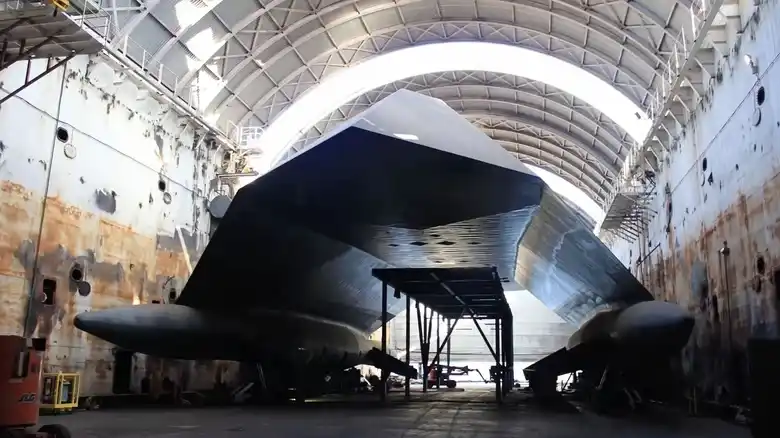
DARPA embraced the challenge and authorized construction of an experimental ship unlike anything afloat. Built under extreme secrecy during the early 1980s, the Sea Shadow was assembled inside a floating barge so its outline would never be seen from shore. Even workers involved in the project had limited knowledge of the vessel’s true purpose, underscoring how seriously the Navy guarded the experiment.
Engineering a Floating Stealth Platform
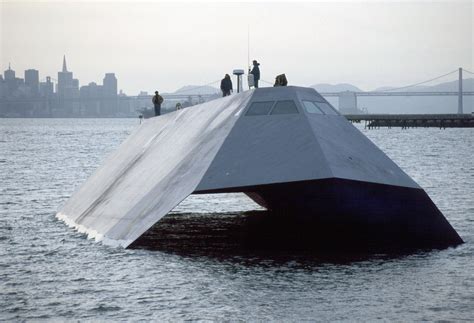
From a technical perspective, the Sea Shadow was as unconventional as its appearance suggested. It used a Small Waterplane Area Twin Hull design, lifting most of its mass above the waves on two submerged pontoons. This reduced wake, improved stability, and limited the radar reflections normally caused by a ship’s interaction with the sea surface. Above the waterline, flat panels replaced curves, echoing the faceted geometry of stealth aircraft.
Early sea trials in 1981 nearly derailed the program. Observers noted a conspicuously large wake trailing the ship, a visibility flaw that contradicted its mission. The cause turned out to be embarrassingly simple: the propellers had been installed backwards. Once corrected, the Sea Shadow demonstrated remarkably smooth and quiet operation, validating many of the theoretical assumptions behind its design.
Radar, Reflection, and Cold War Urgency
The Cold War context cannot be overstated. Soviet reconnaissance satellites relied heavily on predictable radar returns to track Western naval movements. By minimizing those returns, the Sea Shadow explored how future fleets might operate with reduced electronic footprints. Its sharply angled surfaces redirected radar energy away from the source, while experimental coatings tested how materials degraded under constant exposure to salt spray and sunlight.
When the Sea Shadow was finally revealed to the public in 1993, the geopolitical landscape had already shifted. The Soviet Union was gone, and the once-urgent secrecy surrounding the vessel gave way to curiosity and admiration. Visitors were struck by how closely the ship resembled a stealth aircraft resting on water, a visual reminder of how deeply aviation concepts had influenced its creation.
From Classified Testbed to Lasting Legacy
Despite its success as a research platform, the Sea Shadow was never intended for mass production. After completing its trials, it served briefly as a demonstration piece during Navy events, offering rare glimpses into a project once hidden entirely from view. The ship was ultimately scrapped in 2006, a quiet end for such a visually striking machine.
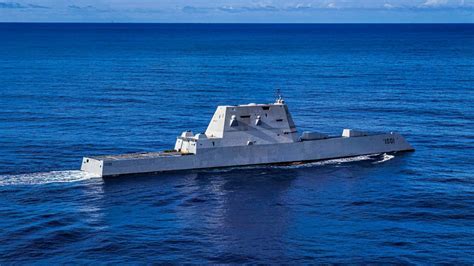
Its influence, however, did not disappear. Data gathered from the Sea Shadow informed the design of modern submarine periscopes and directly shaped the radical lines of the Zumwalt-class guided missile destroyers. Those massive ships, with their inward-sloping hulls and reduced radar signatures, carry the Sea Shadow’s DNA into the twenty-first century.
The Sea Shadow remains a powerful reminder that some of the most transformative military innovations never see combat. Built in silence, tested in secrecy, and dismantled without ceremony, it nonetheless proved that stealth was not confined to the skies. Its ghost still sails in the sharp edges of modern warships, a testament to an era when engineers dared to make the ocean itself a little harder to see.