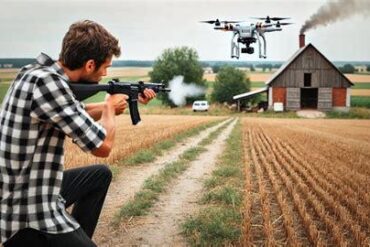
Modern warfare is increasingly shaped by unmanned aerial vehicles (UAVs), commonly known as drones. These machines, cheap and deadly, are transforming battlefields around the globe—from the war zones of Ukraine to the gang-ridden streets of Port-au-Prince, and the contested airspace between India and Pakistan. As drones evolve in both number and sophistication, so too do the methods to take them down. While most counter-drone technologies rely on signal jamming, microwave weapons, or laser systems, one ambitious startup is going back to basics—bullets.
Allen Control Systems and the Birth of Bullfrog
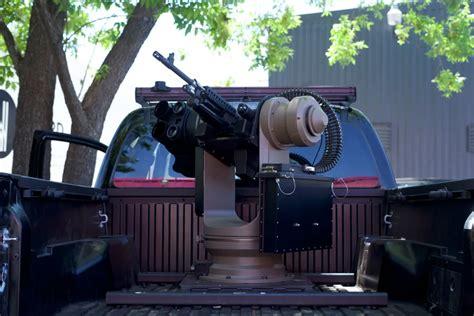
Enter Allen Control Systems (ACS), an Austin-based defense startup that is shaking up the counter-drone arms race. Their answer to increasingly resilient drones isn’t to outsmart them with radio frequency hacks or burn them with lasers. Instead, they’re aiming to literally shoot them out of the sky using an AI-powered robotic gun system called the Bullfrog.
ACS co-founder and president Steve Simoni, a former U.S. naval officer and tech entrepreneur, believes current counter-drone systems are ultimately too brittle. “We had the idea that we would use a cheap bullet to basically shoot these drones out of the sky,” says Simoni. “The drones of the future would be impervious to these other attacks.”
Simoni’s assertion rests on a grim battlefield reality: drones are evolving too quickly. Already, Ukrainian and Russian forces are using drones strung with fiber optic cables to avoid radio jamming. Add conductive shielding, and microwave weapons can be rendered moot. But no amount of ingenuity, Simoni argues, can make drones bulletproof without grounding them entirely.
Inside the Bullfrog: Old-School Firepower Meets Cutting-Edge AI
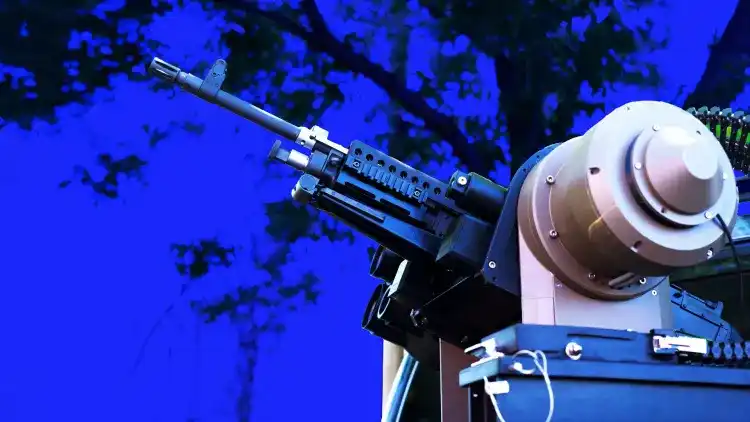
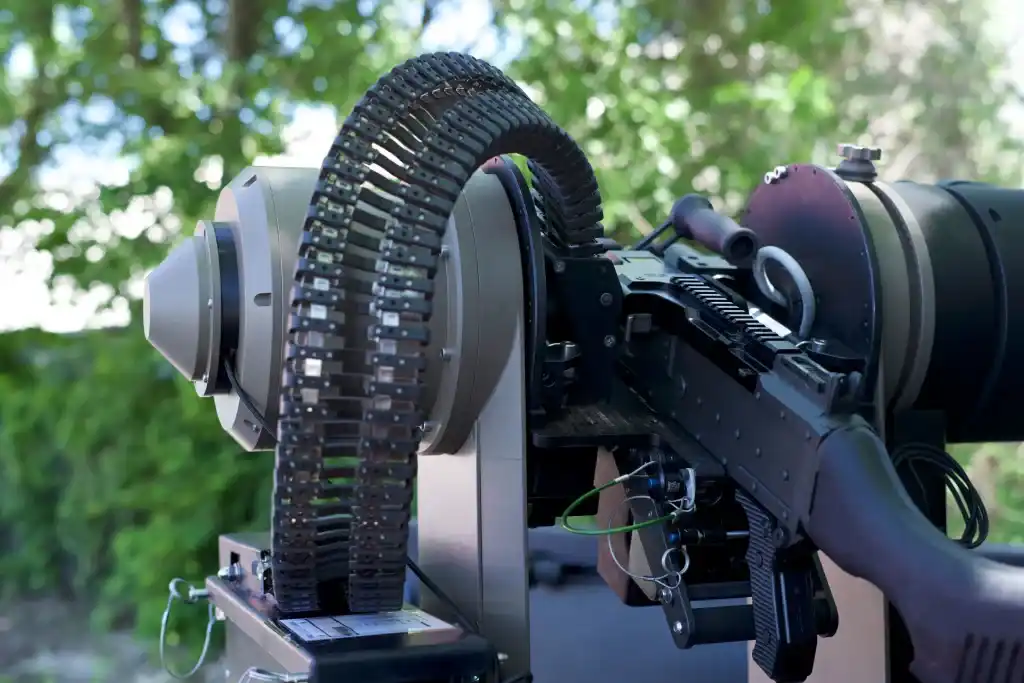
The Bullfrog system is based on the U.S. military’s existing Common Remotely Operated Weapon Station (CROWS) architecture, which is typically operated by a human with a joystick. But humans simply aren’t fast enough when it comes to intercepting fast-moving or swarming drones. The Bullfrog removes this bottleneck by integrating AI computer vision systems, allowing the weapon to autonomously detect, lock onto, and fire at UAVs with sub-second precision.
Using standard NATO 7.62x51mm rounds, Bullfrog doesn’t require exotic munitions or complicated logistics. Its camera arrays and AI target recognition algorithms can identify a drone, calculate its trajectory, and fire what Simoni calls “a very precise sniper shot” in milliseconds. According to Simoni, “From the time we see it to the time we shoot, there’s not many places a drone can really move in that time period.”
This fast reaction time gives ACS a practical advantage in the field. Attack drones, whether off-the-shelf quadcopters or military-grade UAVs, are often designed for speed and predictability, which ironically makes them more vulnerable to well-timed ballistic countermeasures. Even if future drones try to fly erratically, AI-powered systems can update calculations faster than a human possibly could.
Field Tests and Human Oversight
The Bullfrog system recently underwent a successful U.S. Army test, in which it neutralized all seven incoming drones. Though the system incorporates autonomous detection and targeting, a human operator remains in the loop, setting the rules of engagement and authorizing fire. A live feed shows approaching UAVs, allowing human personnel to select targets within predefined safety zones.
Simoni explains that these rules can be finely tuned—users can restrict fire to specific zones or altitude ranges, protecting non-combat areas and minimizing collateral damage. In more chaotic swarm scenarios, variants of Bullfrog will increasingly rely on AI to prioritize and engage threats, but always within boundaries established by human decision-makers.
Training the AI with Unreal Realism
To ensure the AI’s reliability, ACS feeds it thousands of hours of simulated combat scenarios using Unreal Engine, the game development platform best known for powering blockbuster video games. By creating virtual 3D models of drones and embedding them into diverse environments and weather conditions, ACS can simulate countless engagement scenarios.
This approach allows the system to not only refine its aim but also learn to distinguish drones from birds, aircraft, or debris. In military bases where using unknown drones for testing is restricted, these digital simulations act as critical training grounds. It’s a scalable, non-destructive way to prepare the Bullfrog AI for the field without wasting bullets or expensive drones.
Why Bullets Beat Beams in Real-World Combat
While high-tech options like lasers and microwave weapons are exciting in theory, they falter under real-world constraints. Lasers require steady beams and precise tracking, which are hard to maintain during movement or in bad weather. Microwave attacks can be thwarted by metallic coatings or countermeasures. But bullets, traveling at thousands of feet per second, are ruthlessly consistent.
“There’s not enough armor you could put on a drone to stop a bullet like that,” says Simoni. A drone heavy enough to resist small-caliber bullets would be far too slow and clumsy to be militarily useful. It’s physics—no software patch or composite shell can overcome the raw force of kinetic energy delivered at the right time.
Deployment and Practical Use Cases
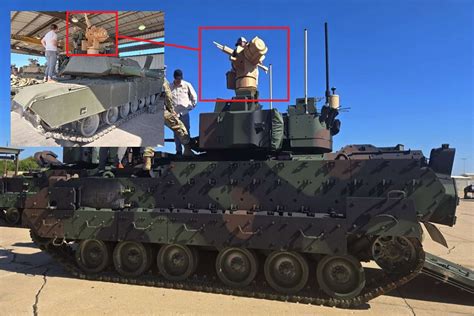
Weighing in at just 200 pounds, Bullfrog is designed to be modular and mountable on a wide range of platforms—from trucks and jeeps to naval vessels and stationary defense posts. It draws power from the host vehicle and requires no proprietary infrastructure.
At present, its effective range of about one kilometer makes it best suited for mobile units rather than stationary bases, which typically prefer longer engagement distances. However, in convoy protection or urban conflict environments, where drones often strike at close range, Bullfrog fills a critical gap.
Simoni admits the system isn’t ideal for civilian applications like stadium or airport protection, where stray bullets pose unacceptable risks. For those scenarios, net guns or radio-jamming devices might be better options. But for battle-tested military contexts, Bullfrog offers a rugged, economical solution with minimal training required.
Financial Firepower: Backing and Battlefield Goals
In March 2025, ACS announced a $30 million Series A funding round led by Craft Ventures, with participation from Inspired Capital and Rally Ventures. The capital infusion is aimed at expanding testing, integrating with various military platforms, and preparing for early 2026 battlefield deployment.
The goal? Make robot-on-robot warfare the norm. Simoni envisions a not-so-distant future where human soldiers take a back seat to autonomous systems. “The future of conventional warfare is mostly going to be robots shooting at other robots,” he says. “It is far too dangerous to be out there.”
By focusing on cost-per-kill efficiency, ACS aims to reduce the cost of drone neutralization to just a few dollars per target—a figure that dwarfs the astronomical costs of laser systems or high-frequency weapons. And with drones becoming cheaper and more ubiquitous, low-cost defense will be a strategic necessity.
The Old Way Might Just Be the Future
While the defense sector races to develop increasingly abstract, high-concept anti-drone weapons, ACS is taking a refreshingly pragmatic route. In a world of counter-electronics, advanced materials, and experimental directed-energy weapons, the sound of a bullet cracking the air might just remain the most reliable sound of defense.
Allen Control Systems is betting big that autonomous ballistics will be the ultimate answer to the drone swarm dilemma. It’s an idea rooted in simplicity—but made powerful through AI precision, real-time data, and good old-fashioned firepower.