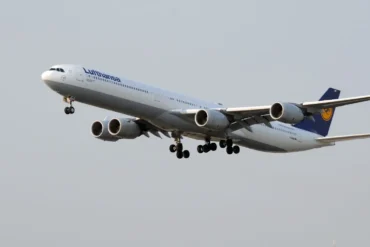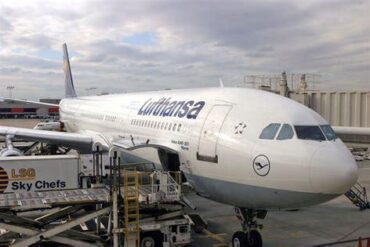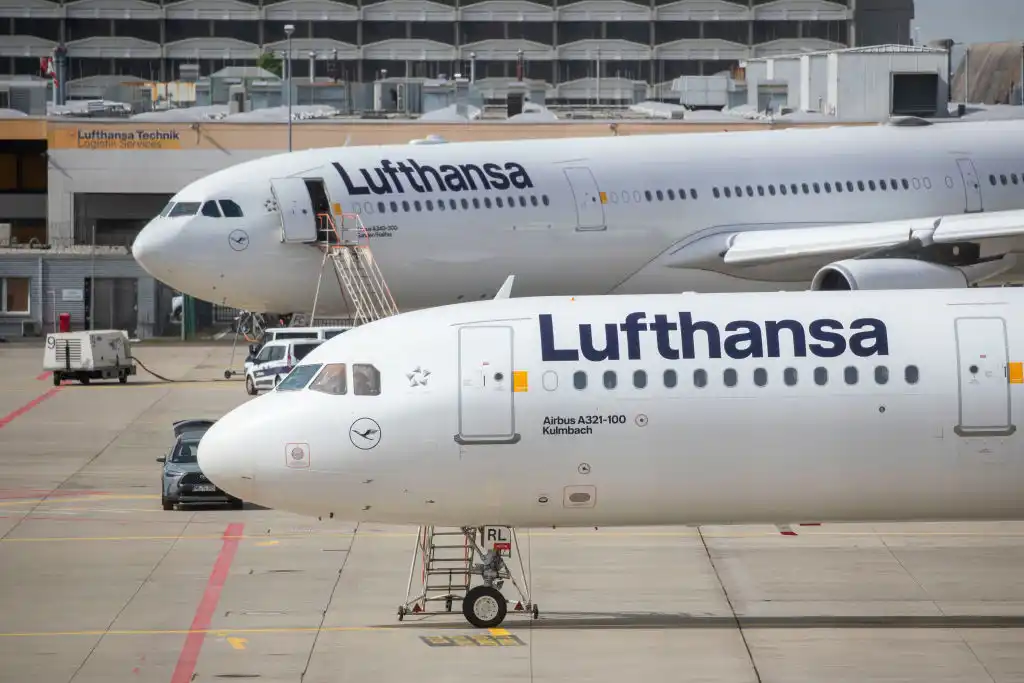
The unexpected grounding of Lufthansa flight LH560 on November 23 sent ripples far beyond Frankfurt Airport. What began as a routine long-haul service to Luanda abruptly shifted into an uncommon diplomatic hiccup when three European Prime Ministers — Finland’s Petteri Orpo, Denmark’s Mette Frederiksen, and Luxembourg’s Luc Frieden — found themselves involuntarily overnighting in Germany. Their trip to the EU–Africa Summit in Angola was halted not by geopolitics or weather, but by a faulty passenger announcement system aboard the aging Airbus A340-300.
The aircraft, already positioned on the runway, was forced to return to stand when the PA system malfunctioned. What should have been a straightforward technical reset stretched into an hours-long ordeal. Frankfurt’s strict night-flight curfew sealed the aircraft’s fate, barring any chance of a late departure or rapid aircraft swap. The delay ballooned past 13 hours, grounding not only hundreds of passengers but also a rare trio of national leaders traveling commercially.
Despite the inconvenience, only one head of government carried onward with the mission. Finland’s Petteri Orpo eventually boarded the rescheduled morning departure and reached Luanda in time to advocate for expanded Finnish digital investment in Africa. His counterparts, Frederiksen and Frieden, abandoned the journey entirely, remaining in Europe rather than endure the extended delay.
A Technical Breakdown With Diplomatic Consequences
The saga began with a seemingly simple problem: a non-functioning onboard announcement system. Lufthansa spokesperson Boris Ogursky later underscored that the airline could not legally dispatch the aircraft without a working PA, an essential safety component. Crews attempted troubleshooting throughout the afternoon and evening, but the issue persisted, pushing the flight past Frankfurt’s permissible operational hours. With no backup aircraft available — and no waiver permitted under local regulations — the passengers were left to await morning.
This was the second time in recent years that a high-profile political delegation encountered commercial aviation disruptions in Europe, highlighting the delicate balance political leaders strike when opting for public carriers over dedicated government aircraft. For many European nations, commercial flights are a symbolic gesture of fiscal responsibility, though they occasionally carry unpredictable diplomatic risks.
Inside The EU–Africa Summit They Almost Missed
The Luanda summit aimed to deepen cooperation under the banner of “Promoting peace and prosperity through effective multilateralism.” Attendees included key European figures such as António Costa, Ursula von der Leyen, Emmanuel Macron, Friedrich Merz, and Donald Tusk. Orpo’s late arrival still allowed him to present Finland’s support for the EU–Finnfund guarantee program, encouraging digital transformation investments across the African continent.
The summit’s agenda centered on the Global Gateway Africa–Europe initiative — a €150 billion program targeting renewable energy, digital infrastructure, transportation corridors, and strengthened health and education systems. Another focal point was migration management, including coordinated action against human trafficking and irregular migration patterns.
Lufthansa’s A340 Fleet: Old Quadjets, New Problems
The aircraft at the center of the disruption, the Airbus A340-300, is part of Lufthansa’s oldest long-haul fleet segment, averaging over 26 years in service. Although the airline plans to retire these quadjets by 2028, supply chain delays affecting deliveries of next-generation Airbus A350s and Boeing 787s have forced the carrier to retain and even reactivate several A340-600s. These larger -600 variants have been particularly valuable for their spacious first-class cabins, which newer aircraft currently lack.
The aging A340 fleet remains a vital stopgap, bridging capacity needs across long-haul markets during a period of constrained global aircraft production. Yet the Frankfurt incident underscores how legacy systems — including something as essential as an announcement console — can unexpectedly disrupt tightly choreographed international schedules.
A Rare Glimpse Into the Realities of VIP Commercial Travel
While common for everyday passengers, overnight disruptions are unusual for heads of government. The incident offered a candid reminder that even national leaders are not insulated from the unpredictable mechanics of commercial air travel. It also sparked subtle debate among European political circles over whether commercial flying remains the best balance of cost, efficiency, and official responsibility.
Yet the broader significance lies in timing. With the EU focusing heavily on its relationship with Africa — particularly in green energy, digital connectivity, and youth investment — the delayed arrival of key leaders underscored the fragile logistics behind modern diplomacy. A €150-billion strategic partnership may hinge, at times, on the reliability of a decades-old aircraft’s PA system.
The Frankfurt delay has already entered the growing catalog of aviation-meets-diplomacy anecdotes, reminding the world that even prime ministers sometimes face the same fate as holiday travelers: grounded, waiting, and checking departure boards with a weary sense of irony.