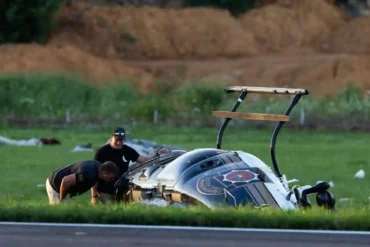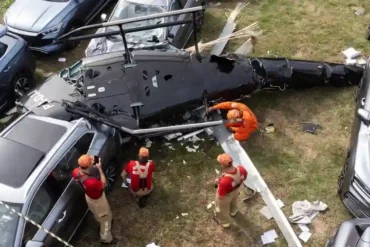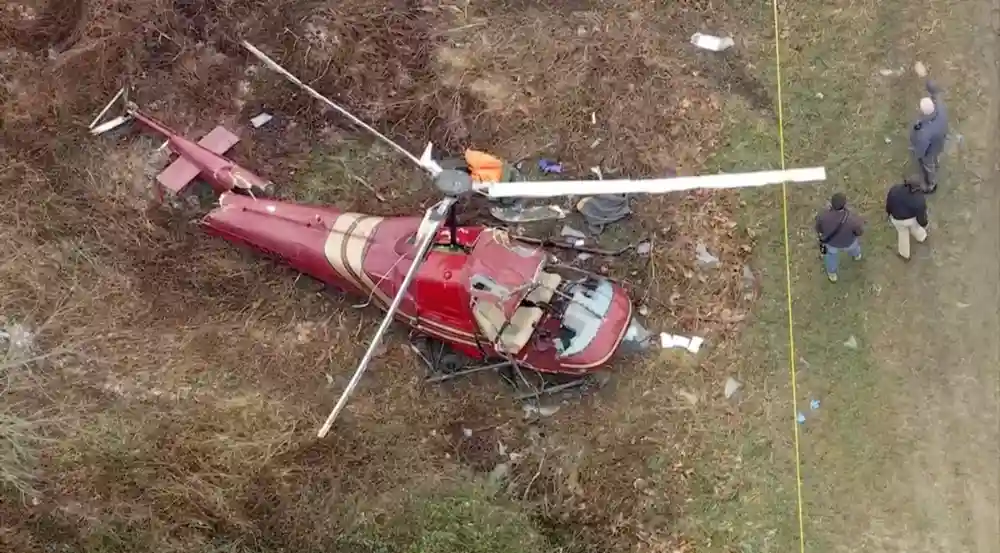
At approximately 11:25 AM EST on Sunday, December 28, 2025, a devastating midair collision between two helicopters occurred over Southern New Jersey, leaving one pilot dead and another critically injured. The collision happened near Hammonton Municipal Airport, not far from Hammonton Hospital, in Atlantic County, roughly 35 miles east of Philadelphia.
The incident has sent shockwaves through the aviation community and raised urgent questions about midair traffic protocols, especially in lower-altitude municipal airspaces.
Collision Over Hammonton: What We Know So Far
According to the Federal Aviation Administration (FAA), the two helicopters involved in the crash were identified as an Enstrom F-28A and an Enstrom 280C. Both aircraft were piloted solo—no passengers were on board at the time of the incident.
“An Enstrom F-28A helicopter and Enstrom 280C helicopter collided in mid-air near Hammonton Municipal Airport in New Jersey around 11:25 a.m. local time on Sunday, Dec. 28,” an FAA spokesperson confirmed.
Eyewitnesses from nearby neighborhoods reported seeing the helicopters flying in close proximity before one suddenly began spinning uncontrollably, trailing smoke as it plummeted toward the ground. Emergency services responded within minutes as the scene unfolded.
One Aircraft Engulfed in Flames, Other Crashed Into Woods
Police Chief Kevin Friel of Hammonton provided harrowing details shortly after the crash.
“There is confirmed one fatality at this point and one subject transported by EMS with critical life-threatening injuries,” he told USA TODAY.
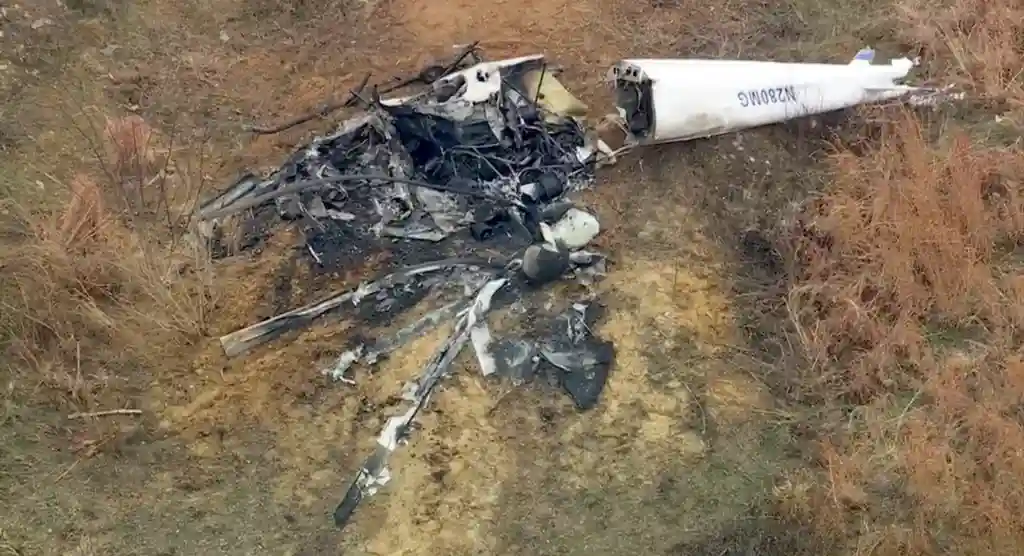
Fire and emergency response teams from Hammonton and surrounding areas arrived at the crash site, battling a fire that had engulfed one of the helicopters upon impact. According to local reports, one aircraft crashed near Bason Road and White Horse Pike (WHP), while the other was located deeper in the nearby wooded area.
Only one of the helicopters caught fire, but both sustained catastrophic damage. The intensity of the flames required a coordinated firefighting effort to suppress.
Video Footage Captures the Chaos
Dramatic video circulated on social media shows one of the helicopters spiraling violently in midair before hitting the ground in a fiery crash. The footage, captured by an anonymous bystander and reposted by @RapidReport2025 on X (formerly Twitter), shows the terrifying descent, suggesting possible mechanical failure or loss of control in the final moments.
As emergency personnel rushed to the scene, updates from Flightradar24 Spotters and local Facebook pages, such as Lancaster County News and Breaking News Alerts, documented the unfolding tragedy. One pilot was extricated alive and transported under critical condition to a nearby medical facility. The second pilot was declared dead at the scene.
Investigators Begin Probing the Wreckage
By early afternoon, the National Transportation Safety Board (NTSB) confirmed it would take the lead in the investigation. A team of crash investigators, aviation safety specialists, and engineers arrived to begin examining the wreckage.
Determining the registration numbers of the helicopters was among the first tasks, as initial reports from the FAA only identified the aircraft types. Officials have yet to release the names of the pilots or owners of the helicopters, pending notification of families.
Authorities cordoned off a significant area around the crash zone, including parts of Bason Road, while crews worked to stabilize the wreck sites and recover black box data—though such data recorders are not standard in all civilian rotorcraft.
Possible Scenarios Under Consideration
While the official cause remains undetermined, several potential factors are being considered:
- Airspace miscommunication between the pilots due to lack of coordination at low altitude.
- Mechanical malfunction in one or both aircraft.
- Pilot error, which remains a possibility given the manual controls of these Enstrom models.
- Environmental conditions, though early reports suggest weather was clear with good visibility at the time.
Experts say that small aircraft and helicopters often share municipal airspace with limited ATC (Air Traffic Control) support, especially outside larger metropolitan zones. This increases the risk of such tragedies unless stringent traffic pattern protocols are followed.
Community Reacts With Shock and Grief
The normally quiet town of Hammonton, known more for its agriculture and small-town charm than aviation incidents, is reeling. Local residents gathered along perimeter roads, some visibly shaken, as emergency crews worked through the wreckage.
“We saw a chopper spiraling down like a leaf. I thought it was part of a stunt at first,” said a witness who wished to remain anonymous. “Then we saw smoke and heard the sirens. That’s when we knew it was real.”
Nearby schools were placed on soft lockdown briefly as a precaution, and Hammonton Hospital confirmed that its emergency facilities had received one crash victim.
FAA and NTSB: A Joint Investigation Ahead
Both the FAA and NTSB have committed to a full-scale investigation, which is expected to take several weeks. Debris analysis, maintenance logs, and pilot credentials will all be part of the process.
Preliminary reports may be available within 7-10 days, but a final ruling on cause can take 6-12 months. The FAA emphasized that any potential safety violations will be thoroughly examined, and regulatory changes could follow if systemic issues are discovered.
Spotlight on Enstrom Helicopters: F-28A and 280C Models
The Enstrom F-28A and Enstrom 280C are both light utility helicopters known for their stability and reliability. Enstrom Helicopter Corporation, based in Michigan, has a reputation for producing robust rotorcraft primarily used for training, surveillance, and light transport.
However, both models are older airframes, with the F-28A first introduced in the late 1960s and the 280C in the mid-1970s. While many units have been upgraded over time, age-related wear and tear remains a concern in aircraft of this vintage.
Aviation analyst Jordan Litz stated: “While Enstrom helicopters have a strong track record, older models like the F-28A need meticulous maintenance. Any oversight can prove catastrophic, especially during flight operations near populated areas.”
Looking Ahead: A Wake-Up Call for Municipal Aviation
Sunday’s collision serves as a tragic reminder of the risks involved in general aviation, particularly in low-regulated zones near small airports. The incident underscores the importance of:
- Enhanced airspace awareness tools for helicopters.
- Mandatory collision-avoidance systems on all rotorcraft.
- Improved pilot communication protocols in uncontrolled airspace.
As the Hammonton community mourns the loss and hopes for the recovery of the injured pilot, broader questions loom about aviation safety standards and the future of helicopter flight regulation.
The skies above New Jersey may be quieter now, but the echoes of this tragedy will likely reverberate in the aviation world for years to come.