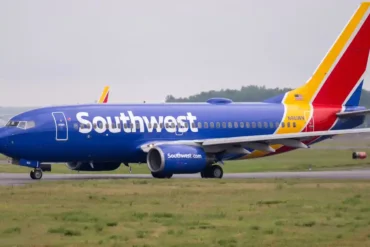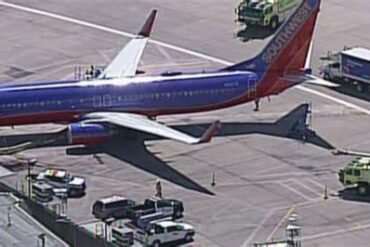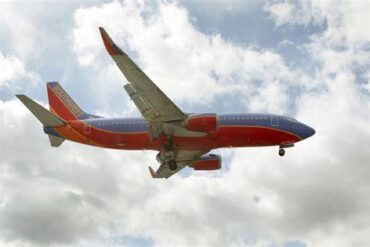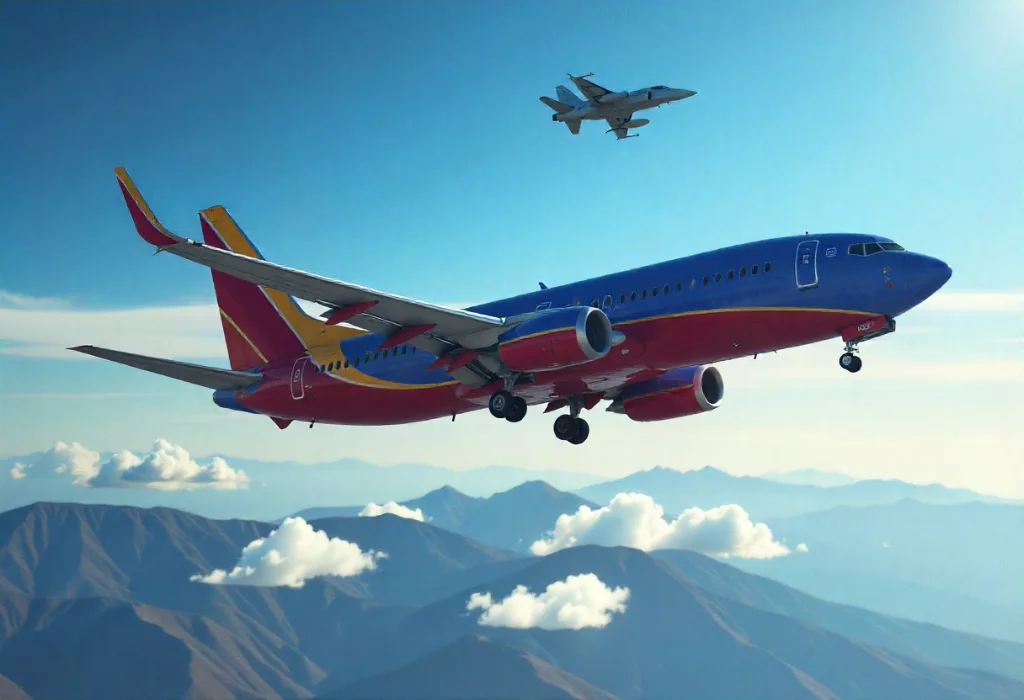
On the evening of July 21, 2025, a Southwest Airlines Boeing 737 en route from Hollywood Burbank Airport to Las Vegas executed an abrupt descent to avoid a near-mid-air collision with a British-made Hawker Hunter fighter jet. The incident, now under investigation by the Federal Aviation Administration (FAA), left two flight attendants injured and raised new concerns about the coordination between civilian and military air traffic operations.
The Incident: A Near-Miss Over the Skies
According to flight tracking data, Southwest Flight 1496 was cruising shortly after departure when an onboard collision avoidance alert sounded in the cockpit. The warning indicated the proximity of another aircraft—later identified as a Hawker Hunter jet—forcing pilots to initiate a rapid descent of nearly 500 feet. The fighter jet reportedly crossed within 350 feet vertically and 4.86 miles horizontally of the commercial airliner, a dangerously close margin by aviation safety standards.
Passengers on board described the moment as terrifying, with one traveler comparing the sudden maneuver to a “plunge toward a crash.” Following the evasive action, the pilots reassured passengers and successfully completed the flight to Las Vegas, where the injured attendants received medical attention. No passengers were reported injured.
Injuries and Passenger Reactions
Two flight attendants sustained injuries during the descent, though their conditions were not life-threatening. Passengers recounted chaos inside the cabin, with service items tumbling and unbuckled individuals jolted by the sudden movement. Caitlin Burdi, a passenger on the flight, expressed frustration over the lack of immediate communication during the descent, stating that travelers “weren’t told how much time was left in the situation,” which heightened the sense of panic.
Military Aircraft Involvement
The aircraft involved—a Hawker Hunter, a British-designed jet fighter—was operating in U.S. airspace, though the U.S. Air Force has yet to clarify its mission or provide an explanation for its close proximity to the commercial flight. This near miss is particularly concerning as it underscores coordination gaps between military and civilian air traffic controllers, an issue that aviation experts say requires urgent attention.
A Troubling Pattern of Close Calls
This latest incident is part of a disturbing trend involving military aircraft and commercial flights in 2025. Just a week earlier, a SkyWest Airlines flight narrowly avoided a collision with a B-52 bomber during its approach to a North Dakota airport. In another recent case, Delta Air Lines Flight 319 encountered military aircraft near Reagan National Airport, prompting federal investigations.
These close calls have sparked broader discussions about airspace management, particularly in areas where military exercises and civilian flights intersect. Experts argue that current protocols may not provide adequate safeguards to prevent such dangerous encounters.
FAA and NTSB Investigations
The FAA’s Safety Investigation Division has launched a comprehensive investigation into the incident, working in collaboration with the National Transportation Safety Board (NTSB). Officials are examining air traffic communications, radar logs, and coordination procedures between civilian and military air controllers. An FAA spokesperson confirmed that the investigation is being treated as a “serious safety concern.”
One of the primary issues under review is whether air traffic controllers had sufficient situational awareness of both the Southwest flight and the military jet. Additionally, investigators are looking into whether existing separation protocols for military aircraft are robust enough when operating near civilian corridors.
The Coordination Gap Between Civilian and Military Air Traffic
The United States National Airspace System traditionally prioritizes civilian operations, but the increasing presence of military aircraft in shared corridors presents a growing challenge. Aviation experts stress that better communication protocols between military and civilian controllers are critical. Professor Alan Stogdale, an aviation safety specialist, warned that “these events expose weaknesses in coordination that, if left unresolved, could lead to catastrophic outcomes.”
Safety Concerns and Reassurances
While the incident underscores the inherent risks of shared airspace, both Southwest Airlines and the FAA have emphasized that commercial aviation remains among the safest modes of transportation. The airline confirmed that its Boeing 737 sustained no damage and praised the crew for their swift and decisive response. “Our pilots acted in accordance with safety procedures to protect everyone on board,” the company said in a statement.
Still, the injuries to crew members and the growing number of near-miss reports have left passengers and aviation stakeholders calling for immediate policy changes. Among the proposals are enhanced military flight notifications, improved real-time radar coordination, and greater restrictions on low-altitude military operations near civilian routes.
Growing Alarm in the Aviation Community
The recent surge in incidents has caused unease among airline unions, safety boards, and the flying public. Aviation unions have urged regulators to establish clearer operational boundaries for military aircraft. Meanwhile, passenger advocacy groups are demanding transparency on how close these near misses are coming to full-blown disasters.
Several experts are pushing for modernized collision avoidance systems that allow for real-time data sharing between commercial airlines and military flights. Such systems could help prevent future incidents by automatically alerting all parties when aircraft come dangerously close.
Lessons for Passengers and Airlines
For passengers, incidents like this often reignite fears about air travel, particularly regarding unforeseen military activity in civilian airspace. However, aviation analysts emphasize that near misses are rare and that crew training and modern aircraft systems are designed to handle such emergencies effectively.
For airlines, this event highlights the need for enhanced training for flight crews in handling unpredictable airspace encounters. Additionally, airlines may push for more proactive collaboration with the Department of Defense to create better safeguards for civilian flights.
Looking Ahead: Strengthening Airspace Safety
In the wake of this incident, the FAA is expected to tighten its oversight of shared airspace operations. There are discussions underway about implementing mandatory pre-flight notifications for all military aircraft flying near commercial corridors, as well as expanding civilian access to military flight activity data.
While the Southwest Airlines crew successfully averted disaster, the event serves as a stark reminder of the constant vigilance required in modern aviation. As air traffic density continues to grow, ensuring seamless coordination between all operators—civilian and military alike—will be essential to maintaining the safety of U.S. skies.
Conclusion
The Southwest Airlines near-miss with a Hawker Hunter fighter jet is more than an isolated incident—it is a wake-up call for the aviation industry. With two crew members injured, rising concerns about military-civilian airspace management, and a growing pattern of similar encounters, the event underscores the urgent need for enhanced coordination and stricter safety protocols. While passengers can take comfort in knowing that aviation remains highly safe, these incidents demand immediate action to close the gaps in airspace management and prevent future tragedies.