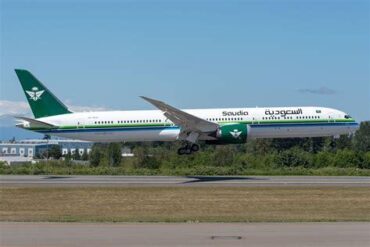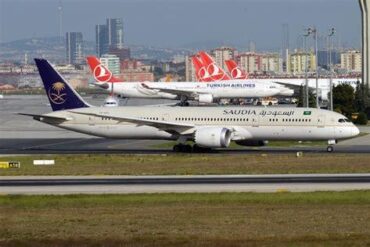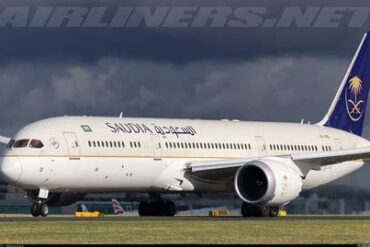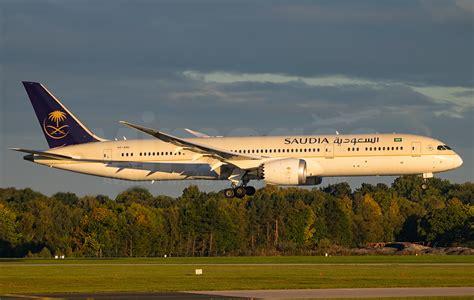
On May 28, 2025, a Saudia Boeing 787-9 Dreamliner registered as HZ-ARF suffered significant structural damage at London Heathrow Airport (LHR) when a ground service truck collided with its aft fuselage. The widebody jet, freshly arrived from Jeddah King Abdulaziz International Airport (JED) on flight SV105, was stationary at a remote stand when the incident occurred. The impact punctured the aircraft’s composite skin, forcing the airline to cancel the return flight, SV106, which was due to depart at 17:45 local time.
Aft Fuselage Breach: Extent Of Structural Damage
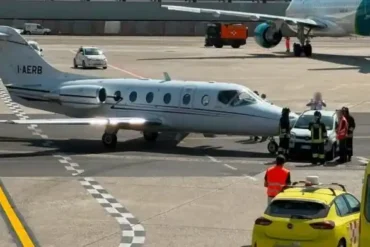
The collision involved a metal-railed ground service truck, which struck the rear fuselage of the aircraft, penetrating the structure near the lower empennage area. Images captured on the tarmac showed airport firefighting personnel and ground crew surrounding the damaged aircraft, examining the extent of the breach. The embedded metal railings visibly gouged through the carbon-fiber-reinforced fuselage skin of the Dreamliner—a critical integrity zone that supports pressurization and houses multiple avionics and systems.
The severity of the structural damage suggests that temporary repairs will not suffice. Composite damage of this nature typically requires inspection and repair by certified Boeing structural technicians, potentially extending the aircraft’s downtime for several weeks. London Heathrow’s on-site British Airways Maintenance Facility, located near Terminal 3, offers structural and composite workshops capable of managing such repairs. However, the incident could necessitate parts or teams being dispatched from Boeing’s repair network.
Flight SV106 Canceled: Passenger Disruption And Regulatory Obligations
With the aircraft grounded, flight SV106 to Jeddah was canceled. According to Flightradar24, the Dreamliner had landed at 14:47 local time after a 4-hour flight from Saudi Arabia. Under the UK Civil Aviation Authority (CAA) passenger rights framework, Saudia is now responsible for offering affected passengers food, accommodation, transportation, and a means of communication.
The CAA’s guidance mandates that airlines, regardless of fault or cause of cancellation, provide the necessary support until an alternate flight is arranged. Saudia, being a third-country carrier operating out of Heathrow, falls fully under this jurisdiction. Passengers from SV106 were likely rebooked onto alternative Saudia services or offered seats aboard British Airways or Virgin Atlantic flights to Saudi destinations.
Saudia’s London Operations: Schedule And Strategic Impact
On May 28, Saudia had three scheduled outbound flights from Heathrow to Jeddah: SV106, SV118 (departing 22:10), and SV120 (departing 14:40). With SV106 canceled, load pressure likely increased on the remaining flights. In addition, British Airways and Virgin Atlantic operate from London to Riyadh, presenting limited alternative options for Jeddah-bound travelers.
The timing of this disruption is particularly critical for Saudia. The airline is scaling up capacity across key UK–KSA routes in anticipation of summer travel and growing traffic due to Saudi Vision 2030. Disruption of a high-demand route and the potential long-term grounding of a 787-9 Dreamliner could stress fleet availability. The airline may need to reassign aircraft from other routes or lease in capacity to maintain schedule reliability.
Boeing 787 Structural Damage Protocols: Repair Complexity
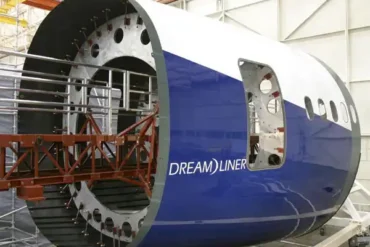
The Boeing 787 Dreamliner, renowned for its fuel efficiency and advanced systems, is also unique in its use of composite materials, with over 50% of the airframe made from carbon-fiber-reinforced polymers. This structural design reduces weight but complicates damage repair. Unlike aluminum aircraft, composites cannot be simply patched; repairs must consider load paths, fiber continuity, and pressurization safety.
The location of the impact—toward the aft pressure bulkhead—raises additional concerns. Any compromise near pressurized zones demands non-destructive testing (NDT), including ultrasonic and thermographic scans, to identify delamination, cracking, or subsurface fiber breakage. Depending on damage classification (minor, major, or beyond economic repair), Boeing’s Aircraft-On-Ground (AOG) support team may dispatch specialized engineers or direct repairs via certified MRO partners.
In some cases, as seen with Air New Zealand’s 777-300ER incident in Brisbane, affected aircraft are flown unpressurized under ferry permits for heavy maintenance. However, such procedures require meticulous inspection and civil aviation authority approval—potentially a logistical challenge for an international carrier like Saudia.
Ground Incident Trends: A Growing Industry Concern
This is not an isolated case of ground vehicle-to-aircraft collision. Similar incidents have surged at major global hubs due to rising traffic, increased apron congestion, and human error. Earlier this year, a jet bridge pierced the nose of an Air New Zealand 777-300ER, leaving a 7 cm hole below the cockpit windshield. In both cases, the aircraft involved had to be removed from service for extensive evaluation.
Industry data suggests that ramp accidents contribute to a significant portion of annual airline insurance claims, with damages ranging from $50,000 to over $1 million per incident. Causes often include:
- Fatigue and distraction among ground crew
- Communication lapses between cockpit and ramp operations
- Inadequate training on maneuvering ground service vehicles
- Tight operational schedules leading to rushed procedures
The Saudia incident at Heathrow underscores the importance of ramp safety audits, enhanced ground crew training, and advanced systems like aircraft proximity alerting to prevent such avoidable but costly mishaps.
Saudia Fleet Implications And Potential Recovery Timeline
The 787-9 involved, HZ-ARF, is one of Saudia’s core long-haul aircraft, supporting premium routes to Europe, North America, and Asia. As of May 2025, Saudia operates 13 Boeing 787-9s, each critical to maintaining high-capacity operations from its Jeddah, Riyadh, and Dammam hubs.
If major fuselage repair is required, the aircraft could be out of rotation for up to 6 weeks, depending on part availability, workshop slotting, and engineering oversight. In the interim, Saudia might:
- Swap aircraft from less time-sensitive routes
- Deploy a Boeing 777-300ER or Airbus A330-300 for capacity substitution
- Explore wet lease arrangements with approved third-party operators
Given that HZ-ARF is painted in the older Saudia livery, there’s also speculation that this downtime might coincide with scheduled repainting or cabin refresh aligned with the airline’s rebranding goals under Vision 2030.
Looking Ahead: Safety Oversight And Operational Integrity
This incident will trigger a full investigation by airport authorities, in cooperation with Saudia’s safety board, Boeing, and likely the UK Air Accidents Investigation Branch (AAIB). Findings may impact future ground handling policies, particularly at Heathrow’s busiest terminals, where multiple airlines operate in constrained apron spaces.
The collision highlights the delicate balance airports must maintain between maximizing aircraft movements and ensuring ramp safety discipline. As aviation rebounds and traffic surges, the Heathrow-Saudia incident is a stark reminder of how a single ground mishap can lead to operational disruption, financial costs, and safety concerns across international borders.
Final Thoughts
The collision between a service truck and Saudia’s Boeing 787-9 at London Heathrow represents more than just a one-off logistical failure—it encapsulates ongoing challenges in ramp safety, composite aircraft maintenance, and the fragility of high-frequency international operations. The outcome of the investigation will likely prompt updated safety recommendations, while Saudia scrambles to manage passenger commitments and restore a critical asset to flying condition.
Until then, flight SV106 remains an unfortunate case study in how a moment of inattention on the tarmac can ripple across time zones, timetables, and trust in global air travel.