The Cold War was not merely a contest of armies and arsenals. It was a shadow war of coded messages, forged identities, and high-altitude gambles. When a U.S. U-2 spy plane was shot down over Soviet territory in 1960, the incident detonated more than a diplomatic crisis. It triggered one of the most famous intelligence exchanges in history—an exchange that immortalized a man known as Rudolf Abel, widely described as the “most famous Soviet spy.”
The downing of the aircraft and the capture of pilot Francis Gary Powers exposed both the technical ambition of American surveillance and the intricate depth of Soviet espionage networks inside the United States. What followed was a geopolitical chess match that culminated at Berlin’s Glienicke Bridge—forever remembered as the “Bridge of Spies.”
The U-2 Program and the Illusion of Invincibility
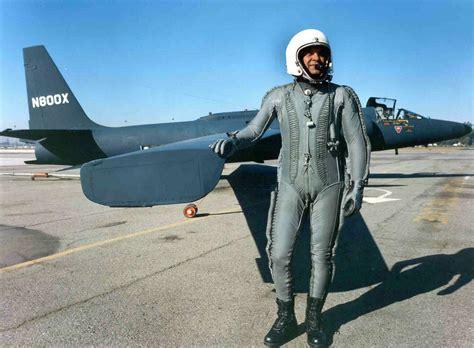
By the mid-1950s, American strategists faced a strategic blind spot. The Soviet Union was opaque, secretive, and expanding its nuclear capabilities. To pierce that veil, the CIA deployed the Lockheed U-2 reconnaissance aircraft, engineered to cruise above 70,000 feet—higher than any interceptor or missile was believed capable of reaching.
American intelligence analysts operated under a crucial assumption: Soviet radar systems could not effectively track targets flying at such extreme altitudes. That assumption proved disastrously optimistic.
Beginning in 1956, U-2 aircraft conducted multiple overflights of Soviet territory, gathering photographic intelligence on missile installations, bomber bases, and military infrastructure. The missions were daring, calculated, and politically volatile. Yet Soviet radar operators were not blind. They could detect the aircraft, even if intercepting it remained difficult.
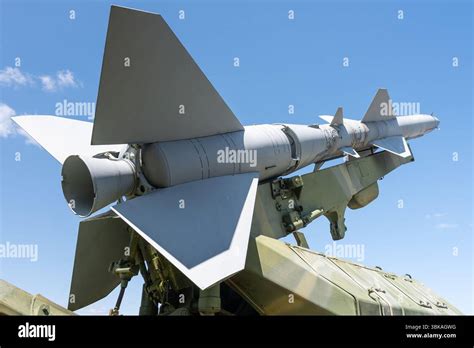
The illusion of immunity shattered on May 1, 1960, when Soviet air defenses launched an S-75 Dvina surface-to-air missile (SAM). The missile detonated near Powers’ aircraft, tearing it apart in the thin upper atmosphere. Powers survived the descent and was captured alive.
The United States initially believed the plane had crashed due to mechanical failure. In a bid to contain the fallout, officials announced that a NASA weather aircraft had gone missing over Turkey. The explanation unraveled when Soviet leader Nikita Khrushchev revealed that Powers was alive and had confessed to espionage. The diplomatic embarrassment was immediate and global. A scheduled summit between President Eisenhower and Khrushchev collapsed. Trust evaporated overnight.
Francis Gary Powers: From CIA Pilot to Soviet Prisoner
Francis Gary Powers was not an ordinary aviator. A former U.S. Air Force pilot, he had transitioned to CIA service to fly some of the most sensitive reconnaissance missions of the era. His capture provided Moscow with a propaganda triumph.
Charged under Article 2 of the Soviet Law on Criminal Responsibility for State Crimes, Powers faced trial for espionage. He was sentenced to ten years—three in prison, seven in labor camps. The Soviet Union showcased the trial as evidence of American aggression.
Back in the United States, Powers’ father worked relentlessly behind the scenes. Publicly, Washington condemned Soviet actions. Privately, officials began calculating options. A captured CIA pilot was not just a prisoner—it was a liability, a symbol, and potentially a bargaining chip.
The possibility of a swap soon emerged. On the other side of the Iron Curtain—or rather, inside an American prison—sat a man of enormous strategic value.
Rudolf Abel: The Deep-Cover “Illegal” in America
Rudolf Abel was not born Rudolf Abel. His real name was Vilyam Genrikhovich Fisher, a seasoned Soviet intelligence officer. The alias he adopted upon arrest became his enduring legend.
Dispatched to the United States in 1948, Abel entered as an “illegal”—a deep-cover operative with no diplomatic protection. He traveled under a forged identity, posing initially as Andrew Yurgesovich Kayotis, a deceased Lithuanian-American. In New York, he reinvented himself as Emil Robert Goldfus, an unassuming artist and photographer.
Behind the façade, Abel managed espionage networks tasked with acquiring top-secret U.S. military and atomic intelligence. His tradecraft was meticulous. Communications were encoded through microdots—tiny photographic reductions of documents—and concealed in everyday objects. Cipher pads, hollow shaving brushes, shortwave radios, and specially modified coins formed part of his operational toolkit minimize detection risk.
One of the most intriguing artifacts linked to Abel was the infamous hollow nickel. In 1953, a Brooklyn newsboy noticed a coin felt unusually light. Dropped on the floor, it split open, revealing a microphotograph containing columns of numbers—an encrypted message. The FBI suspected espionage but could not immediately trace its origin.
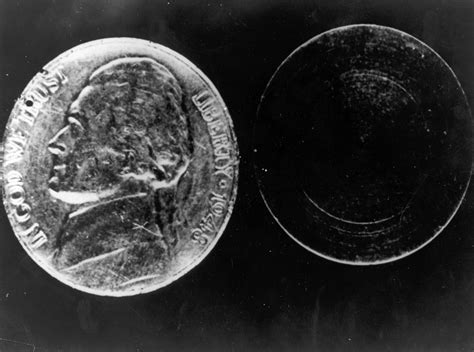
For years, the coin remained an unsolved puzzle. The breakthrough came when Abel’s subordinate, Reino Häyhänen, defected in 1957. Facing recall to Moscow and fearing punishment for poor performance, Häyhänen turned himself in to U.S. authorities in Paris. He revealed operational details and helped decode the hollow nickel message.
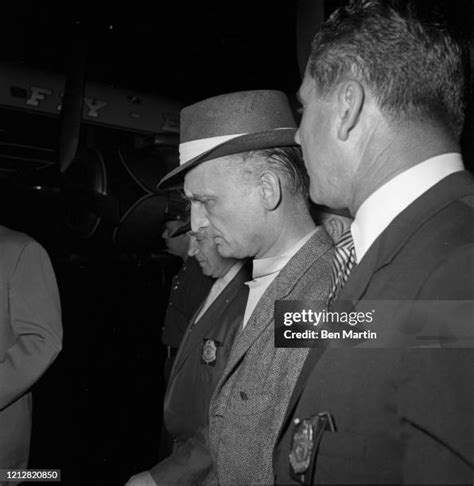
With insider confirmation, the FBI arrested Abel on June 21, 1957. A search of his Brooklyn apartment uncovered radio equipment, cipher materials, cameras, and microdot apparatus. The case became known as the Hollow Nickel Case, emblematic of the silent war unfolding within American cities.
The Trial That Preserved a Bargaining Chip
Abel’s prosecution in U.S. federal court could have ended in execution. Instead, his defense attorney, James B. Donovan, argued against the death penalty. Donovan reasoned that sparing Abel might one day serve American interests in a prisoner exchange.
It was a calculated, pragmatic stance—and history vindicated it.
Abel was convicted on three counts of conspiracy and espionage, receiving a 30-year sentence and a $3,000 fine. Yet even as he entered prison, the strategic logic of keeping him alive lingered in intelligence circles.
When Powers was captured in 1960, that logic crystallized into action.
The Bridge of Spies: A Cold War Exchange
Negotiations unfolded quietly, involving Donovan and U.S. officials including CIA-linked legal counsel. Diplomatic channels threaded through divided Berlin, the symbolic epicenter of East-West confrontation.
On February 10, 1962, approximately one year, nine months, and ten days after Powers’ capture, the exchange took place at the Glienicke Bridge connecting West Berlin and Potsdam. The bridge, spanning a literal boundary between opposing blocs, provided a cinematic stage for the swap.
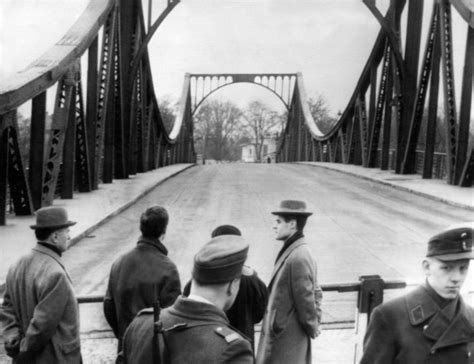
Powers crossed toward freedom. Abel crossed toward the Soviet sphere. The exchange was executed with precision, restraint, and minimal theatrics—yet its symbolism was immense. Two superpowers had acknowledged mutual vulnerability.
The bridge would thereafter earn its enduring nickname: the Bridge of Spies.
Aftermath: Diverging Paths of Two Intelligence Icons
Following his return, Francis Gary Powers faced scrutiny at home before eventually receiving the CIA Intelligence Star in 1965. His mission, once controversial, was later reassessed in the broader context of Cold War intelligence necessity.
Rudolf Abel, restored to Moscow, resumed work within the KGB’s Illegals Directorate, mentoring future operatives in the art of deep-cover infiltration. He died in 1971, but his legend expanded beyond classified archives. His story later inspired books and the internationally acclaimed film “Bridge of Spies,” directed by Steven Spielberg.
The exchange underscored a hard truth of Cold War strategy: spies were not disposable assets. They were investments—valuable, trained, and politically potent.
Strategic Lessons from the U-2 Incident
The U-2 shootdown demonstrated the limits of technological hubris. American planners underestimated Soviet radar and missile capabilities. The S-75 Dvina proved that altitude alone could not guarantee immunity.
At the same time, the Abel case highlighted the sophistication of Soviet human intelligence operations. Deep-cover “illegals” required patience, cultural fluency, and operational discipline measured not in months, but in decades.
Both cases illustrated a broader principle of Cold War geopolitics: intelligence gathering was indispensable, but exposure carried profound consequences. The shootdown collapsed diplomatic initiatives. The espionage trial inflamed public opinion. Yet both crises ultimately produced a negotiated settlement rather than escalation.
In the strange arithmetic of deterrence, even adversaries required communication channels.
Why Rudolf Abel Remains the “Most Famous Soviet Spy”
Rudolf Abel’s fame rests not only on his operational success but on the drama surrounding his capture and exchange. He embodied the archetype of the disciplined, ideologically committed intelligence officer who maintained composure under arrest and refused to betray his network.
Unlike flamboyant fictional spies, Abel operated in quiet anonymity—until history forced him into the spotlight. His alias became synonymous with Cold War espionage, while his true identity, Vilyam Fisher, remained secondary in public memory.
His story persists because it merges technology, human tradecraft, diplomatic brinkmanship, and cinematic symbolism into a single narrative arc. A high-altitude spy plane destroyed by a Soviet missile. A captured pilot facing trial. A hollow coin concealing secrets. A midnight exchange on a divided bridge.
Each element reinforces the enduring fascination with the era’s intelligence wars.
A Cold War Turning Point
The U.S. spy plane shot down over the Soviet Union was more than a tactical loss. It marked a turning point in superpower relations and underscored the fragility of strategic assumptions. It revealed the depth of espionage penetration on both sides and demonstrated that even bitter rivals could engage in pragmatic negotiation.
The exchange of Francis Gary Powers and Rudolf Abel did not thaw the Cold War. It did not erase ideological hostility. But it proved that beneath the rhetoric and rivalry, both nations recognized the value of restraint.
In a conflict defined by secrecy and suspicion, the Bridge of Spies became a rare site of calculated cooperation—a narrow span over turbulent waters, where two adversaries met not as friends, but as realists.