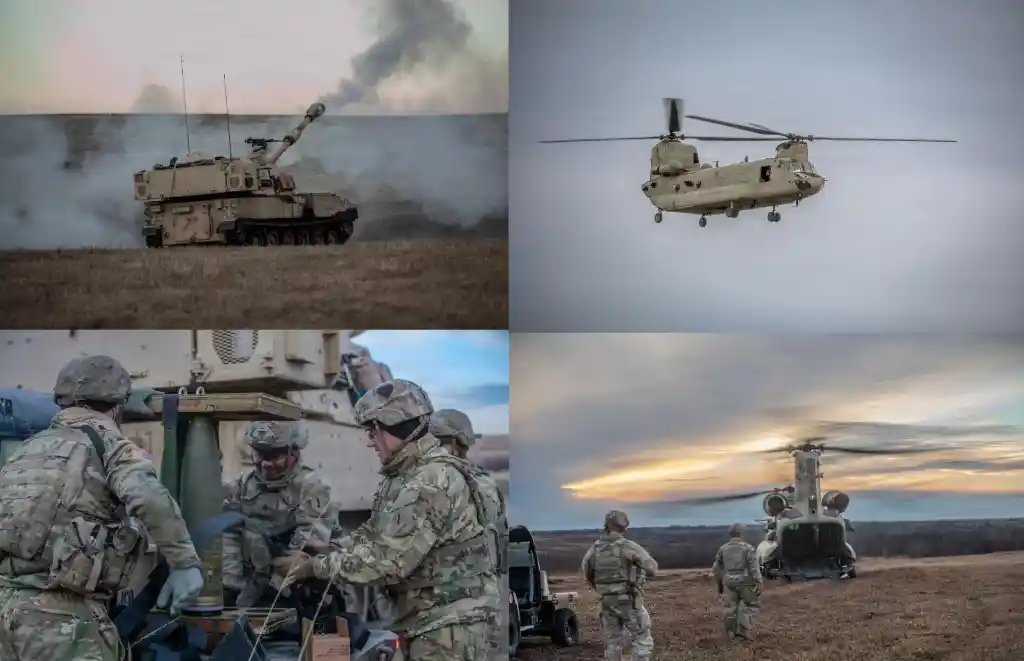
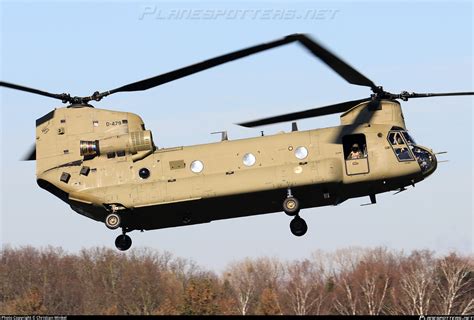
The U.S. Army is aggressively refining its artillery tactics for high-end warfare, shifting away from vulnerable ground-based logistics and embracing helicopter-enabled mobility and resupply. In a recently conducted gun raid at Fort Riley, Kansas, artillery crews from the 1st Battalion, 7th Field Artillery Regiment demonstrated a fast-moving, survivability-focused operation in which CH-47 Chinook helicopters delivered 155mm ammunition directly to firing units. The exercise reflects a vital doctrinal evolution as the Army adapts to a battlefield where fixed supply routes may no longer be viable.
Gun Raids as a Tactical Evolution in the Counterfire Race
At the heart of the exercise was a concept known as the gun raid, a rapid fire-and-displace maneuver designed to deliver lethal artillery effects before enemy counterbattery systems can respond. The urgency of modern warfare, especially in contested environments with peer adversaries, has made this speed essential. Unlike traditional fire missions that often rely on pre-established ground convoys and lengthy setup times, this raid underscored a fundamental shift to temporal advantage—occupy, fire, and reposition in a matter of minutes.
The Fort Riley operation was not merely a training scenario but a capabilities validation, testing how air mobility could drastically shorten the timeline from ammunition delivery to effective fires. As stated in official summaries, the battalion “tested their capabilities by flying in ammo to their field artillery guns,” a subtle line that masks the transformational impact of such a tactic.
The Role of the M109A7 Paladin in Mobile Fire Support
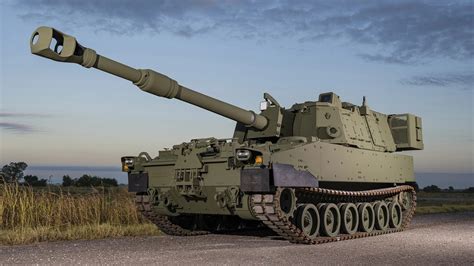
At the center of the operation was the M109A7 Paladin, a self-propelled 155mm howitzer designed to maneuver with armored units such as the Abrams tank and Bradley Fighting Vehicle. With a 39-caliber cannon and a range of approximately 22 km with standard rounds—and up to 30 km using rocket-assisted projectiles—the Paladin provides the long-range, mobile firepower needed in dynamic engagements.
Unlike fixed-cartridge systems, the Paladin uses separate-loading ammunition, which includes the projectile, propellant, and fuze as distinct components. A common projectile, the M795 high explosive round, weighs about 103 pounds and must be handled with care and speed to maintain a high rate of fire. This operational burden is part of what makes crew discipline and drill efficiency crucial in high-end warfighting.
During the Fort Riley raid, photographs revealed crews managing full-size rounds, lifting and prepping these heavy munitions under the time pressure inherent to avoiding counterfire. It is in these details—loading speed, fatigue, and physical coordination—that artillery lethality is sustained or lost.
Reimagining Logistics: Helicopter-Enabled Ammunition Resupply
The real innovation in this training event was aerial resupply. Traditionally, the M992A3 Carrier Ammunition Tracked (CAT) delivers ammunition alongside the guns, sharing parts and mobility traits with the M109A7. With a carrying capacity of up to 12,000 pounds, it remains a vital tool. But in a conflict where roads may be cratered or heavily surveilled, the Army is preparing for scenarios where ground movement is a liability.
Enter the CH-47 Chinook, a dual-rotor helicopter capable of sling-loading up to 26,000 pounds on its center hook. This capability enables the movement of entire pallets of 155mm rounds, fuze assemblies, and propellant charges—effectively turning ammunition into a maneuverable battlefield resource.
By airlifting ammunition directly to gun positions, commanders gain logistical agility, shifting ammunition stockpiles to wherever the mission requires—whether to support a breach, reinforce a flank, or mass fires at a decisive moment. More than just supply, this method turns logistics into a tactical enabler, allowing artillery units to adapt instantly to the evolving contours of the fight.
Disrupting Enemy Surveillance and Targeting Loops
Modern artillery is not just about range and accuracy—it’s about survivability in an era of precision counterfire. Adversaries with advanced ISR (Intelligence, Surveillance, and Reconnaissance) systems and long-range fires pose a persistent threat to static or predictable units. In this environment, artillery units that linger too long risk catastrophic losses.
Gun raids supported by helicopters reduce that vulnerability. By decoupling resupply from ground networks and maintaining movement as a constant, the U.S. Army complicates the targeting calculus for any enemy trying to track, predict, and destroy artillery positions. Every lift of the Chinook, every repositioned battery, becomes a challenge to adversary sensors and command timelines.
This is not theory. It’s the doctrine for the wars the U.S. Army sees coming. In environments as diverse as Eastern Europe, the Indo-Pacific, or even Arctic regions, the ability to maneuver firepower and sustain it through air corridors may determine battlefield dominance.
A Culture of Readiness: Integrating Logistics with Fires
One of the most revealing aspects of the Fort Riley gun raid was how it integrated logistics directly into the fires mission. Historically, sustainment and combat have been treated as separate domains—logistics follows, it doesn’t lead. But high-end conflict forces a rethinking of that premise.
In this raid, logisticians, pilots, and gunners worked as one, not in sequence but in simultaneity. The emphasis was not just on “can the gun fire” but on “can it keep firing under pressure and move before being struck.” That represents a mature evolution of combined arms thinking, where air mobility, artillery, and sustainment converge in real time.
Implications for Peer Conflict and Force Design
Exercises like this are not isolated—they signal the broader direction of Army modernization. As the U.S. military prepares for conflict with peer adversaries such as China or Russia, every branch is examining how to operate under conditions of degraded communications, contested logistics, and persistent surveillance.
The Fort Riley gun raid demonstrates that artillery units must not only fire effectively but maneuver and resupply autonomously. This self-sufficiency allows them to support distributed formations, hold positions without exposing long logistics tails, and reinforce efforts across vast frontlines. These capabilities align with emerging Army doctrines such as Multi-Domain Operations (MDO) and the Army 2030 vision.
Crucially, the event reflects the Army’s growing understanding that agility and flexibility are as vital as firepower. A battery that can fire once and disappear is far more dangerous than one that lingers and gets destroyed. By training for this kind of operational tempo now, units like the 1st Battalion, 7th Field Artillery Regiment are preparing not just for battle—but for victory.
Conclusion: Training Today for the Battles of Tomorrow
The December 2025 gun raid at Fort Riley was more than a training exercise—it was a live rehearsal for future warfare. It brought together cutting-edge mobility, logistics integration, and artillery precision into a seamless package capable of defeating modern threats. The use of CH-47 helicopters to deliver 155mm ammunition is not simply a novel idea—it is a necessity born of the evolving character of war.
As the U.S. Army continues to innovate and modernize its forces, events like this prove that artillery is no longer a static arm. It is a maneuver force, one that flies, fires, and moves faster than the enemy can respond. The gun raids of today may well be the artillery campaigns of tomorrow—and the lessons from Fort Riley will shape the doctrines that define success in the next war.