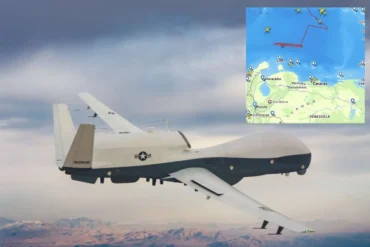
On January 6, 2026, a U.S. Air Force RC-135W Rivet Joint reconnaissance aircraft carried out a prolonged signals intelligence (SIGINT) mission near Venezuelan airspace. This mission, flown over the Caribbean Sea in international airspace, marks a continued escalation in U.S. surveillance activity in Latin America amid simmering geopolitical unease.
The aircraft, bearing tail number 64-14848, departed from Homestead Air Reserve Base in Florida and remained airborne well into the evening, operating a racetrack flight pattern parallel to Venezuela’s northern coastline. The extended loiter time, combined with this specific flight path, underscores the intensive and deliberate nature of the sortie, aimed at harvesting electromagnetic signals across a broad swath of Venezuelan territory.
Strategic Significance of the RC-135W Mission Near Venezuela
This latest surveillance activity comes on the heels of U.S. Special Forces operations targeting Venezuela-linked entities and assets, signaling a broader strategic posture. The Rivet Joint’s presence complements ongoing intelligence collection efforts designed to provide real-time assessments of Venezuelan military readiness, electronic warfare capabilities, and potential external alliances.
With the aircraft maintaining operations in international airspace, the U.S. reinforces its adherence to international law while still asserting intelligence dominance in the region. These missions serve dual objectives: collecting critical SIGINT and sending a clear signal to Caracas and its allies that U.S. eyes remain trained on developments that could threaten regional stability.
The Rivet Joint’s Capabilities: A Flying Intelligence Fusion Center
The RC-135W Rivet Joint is one of the most advanced platforms in the U.S. Air Force’s airborne intelligence arsenal. Based on the C-135 Stratolifter airframe, it has undergone extensive modernization and sensor upgrades. Its role transcends traditional surveillance; it acts as an airborne fusion node, aggregating, analyzing, and disseminating intelligence in near-real time.
Internally, the Rivet Joint accommodates over 30 specialized personnel, including electronic warfare officers, linguists, intelligence analysts, and systems operators. The mission crew typically includes 21–27 specialists in addition to the five flight crew members, enabling complex, multi-domain intelligence operations.
SIGINT Technology and Tactical Reach
The aircraft’s sensor suite can detect, classify, and geolocate a vast array of electromagnetic emissions. These include:
- Military air defense radar
- Tactical communication links
- Command and control transmissions
- Data-link networks
This breadth of collection allows Rivet Joint crews to build an electronic order of battle (EOB), offering insight into how Venezuela’s military units are postured and how they might react under pressure. The information is instantly relayed via secure satellite and line-of-sight communications to command centers, enabling timely decision-making at both tactical and strategic levels.
Performance Profile: Endurance and Power
The RC-135W is powered by four CFM International F108-CF-201 turbofan engines, each providing 21,600 pounds of thrust. It boasts a wingspan of 131 feet, a length of 135 feet, and a maximum takeoff weight nearing 297,000 pounds. Capable of flying up to 50,000 feet and cruising at over 500 mph, the aircraft has an unrefueled range of approximately 3,900 miles—with aerial refueling capabilities extending missions indefinitely.

Homestead Launch Point and Forward Deployment
Homestead ARB in Florida serves as a strategic launchpad for Rivet Joint missions focused on Latin America. While all RC-135W aircraft are home-based at Offutt Air Force Base, Nebraska, under the 55th Wing of Air Combat Command, forward deployments are common to enable persistent coverage and rapid response. The Caribbean Sea’s proximity to multiple strategic flashpoints makes it a hotbed for airborne intelligence operations.
This is not an isolated operation. Regional monitoring accounts confirm that Rivet Joint aircraft have operated with unprecedented frequency in the Caribbean throughout early January 2026. These flights mirror those seen during prior periods of tension, such as during Operation Unified Resolve or more recently during the 2024 maritime interception campaigns targeting illicit arms shipments.
Venezuela as a Focus of U.S. Strategic Surveillance
The intelligence mission near Venezuela is occurring in the context of renewed U.S. scrutiny of the country’s military communications networks, radar coverage, and possible foreign military cooperation—especially with Russia and Iran. This is especially critical following the seizure of oil assets linked to the Sophia Energy network, which has alleged Russian and Venezuelan ties.
The RC-135’s presence offers granular, real-time insight into how Venezuelan forces are responding. Has there been an uptick in radar activity? Are air defense units repositioning? Have encrypted military channels gone active? These are the types of electronic indicators Rivet Joint missions are built to detect and interpret.
Legacy of the Rivet Joint Platform in Global Operations
Since its inception in 1962, the RC-135 platform has evolved through multiple conflicts and theaters, from Vietnam to Kosovo, Iraq, and Syria. The current RC-135W/V variants represent the pinnacle of airborne SIGINT capability, shaped by decades of operational experience and technological adaptation.
Its continuous role in conflicts like Desert Storm, Enduring Freedom, and Inherent Resolve reflects its adaptability to emerging threats. Moreover, its ability to operate without violating sovereign airspace makes it a go-to tool for influence without incursion.
The current deployment near Venezuela is not a departure from tradition but a continuation of this strategic lineage, adapted to modern geopolitical realities in the Western Hemisphere.
Strategic Messaging Through Aerial Presence
Though Pentagon officials refrain from commenting on specific missions, the implications are clear. The RC-135W’s flight sends an unmistakable message of strategic intent. It highlights the U.S. commitment to monitoring regions where geopolitical shifts—be they economic, military, or hybrid—pose potential threats to regional stability or American interests.
By remaining within international airspace while gathering comprehensive intelligence, the Rivet Joint exemplifies how power projection and restraint can coexist. In the absence of overt conflict, such missions act as pressure valves and early warning systems, helping to shape diplomacy and military planning alike.
Conclusion: Surveillance as Strategic Leverage
The RC-135W Rivet Joint’s recent mission near Venezuela is a compelling snapshot of how advanced airborne intelligence platforms serve as both tools of information and instruments of strategy. At a time when Latin America’s geopolitical landscape is increasingly contested, such missions are indispensable to ensuring that the U.S. remains informed, prepared, and agile.
With its unmatched SIGINT capabilities, the Rivet Joint enables U.S. commanders and policymakers to respond not just with force, but with awareness—a decisive advantage in any strategic theater. The skies over the Caribbean, it seems, are no longer just a domain of transit—but a battlespace of information.