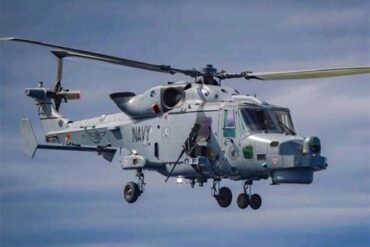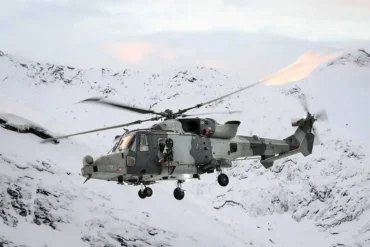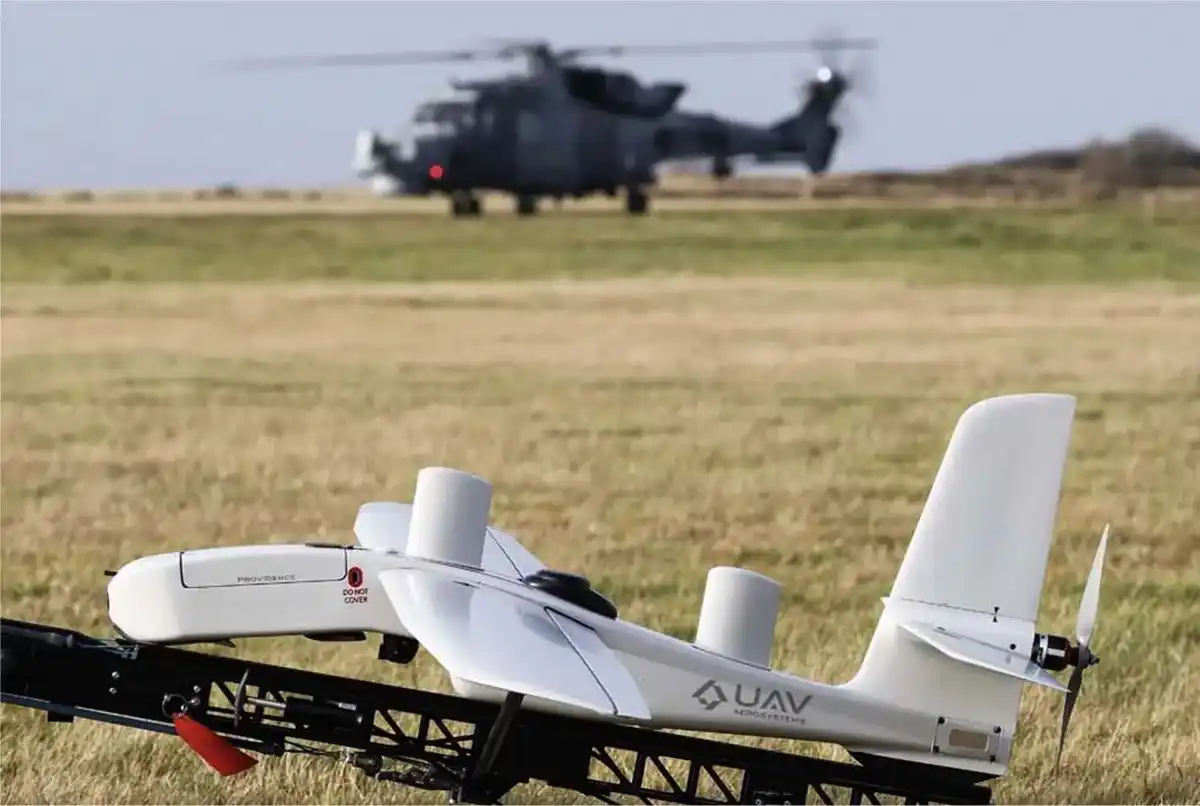
The British Royal Navy has crossed a meaningful threshold in modern naval warfare by proving that a crewed helicopter can command, fuse, and exploit live data from multiple uncrewed aerial systems during a single mission. On 30 January 2026, an AW159 Wildcat helicopter successfully detected, tracked, and targeted a moving vehicle using real-time drone feeds beyond visual range, marking a first for the Royal Navy and a tangible leap toward fully networked, hybrid maritime operations.
This was not a scripted laboratory test or a narrow technology demonstration. It was an operationally representative mission, flown with realistic command-and-control demands, contested communications assumptions, and multiple sensor inputs competing for attention in real time. The Wildcat did not simply receive drone video; it acted as a central airborne node, synthesizing data from different uncrewed platforms and ground-based sensors into a single, coherent targeting picture.
The achievement underscores a strategic shift already reshaping modern militaries: the decisive advantage no longer lies in a single exquisite platform, but in how well sensors, shooters, and decision-makers are connected. The Royal Navy’s Wildcat has now demonstrated that a compact maritime helicopter can sit at the center of that web.
By fusing drone intelligence with onboard systems, the Wildcat crew was able to generate targeting solutions without relying solely on its own radar or electro-optical sensors. This extends the helicopter’s reach far beyond line of sight and allows it to operate with greater discretion, survivability, and tactical flexibility in complex environments.
Network-Enabled Warfare Moves From Concept to Reality
At the heart of the mission was the Royal Navy’s growing emphasis on network-enabled warfare, where platforms act as contributors to a shared battlespace picture rather than isolated actors. During the flight, the Wildcat integrated live feeds from two different uncrewed aerial systems while simultaneously receiving additional data from ground-based sensors, all flowing into the cockpit in near real time.
This fusion of inputs allowed the crew to detect and track a moving target they could not directly see, validating the concept of distributed sensing with centralized decision-making. Instead of pushing the helicopter closer to potential threats, the drones acted as forward eyes, quietly extending situational awareness while the Wildcat remained tactically maneuverable.
The implications are significant. In maritime operations, especially in congested littoral zones, the ability to see first without being seen often determines success or failure. By relying on uncrewed systems for early detection and cueing, the Wildcat can conserve fuel, reduce exposure, and arrive at the decisive moment with a clearer understanding of the battlespace.
Eagles Eye Trials at Predannack Airfield
The milestone mission was conducted during the Eagles Eye trials at Predannack Airfield on Cornwall’s Lizard Peninsula. From this location, the Wildcat operated as the command node of a distributed sensor network, maintaining connectivity with uncrewed platforms even when they moved beyond the visual horizon.
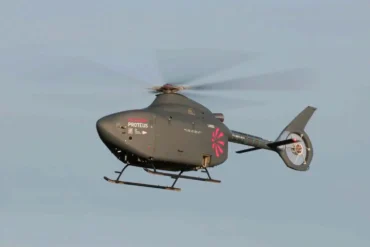
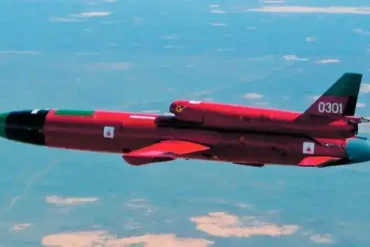
Two drones played key roles. A Puma unmanned aerial system, operated by the Royal Navy’s 700X Naval Air Squadron, provided persistent surveillance, while a smaller Providence drone, flown by industry partners, delivered complementary video feeds. These inputs were layered together with ground-based sensor data, creating a continuously updated targeting picture inside the Wildcat’s cabin.
Crucially, the information flow remained stable even when platforms were separated by distance and terrain. This demonstrated the robustness of the communications architecture and its ability to function beyond line of sight, a critical requirement for real-world operations where direct links are often unreliable or deliberately contested.
Turning the Wildcat Into a Flying Command Center
For the first time, a Royal Navy helicopter crew sent and received live data from multiple drones during an operational flight, effectively transforming the Wildcat into a flying command-and-control hub. Lieutenant Commander Rhydian Edwards, Officer in Command of the Wildcat Maritime Force Operational Advantage Group, described the aircraft as a “flying command centre,” capable of pulling information from any system connected to the network.
This role represents a subtle but profound evolution. Traditionally, helicopters have been sensors and shooters, collecting their own data and acting on it locally. In this mission, the Wildcat became something more: a decision node, orchestrating uncrewed assets while maintaining tactical freedom of movement.
The crew could task drones, receive feeds, correlate sensor data, and share targeting information with other units. In future operations, this same architecture could allow a Wildcat to cue ship-launched weapons, guide fast jets, or pass targeting data to land-based forces, all without exposing itself to unnecessary risk.
Puma and Providence Drones Extend the Sensor Horizon
The Puma drone, already in Royal Navy service for over six years, proved its value as a forward sensor during the trials. Operated by 700X Naval Air Squadron from RNAS Culdrose, Puma has accumulated extensive operational experience providing intelligence, surveillance, and reconnaissance to both ships and aviation units.
With its low acoustic signature and ability to deliver real-time electro-optical and infrared imagery, Puma excels at quietly extending the sensor reach of manned platforms. During the mission, it was operated directly from the Wildcat’s cabin, tightening the loop between detection and decision-making.
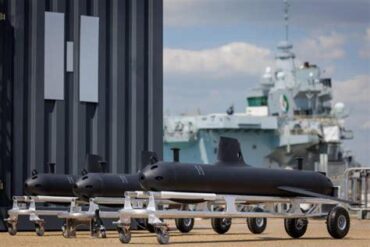
The Providence drone, flown externally by UAV Aerosystems, added a second perspective. The ability to ingest feeds from a drone not directly controlled by the helicopter highlighted the system’s interoperability and flexibility. Together, the drones allowed the Wildcat crew to locate and share multiple targets, building situational awareness incrementally rather than relying on a single sensor.
Precision Engagement and the Martlet Missile
While the demonstration focused on detection and tracking, its implications for precision engagement are clear. The AW159 Wildcat routinely carries the Martlet lightweight missile, a weapon designed to defeat fast attack craft and asymmetric threats with high accuracy and minimal collateral damage.
By cueing Martlet using off-board sensors, the Wildcat can engage targets without broadcasting its own position through active sensors. This silent kill chain is especially valuable in contested littoral environments, where adversaries may employ electronic surveillance, decoys, or swarm tactics.
The trials showed how helicopters could silently build a targeting solution, confirm it through multiple independent feeds, and then execute a precision strike at the moment of their choosing.
MESH Networks and Lessons From Modern Conflict
A defining feature of the Eagles Eye trials was the use of a decentralized MESH network architecture. Unlike traditional point-to-point links, a MESH network allows each node to relay data dynamically, rerouting traffic if a connection is degraded or lost.
This self-healing quality is essential in modern warfare, where electronic attack and signal disruption are the norm rather than the exception. Similar architectures have proven decisive in Ukraine, enabling forces to maintain command, control, and targeting under intense electronic warfare pressure. The Royal Navy has clearly internalized those lessons.
By designing a network that assumes disruption and adapts automatically, the Wildcat and its associated drones can continue to operate even when parts of the system are denied, damaged, or jammed.
Industry Collaboration and the Hybrid Navy Vision
The success of the mission was also a testament to deep collaboration between the Royal Navy and industry. Specialists from 700X Naval Air Squadron and 847 Naval Air Squadron worked alongside partners including MarWorks, TeleplanForsberg, General Dynamics, C3IA, UAV Aerosystems, and Collins Aerospace.
Their shared goal was to break down long-standing interoperability barriers between sensors, platforms, and weapon systems. Lieutenant Commander Edwards likened the resulting architecture to a universal translator, removing the need for bespoke interfaces every time a new drone or sensor is introduced.
Commander Andrew Henderson, Commanding Officer of the Wildcat Maritime Force, framed the achievement within the Royal Navy’s Hybrid Navy concept. He emphasized that operational advantage comes from resilient, secure access to the network rather than from any single platform. Modular design and hardened links, he noted, are what make a force both more lethal and harder to disrupt.
From Trials to Operational Deployment
The Eagles Eye trials are not an endpoint. The lessons learned will feed directly into upcoming deployments, including a planned mission to Norway later this year, where Royal Navy Wildcats will operate alongside the Royal Norwegian Navy in the challenging fjord environment around Bergen.
There, crewed-uncrewed teaming will be tested against fast attack craft and asymmetric maritime threats in terrain that compresses decision timelines and limits sensor visibility. With its new role as an airborne command hub, the Wildcat is poised to become a central player in these operations.
What was demonstrated over Cornwall is more than a technical milestone. It is a glimpse of how future naval battles will be fought: distributed sensors, resilient networks, and crewed platforms acting as intelligent conductors of uncrewed systems, shaping the fight before the adversary realizes it has begun.