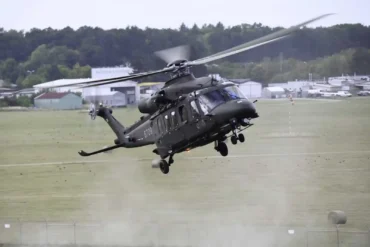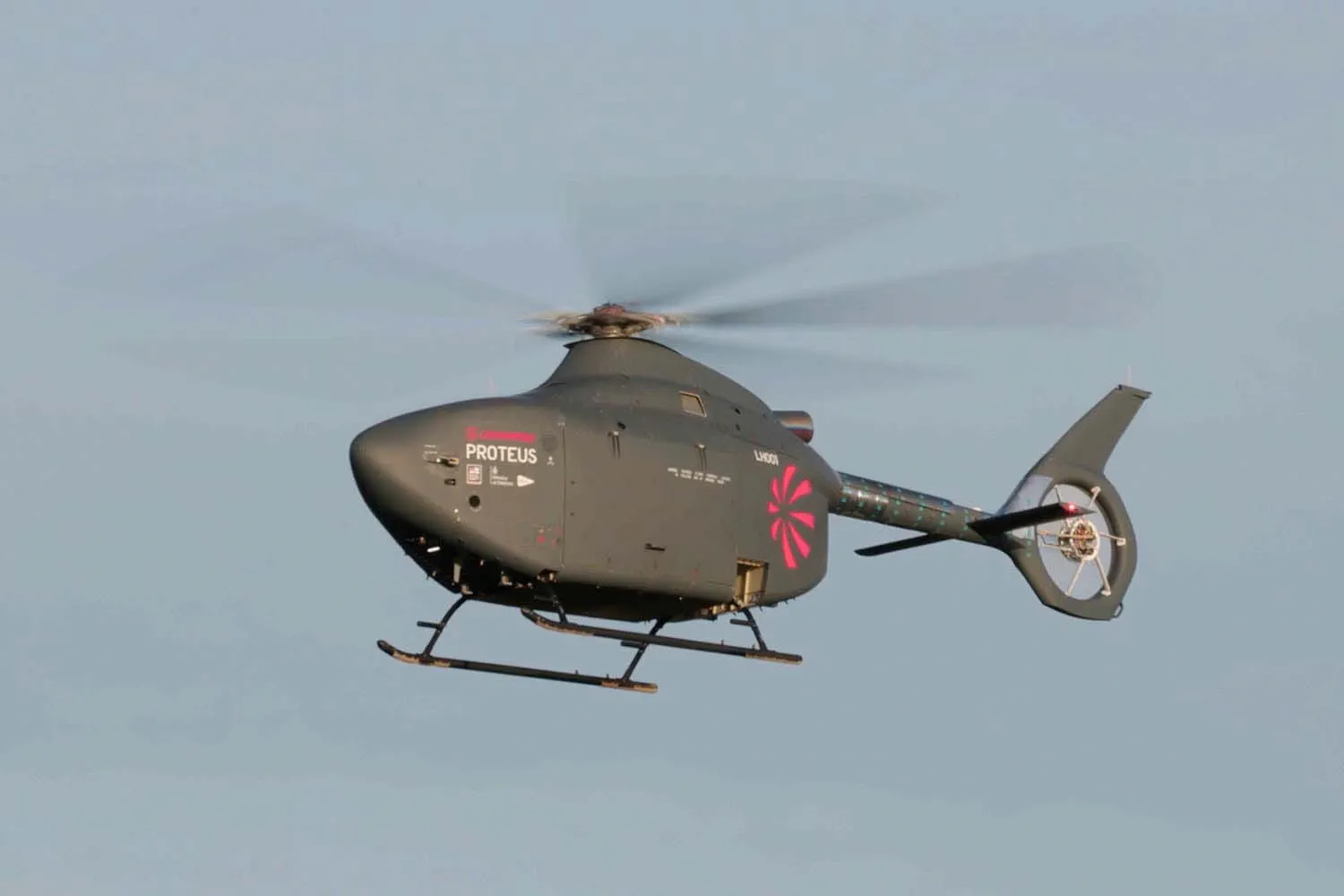
Leonardo’s Proteus has crossed a decisive threshold for British naval aviation, completing the United Kingdom Royal Navy’s first-ever autonomous flight of a full-size helicopter. Conducted on 16 January 2026 from Predannack Airfield in Cornwall, the milestone flight confirms that large uncrewed rotary-wing aircraft are no longer theoretical concepts but practical, airborne systems ready to shape future maritime operations. The achievement signals a structural shift in how the Royal Navy intends to project power, sustain presence, and manage risk across vast oceanic theatres.
The autonomous flight was executed without any pilot onboard, with the aircraft controlling its own flight systems from start to finish. Ground-based test pilots continuously supervised the mission to ensure safety, but the Proteus independently handled stability, navigation, and flight control throughout the sequence. This moment marks the transition of the Proteus programme from prolonged ground testing into airborne validation, opening the door to progressively more complex trials and operationally relevant scenarios.
The significance of this event extends well beyond a single test flight. It represents the first tangible expression of the Royal Navy’s ambition to integrate autonomous systems directly alongside crewed aircraft within future hybrid air wings. By demonstrating that a large helicopter can safely operate without a pilot onboard, the Proteus validates years of investment in autonomy, digital engineering, and naval innovation, while providing a credible pathway toward reduced risk for personnel and expanded operational endurance at sea.
Predannack Airfield and the Strategic Context of the First Flight
Predannack Airfield was not a symbolic choice for this historic flight. Located in Cornwall, it operates as a satellite airfield for helicopters based at RNAS Culdrose and has evolved into the United Kingdom’s National Drone Hub for naval uncrewed aviation. Its infrastructure, regulatory framework, and proximity to active Royal Navy helicopter units make it uniquely suited for experimentation with autonomous and uncrewed systems intended for maritime use.
The presence of engineers, test pilots, and representatives from Leonardo UK, the Royal Navy, and UK Defence Innovation underlined the collaborative nature of the programme. Predannack’s role bridges experimental development and frontline naval aviation, ensuring that autonomy concepts are shaped by real operational needs rather than abstract laboratory assumptions. This environment allows Proteus to be tested in airspace and conditions directly relevant to naval missions, including those involving ship integration and maritime coordination.
The flight also aligns with broader UK defence policy objectives. The Strategic Defence Review outlines the creation of a New Hybrid Navy, in which autonomous systems operate as force multipliers rather than replacements for crewed platforms. Proteus stands as a cornerstone of this vision, particularly within the Atlantic Bastion programme, which prioritises the security of the North Atlantic against increasingly sophisticated undersea threats.
Why the Name Proteus Reflects the Aircraft’s Core Philosophy
The helicopter’s name is more than a branding exercise. In Greek mythology, Proteus was a shape-shifting sea god capable of changing form to suit his environment. Leonardo selected the name to reflect the aircraft’s modular architecture and its ability to adapt rapidly to different missions through reconfigurable payloads and software-driven behaviours.
Proteus is designed as a platform rather than a single-purpose aircraft. Its mission profile can be altered without redesigning the airframe, allowing it to shift between surveillance, anti-submarine warfare support, communications relay, and sensor deployment roles. This adaptability is fundamental to naval operations, where mission demands can evolve rapidly due to changing threat conditions, weather, or tasking priorities.
By embracing modularity and software-defined capability, Proteus embodies a future in which naval aviation assets are no longer locked into fixed roles. Instead, they become flexible nodes within a larger information and sensing network, able to respond dynamically to operational requirements across the maritime battlespace.
A Development Journey Spanning More Than a Decade
The origins of Proteus trace back to August 2013, when the UK Ministry of Defence awarded a £2.3 million contract to AgustaWestland under the Anti-Submarine Warfare Spearhead programme. The objective was to explore the feasibility of a rotary-wing unmanned air system capable of supporting maritime operations. Early work relied heavily on the SW-4 Solo uncrewed helicopter, derived from the PZL SW-4 Puszczyk, which served as a flying laboratory for autonomy, ship integration, and control law experimentation.
Progress accelerated in 2017 with an £8 million second-phase contract jointly funded by Leonardo and the Ministry of Defence. This phase expanded the scope of autonomy development and began to focus more directly on mission relevance, particularly in the maritime domain. Lessons learned during this period shaped the conceptual foundations of what would eventually become Proteus.
A decisive turning point came in July 2022, when a four-year £60 million contract was signed to bring the programme into full-scale development. This investment supported approximately 100 skilled jobs in the United Kingdom and positioned Proteus as one of the world’s first truly full-size autonomous helicopters, alongside the American S-70UAS U-Hawk. The January 2026 flight represents the most visible validation of that investment to date.
Ground Trials, Digital Engineering, and the Road to Flight
Before taking to the air, Proteus underwent an extensive series of ground-running trials in December 2025 at Leonardo’s Yeovil facility. These tests progressively validated the helicopter’s engines, sensors, avionics, and autonomous control systems. Only after meeting stringent safety and performance criteria was the aircraft cleared for its first autonomous flight.
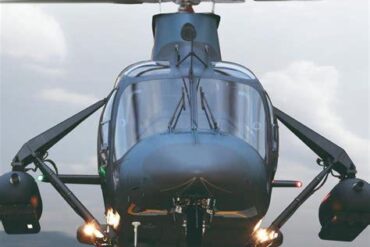
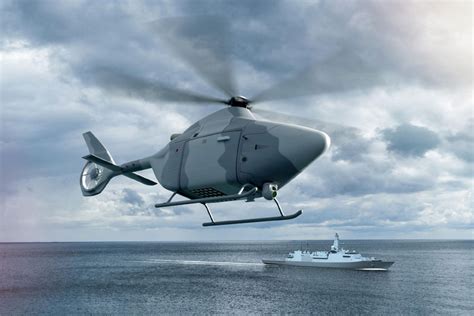
Proteus has been developed using advanced digital engineering techniques, including a comprehensive digital twin. This approach allowed engineers to simulate structural loads, flight dynamics, sensor integration, and autonomy behaviours long before physical components were manufactured. The external design, publicly revealed in January 2025, confirmed that Proteus is structurally based on the Kopter AW09 light single-engine helicopter, heavily modified for autonomous operation and increased payload capacity.
The airframe incorporates a five-bladed main rotor and a shrouded anti-torque tail rotor, optimised for efficiency and reduced acoustic signature. More than 40 components are manufactured from advanced composite materials, particularly in load-bearing structures, to reduce weight and improve resistance to corrosion in harsh maritime environments.
Inside the Autonomous Brain of Proteus
At the heart of Proteus lies a fully integrated autonomy architecture designed to operate without onboard human intervention. The system combines flight control, navigation, perception, and mission management within a redundant digital framework intended to minimise single-point failures.
The helicopter integrates inertial measurement units, global navigation satellite system receivers, air data computers, and obstacle-detection sensors such as lidar or radar. These inputs are fused in real time to provide continuous awareness of position, attitude, airspeed, and surrounding obstacles. Sensor-fusion algorithms merge this data with terrain, atmospheric, and flight-state models, allowing the aircraft to generate accurate situational awareness even in degraded conditions.
Autonomy functions are structured hierarchically. At the lowest level, control laws maintain stability and manage responses to wind and turbulence. Above this, navigation functions handle waypoint tracking, geofencing, and dynamic route adjustment. At the highest level, mission-management software governs task sequencing, sensor operation, and coordination with external platforms via secure datalinks. This layered design allows Proteus to function as part of a networked naval force rather than as an isolated drone.
Mission Payloads and Maritime Roles
Proteus has been engineered with a payload architecture optimised for maritime operations. Its modular bays can accommodate maritime search radars, electro-optical and infrared sensor turrets, magnetic anomaly detection equipment, sonobuoy deployment and reception systems, electronic support measures, and communications relay payloads.
This versatility positions Proteus as a critical enabler for anti-submarine warfare support and persistent sea patrol missions. Within the Atlantic Bastion framework, the helicopter is intended to extend the reach of crewed platforms by providing wide-area sensing and tracking across vast oceanic spaces. By operating as part of a distributed sensor network, Proteus can help detect and monitor underwater contacts while reducing the workload and exposure of crewed aircraft.
Scale, Capability, and the Future of Hybrid Air Wings
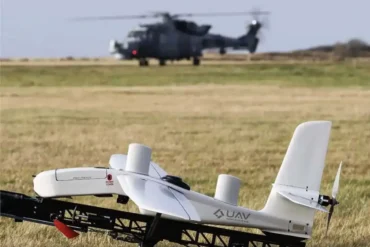
In terms of scale, Proteus sits well above the Royal Navy’s existing uncrewed aerial systems, such as Malloy octocopters and the Peregrine surveillance drone. Its payload capacity exceeds one tonne, enabling it to carry sophisticated sensor suites and substantial fuel loads. Although official maximum takeoff weight figures remain undisclosed, the aircraft is widely understood to occupy a three-tonne class when configured for autonomous operations.
The absence of a cockpit and crew accommodations allows a higher payload fraction to be dedicated to mission systems, endurance, and redundancy. This design philosophy aligns with the Royal Navy’s vision of hybrid air wings, where autonomous helicopters operate alongside crewed aircraft, sharing data, extending coverage, and assuming high-risk or endurance-intensive tasks.
The successful autonomous flight of Proteus marks the beginning of a new chapter rather than its conclusion. As flight testing expands, the data gathered will inform future decisions on integrating autonomous rotary-wing aircraft into Royal Navy and NATO operations. Proteus stands as a clear signal that the era of large, autonomous naval helicopters has arrived, reshaping how maritime air power will be generated, sustained, and deployed in the decades ahead.