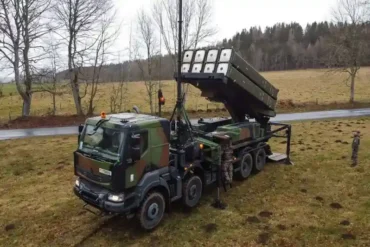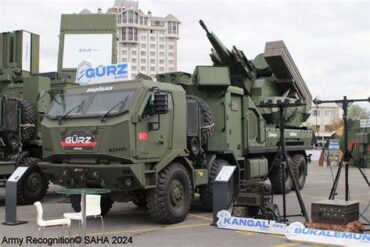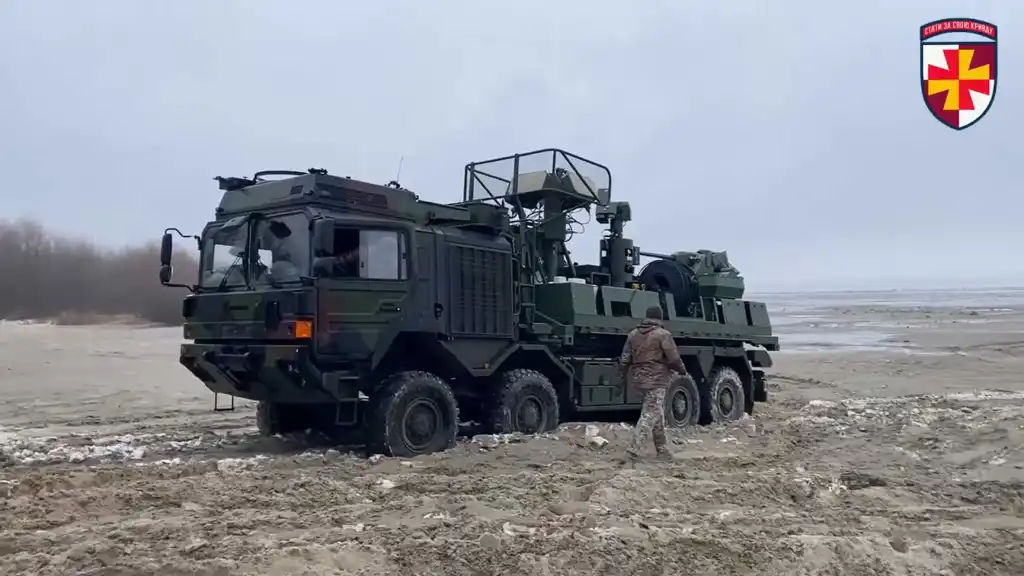
Ukraine has marked a pivotal moment in its evolving air defense strategy with the deployment of the British MSI-DS Terrahawk Paladin very short-range air defense (VSHORAD) system, a significant milestone in its war against Russian drone incursions. The Ukrainian 156th Anti-Aircraft Missile Regiment revealed this advancement via a video released on November 18, 2025, showcasing the first operational fielding of the Terrahawk Paladin system integrated onto a MAN HX 8×8 tactical truck, indicating full deployment readiness.
This state-of-the-art weapon represents a significant capability leap in defending high-value targets and infrastructure from relentless Russian drone assaults, which have become a staple of Moscow’s asymmetric tactics in Ukrainian skies. Originally designed for naval operations, the MSI-DS platform has now been reborn as a versatile land-based counter-drone sentinel, aligning with Ukraine’s urgent demand for close-range, mobile, and highly reactive air defense solutions.
From British Aid to Battlefield Reality
The Terrahawk Paladin’s journey to Ukraine began with the October 2023 UK-led military aid package, valued at over £100 million and financed through the International Fund for Ukraine (IFU), which the United Kingdom and Denmark initiated in 2022. With the addition of support from nations like Norway, the Netherlands, Sweden, Iceland, and Lithuania, this collaborative defense commitment channeled over £70 million directly into air defense procurement, specifically targeting low-altitude threats such as loitering munitions and kamikaze drones.
Within this framework, the Terrahawk Paladin system was highlighted as a key asset, designed to deliver rapid and precise protection to military units and critical sites under threat from aerial assault. Ukraine’s defense command fast-tracked integration of this system, utilizing modular deployment on NATO-standard flat racks for rapid mobility and operational flexibility.
Evolution of the 156th Regiment and Its Role
The 156th Anti-Aircraft Missile Regiment, rooted in the legacy of the Soviet 14th Guards Combined Arms Army, has played a central role in defending Ukraine’s skies since the Donbas conflict and full-scale 2022 invasion. Based in Zolotonosha, Cherkasy Oblast, the unit has been at the forefront of repelling drone and missile threats across a vast area—destroying 619 targets, including 542 drones, 29 helicopters, and 13 aircraft from the start of the invasion through November 2025.
With its rich operational history, including pivotal roles in Kyiv, Donetsk, and Luhansk, the regiment is ideally suited for fielding new technologies like the Terrahawk Paladin, whose integration enhances its capacity to intercept low-flying targets that have proved difficult to counter using legacy systems.
Terrahawk Paladin: A Modern Mobile Sentinel
The Terrahawk Paladin is not merely a weapon; it is a multi-domain air defense architecture, drawing from MSI Defence Systems’ deep roots in naval close-in weapon systems (CIWS). Originally designed to operate on vessels like the Seahawk Lightweight mount, the Paladin has evolved into a land-deployable system with battlefield survivability and modular scalability at its core.
The core of the system is a stabilized 30x173mm Mk44 Bushmaster II chain gun, capable of engaging targets up to 2 kilometers away using programmable air burst ammunition. This ammunition allows the gun to effectively neutralize small drones by detonating in proximity, shredding UAVs with shrapnel. With a dual-feed system and 200-240 rounds ready-to-fire, the Paladin offers seamless switching between ammunition types for maximum flexibility.
Complementing this weapon is the SATOS (Surveillance Acquisition Targeting Optical System), an electro-optic targeting director that integrates a daylight camera, thermal imaging, and laser rangefinder. The system provides target detection and engagement day or night with high precision and minimal operator workload. The laser rangefinder’s 10 km range offers deep situational awareness and supports precise engagement.
Full Spectrum Surveillance and AI-Enabled Fire Control
Surveillance is driven by mast-mounted active electronically scanned array (AESA) radar panels, configured in a 360-degree coverage format. These radar panels feed into a fire control system enhanced with artificial intelligence, offering automated tracking, ballistic computation, semi-autonomous slew-to-cue functions, and target classification algorithms developed alongside Advanced Protection Systems.
One of the standout features of the Terrahawk Paladin’s architecture is its networked operational capacity. It supports up to 16 weapon stations simultaneously, interconnected via a mesh C3/C4 architecture. This enables battery-level coordination, real-time sensor fusion, and collective engagement logic across geographically dispersed units—creating a wide-area VSHORAD network to deny aerial access at low altitudes.
Rapid Mobility and Crew Survivability
Designed to weigh under 10 tons as a complete module, the Terrahawk Paladin can be mounted on a variety of mobile platforms, including trailers and NATO DROPS flatracks. In Ukraine, this has taken shape via German-made MAN HX 8×8 trucks, providing all-terrain performance and logistics compatibility.
The Paladin can be remotely operated via wired or line-of-sight communications, allowing its crew to remain in protected shelters at a distance from the system, thus enhancing operator survivability. The offset control model also allows it to be deployed in forward positions without exposing personnel to direct fire or counter-battery strikes.
Tactical Role in Ukraine’s Layered Defense Network
The strategic doctrine behind Terrahawk Paladin deployment in Ukraine points to a layered defense strategy. As a VSHORAD platform, it does not replace but complements higher-tier systems such as IRIS-T, NASAMS, or Buk-M1 units. The goal is to defeat massed drone attacks, especially those composed of low-cost platforms like Iranian-origin Shahed loitering munitions, by intercepting them at short range before they can overwhelm missile-based defenses.
By preserving higher-cost interceptors for complex aerial threats, the Paladin allows Ukrainian forces to economically and effectively blunt daily drone barrages targeting energy grids, logistics hubs, and frontline formations. Its cross-domain capabilities also provide utility against low-flying helicopters, terrain-hugging fixed-wing aircraft, and even lightly armored vehicles, reflecting its naval roots and land-sea crossover design philosophy.
Global Interest and Future Expansion
Ukraine is not the only country recognizing the Terrahawk Paladin’s potential. The Royal Jordanian Air Force publicly demonstrated its units during Exercise Sky Shield 2025, signaling growing international demand for compact, modular, and autonomous air defense systems capable of operating in hybrid threat environments.
As more NATO and partner countries move to replace outdated SHORAD systems and confront growing unmanned threats, the Paladin is positioned as a scalable, cost-effective, and combat-proven option. Its adaptability for both static defense of critical infrastructure and high-mobility convoy protection ensures its relevance in both conventional and irregular warfare theatres.
Conclusion: A Precision Answer to a Persistent Threat
The Terrahawk Paladin is not a silver bullet—but in the context of Ukraine’s operational needs, it is a precise, timely, and strategically integrated solution. Its fusion of advanced sensors, networked control, flexible deployment platforms, and kinetic precision offers Ukrainian forces a credible counter to the persistent drone threat posed by Russia.
As Moscow continues to rely on attritional drone tactics, and Ukraine works to secure its skies over cities, infrastructure, and frontlines, the British-supplied Terrahawk Paladin stands as a testament to international cooperation, technological innovation, and adaptive warfare doctrine in modern conflict zones.
Its fielding marks a new phase in Ukraine’s layered defense strategy, one where VSHORAD systems like the Terrahawk don’t just support the fight—they shape the battlefield.