The Electronic Data Interchange for Administration, Commerce and Transport (EDIFACT) standard, established under the auspices of the United Nations Economic Commission for Europe (UNECE), represents a cornerstone in the global exchange of structured business data. Known formally as UN/EDIFACT, this standard harmonizes international EDI practices, enabling seamless interoperability across industries and borders. First formalized in 1987, EDIFACT succeeded in unifying divergent EDI syntax standards — most notably those proposed by the United Nations and the American National Standards Institute (ANSI) — into a single, coherent framework approved under ISO 9735.
From its inception, EDIFACT has aimed to resolve the inefficiencies and fragmentation inherent in traditional data exchange methods. Prior to standardization, organizations were often burdened with incompatible formats that obstructed automation, inflated operational costs, and impeded global scalability. UN/EDIFACT addressed these challenges by introducing syntax rules, interactive exchange protocols (I-EDI), and standardized message formats, allowing for consistent structuring, encoding, and transmission of business data across systems.
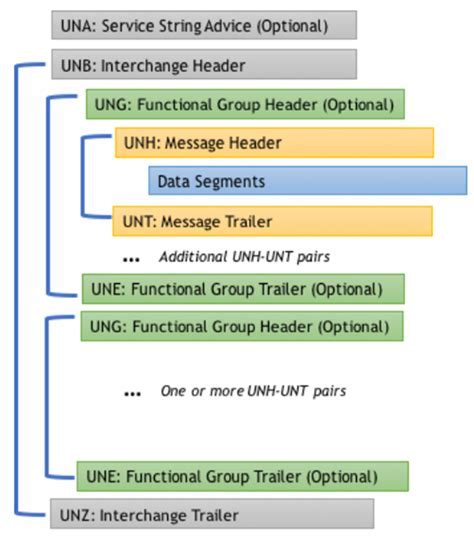
At the heart of EDIFACT’s architecture lies a meticulously layered hierarchy. Each interchange encapsulates one or more messages, which in turn comprise segments, composites, and elements. This granular design allows for precise data modeling and efficient validation. The Service String Advice (UNA) segment optionally initiates a message, specifying control characters for interpreting data separators, decimal marks, and segment terminators. When omitted, default characters are assumed, maintaining backward compatibility with older systems.
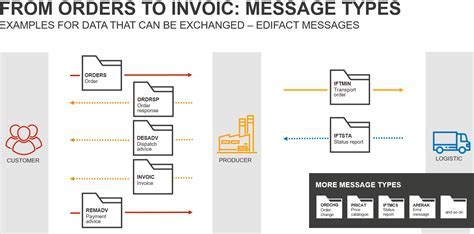
A typical EDIFACT transmission begins with the UNB (Interchange Header), a mandatory segment that identifies the sender, receiver, and syntax version. This is followed by optional segments like UNG (Functional Group Header), mandatory UNH (Message Header) segments, and data-specific segments encapsulated between UNT (Message Trailer) and UNZ (Interchange Trailer). Each message type, from invoices and shipping notices to flight availability requests, adheres to rigorously defined specifications published in the UN/EDIFACT Directories, ensuring structural integrity across implementations.
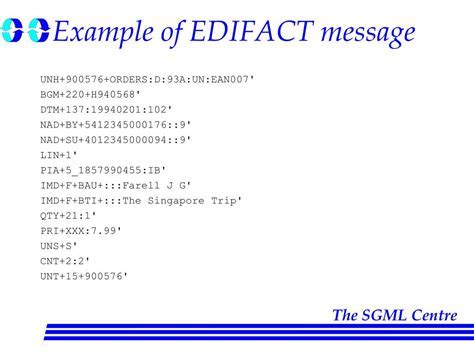
Consider the following EDIFACT message example, which responds to a flight ticket availability inquiry:
UNA:+.? '

UNB+IATB:1+6XPPC:ZZ+LHPPC:ZZ+940101:0950+1'

UNH+1+PAORES:93:1:IA'

IFT+3+XYZCOMPANY AVAILABILITY'

ERC+A7V:1:AMD'

IFT+3+NO MORE FLIGHTS'

TVL+240493:1000::1220+FRA+JFK+DL+400+C'

PDI++C:3+Y::3+F::1'

APD+74C:0:::6++++++6X'

TVL+240493:1740::2030+JFK+MIA+DL+081+C'

PDI++C:4'

APD+EM2:0:1630::6+++++++DA'

UNT+13+1'

UNZ+1+1'
Each line corresponds to a segment. For instance, UNH+1+PAORES:93:1:IA' defines the message header, indicating the use of message type PAORES (Passenger Airline Operations Reservation), version 93, and revision 1 by the International Air Transport Association (IATA). The segment IFT+3+NO MORE FLIGHTS' is a free-text field conveying that no flights are available. Lastly, UNT+13+1' and UNZ+1+1' serve as message and interchange trailers respectively, confirming segment counts and session boundaries.
What distinguishes EDIFACT is not only its rigid structure but also its adaptability. The use of conditional segments, denoted by C (e.g., C99), and mandatory segments, marked with M (e.g., M99), allows messages to scale in complexity based on contextual needs. For example, an invoice message might repeat tax or line item segments multiple times, as permitted by their repeat counts.
The EDIFACT standard also incorporates escape characters (release indicators) to allow otherwise reserved characters to appear as literal values in data payloads. This feature, analogous to backslashes in regular expressions, provides the flexibility needed when transmitting diverse alphanumeric content, particularly in internationalized contexts.
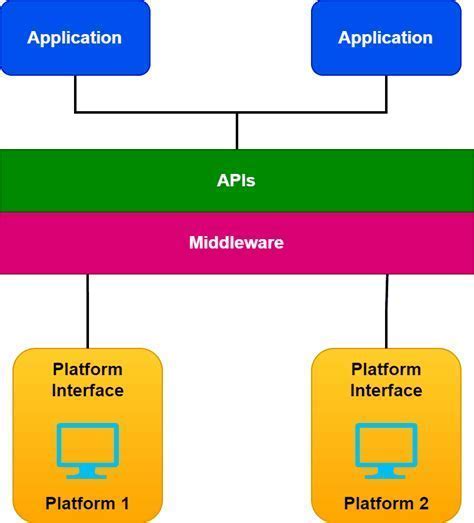
As technology evolved, the need to interface EDIFACT with modern systems prompted the emergence of XML/EDIFACT, a reformulation of the original format using Extensible Markup Language. XML-based schemas offer human readability and are easier to integrate with contemporary middleware, APIs, and web services. Furthermore, development tools such as Data Format Description Language (DFDL) schemas and JSON models have extended EDIFACT’s utility into modern IT ecosystems, fostering greater automation in logistics, customs, finance, and supply chain operations.
Oversight and development of the EDIFACT standard is handled by UN/CEFACT, specifically its TBG5 Finance Domain Working Group. This governance ensures the standard remains responsive to industry demands and regulatory changes. Each release of the EDIFACT directory, such as D.20B or D.22B, includes updated message definitions, code lists, and structural rules that reflect current business and legal requirements.
The global adoption of EDIFACT has spanned sectors and continents. In international trade, it underpins customs declarations, shipping instructions, and order processing across thousands of enterprises and governmental agencies. In aviation, it facilitates real-time passenger data exchange and operational coordination among carriers and travel service providers. In retail, it supports procurement, inventory, and invoicing processes at scale. Organizations implementing EDIFACT report significant reductions in manual data entry, transmission errors, and document processing time.
Nevertheless, EDIFACT is not without its challenges. Its steep learning curve, coupled with its syntax complexity, has often deterred smaller organizations from direct implementation. The reliance on legacy systems also poses hurdles when integrating with agile, cloud-native platforms. As such, intermediary services like EDI gateways, value-added networks (VANs), and integration hubs have proliferated, offering simplified onramps to the EDIFACT ecosystem.
Looking ahead, EDIFACT continues to evolve in tandem with digital transformation trends. Its fusion with technologies such as blockchain, machine learning, and event-driven architectures promises to further enhance the reliability, traceability, and intelligence of global data exchanges. While newer standards like JSON-LD and RESTful APIs gain traction, EDIFACT’s foundational role in regulated, high-volume B2B transactions ensures its relevance well into the future.
In conclusion, EDIFACT remains a robust, internationally endorsed framework that has transformed the way businesses communicate structured information. Its rigorous design, maintained by global governance, supports critical industries by ensuring interoperability, compliance, and operational efficiency. As digital economies continue to scale and diversify, EDIFACT’s principles of structured, standardized messaging endure as a cornerstone of modern e-commerce infrastructure.