In the quiet pre-dawn hours of March 9, 2026, a small aircraft with no known operator drifted into some of the most tightly controlled airspace in the United States. Within minutes, security forces at Barksdale Air Force Base in Louisiana escalated defensive measures, issued emergency alerts to personnel, and temporarily locked down sections of the installation. What might appear at first glance to be a stray drone incident quickly evolved into a serious strategic security event at one of the central hubs of the United States’ nuclear-capable bomber force.
The alert was triggered when base monitoring systems detected an unidentified unmanned aerial vehicle (UAV) flying over restricted airspace directly above the installation. Because Barksdale hosts the headquarters of Air Force Global Strike Command (AFGSC)—the command responsible for the nation’s strategic bombers and intercontinental ballistic missiles—the presence of any unauthorized aircraft immediately raises concerns about reconnaissance, surveillance, or potential targeting preparation.
Authorities reacted quickly. Base officials issued a shelter-in-place order to personnel shortly before 6:00 a.m., temporarily raising the installation’s threat posture to Force Protection Condition Charlie (FPCON Charlie), a security status used when intelligence or events indicate a possible terrorist action against military facilities or personnel.
Strategic Importance of Barksdale Air Force Base
To understand why a single drone could trigger such a serious response, one must appreciate the strategic role of Barksdale Air Force Base, located in Bossier Parish, Louisiana, near the city of Bossier City. The installation occupies more than 22,000 acres and houses one of the most critical command structures within the U.S. military’s strategic deterrence architecture.
Barksdale is the headquarters of Air Force Global Strike Command, the organization responsible for managing the United States’ nuclear-capable bomber fleet and land-based intercontinental ballistic missiles. From this command center, military planners coordinate the readiness and deployment of aircraft such as the B-52H Stratofortress and the stealth B-2 Spirit, while overseeing Minuteman III ICBM units spread across several American states.
The base also hosts the headquarters of the Eighth Air Force, often called the “Mighty Eighth,” which serves as the operational command responsible for bomber missions and strategic strike planning. This dual command presence effectively makes Barksdale a central node of American nuclear deterrence, where operational command, aircraft readiness, and strike planning converge.
Because of that concentration of strategic assets and command authority, the base has historically been viewed by defense planners as a high-value strategic target. Any unexplained intrusion into its airspace is therefore treated with immediate urgency.
Drone Detection and Immediate Security Measures
The unidentified drone was detected operating directly above restricted military airspace, an area where civilian drone flights are strictly prohibited due to the presence of strategic aircraft and sensitive command infrastructure. The detection prompted an immediate series of security protocols.
Personnel across the installation received text message alerts ordering them to remain indoors while security forces evaluated the situation. Entry to the base was temporarily restricted, and internal security procedures were activated while authorities attempted to determine the drone’s origin, intent, and trajectory.
The base’s security status was raised to FPCON Charlie, which indicates a situation where credible threats or suspicious incidents suggest potential hostile action. Under this posture, access control becomes stricter, patrols increase, and emergency response units move into heightened readiness.
Military authorities monitored the aircraft while attempting to assess whether the drone represented:
- Unintentional airspace violation by a civilian operator
- Navigation error by a commercial drone
- Deliberate reconnaissance or surveillance
- Potential hostile probing of base defenses
The drone’s operator remained unidentified during the initial response. Its final location after the sighting was not immediately confirmed.
Investigation and Coordination With Federal Authorities
Once the immediate threat was assessed as contained, the base lifted the shelter-in-place order and lowered the security alert level. However, the incident quickly transitioned from emergency response to federal investigation.
Officials confirmed that the Federal Aviation Administration (FAA) had been notified and was coordinating with the U.S. Air Force and local law enforcement authorities to determine the drone’s origin. Unauthorized drone operations over military installations are considered a criminal offense under U.S. federal law, potentially punishable by substantial fines and imprisonment.
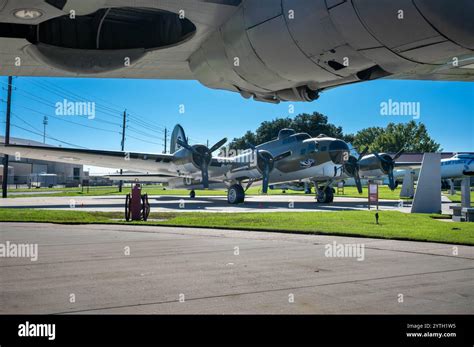
Incidents involving drones near military installations have become increasingly common in recent years as commercial UAV technology becomes cheaper and more accessible. However, incursions over sensitive strategic bases remain rare and highly scrutinized.
Security analysts treat such incidents seriously because even a small quadcopter can perform high-resolution surveillance, potentially capturing imagery of aircraft deployments, infrastructure layout, or security procedures. In the worst-case scenario, drones could also serve as test probes designed to measure response times or exploit weaknesses in air defense systems.
At present, authorities have not determined whether the Barksdale drone incident was accidental, reckless, or deliberate.
Rising Drone Concerns in the Age of Cheap UAV Technology
The Barksdale event illustrates a broader challenge confronting military forces worldwide: the rapid proliferation of small unmanned aerial systems capable of penetrating restricted airspace.
Only a decade ago, drone technology with advanced cameras, GPS navigation, and long-range control links was largely confined to military or industrial users. Today, commercially available drones costing a few hundred dollars can reach several kilometers in range and operate at altitudes high enough to cross military installations before detection.
For defense planners, the problem is not just technological—it is asymmetric. A relatively inexpensive consumer drone can potentially observe aircraft movements or infrastructure that costs billions of dollars to protect.
Military bases have responded by developing counter-UAS (counter-unmanned aerial system) defenses, which may include radar sensors designed to detect small aircraft, electronic jamming systems that disrupt control signals, and kinetic interception methods capable of disabling drones in flight.
Yet even the most advanced defense systems face a difficult reality: identifying and neutralizing a small drone in a crowded electromagnetic environment is far more complex than intercepting traditional aircraft.
A Strategic Base With Deep Historical Roots
The modern importance of Barksdale Air Force Base sits atop a long historical foundation that dates back to the early twentieth century. Construction of the installation began in 1931, following a municipal land acquisition program funded through a $1.5 million bond issue that enabled the purchase of land from more than 800 property owners.
The airfield began flight operations in November 1932 and was officially dedicated on February 2, 1933, under the name Barksdale Field. The base was named in honor of Lieutenant Eugene Hoy Barksdale, a World War I aviator who died in 1926 during a test flight accident involving a Douglas O-2 observation aircraft.
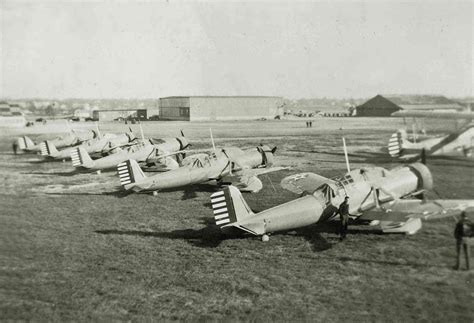
When the United States Air Force was established as an independent military branch in 1947, the installation was redesignated Barksdale Air Force Base in 1948. Over the following decades it evolved into one of the primary operational centers for America’s long-range bomber fleet.
Today the base supports more than 15,000 active-duty and reserve personnel, making it one of the largest military employers in the region.
The 2nd Bomb Wing and the B-52 Stratofortress
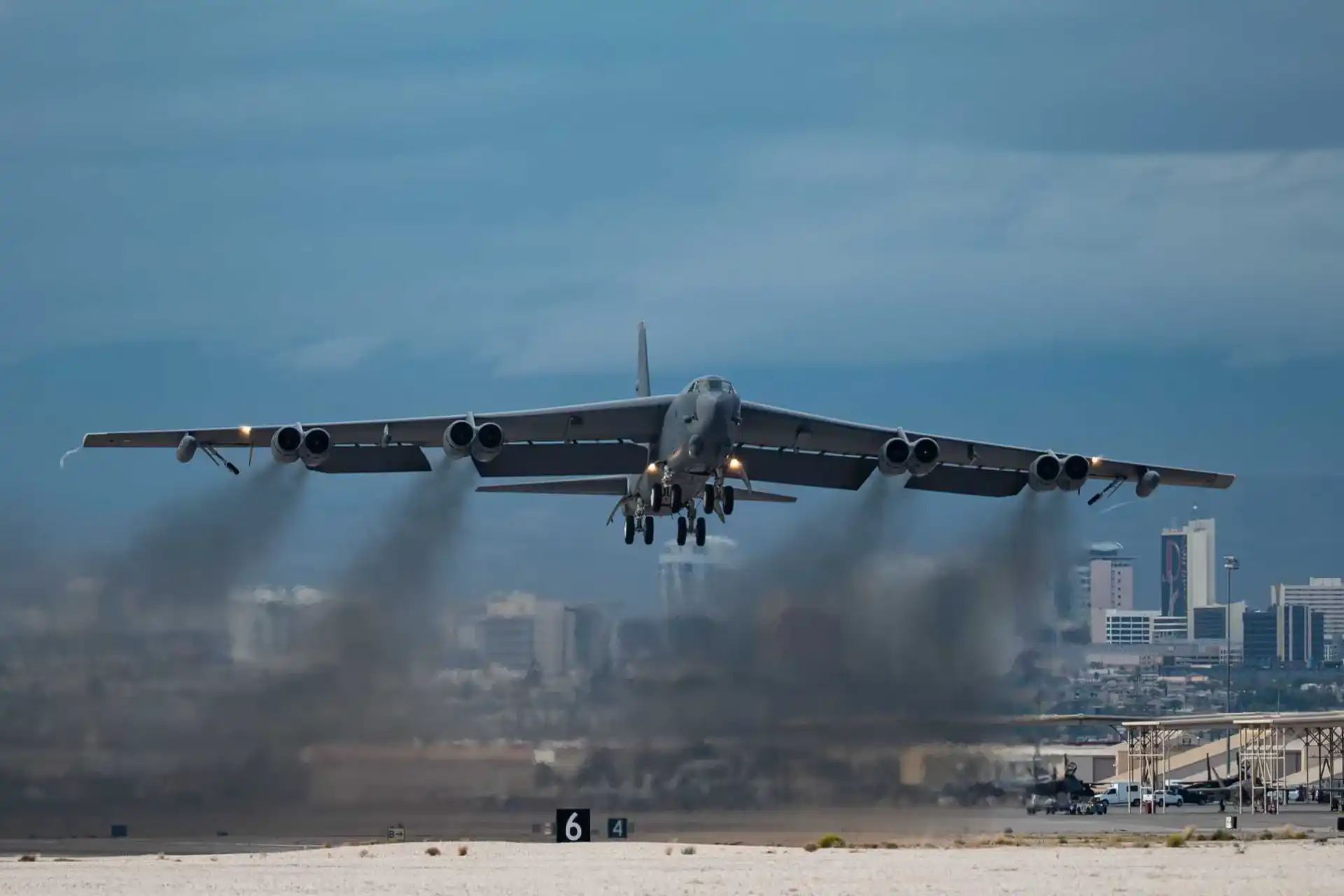
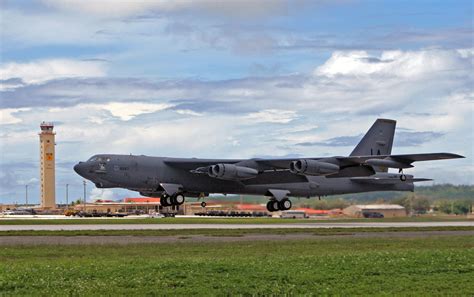
At the heart of Barksdale’s operational mission is the 2nd Bomb Wing, the host unit responsible for maintaining continuous bomber readiness. The wing operates approximately 44 B-52H Stratofortress aircraft, one of the most enduring and adaptable strategic bombers ever built.
Despite entering service in the early 1960s, the B-52 continues to serve as a backbone of the United States’ long-range strike capability thanks to continuous modernization programs. The aircraft is capable of flying at high subsonic speeds, reaching altitudes of 50,000 feet, and delivering a payload of up to 70,000 pounds of ordnance.
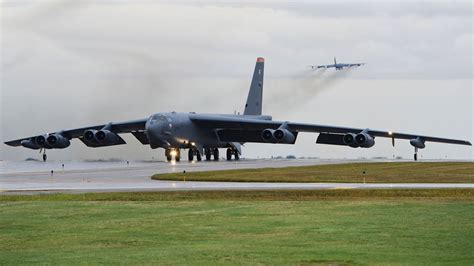
Its operational range without aerial refueling is approximately 8,800 miles, allowing it to reach targets across Europe, the Middle East, or Asia directly from the continental United States. When supported by aerial refueling tankers, the aircraft’s endurance becomes effectively global.
Within the 2nd Bomb Wing, operational flying units include the:
- 11th Bomb Squadron
- 20th Bomb Squadron
- 96th Bomb Squadron
These squadrons conduct training, operational planning, and readiness exercises designed to maintain constant global strike capability.
A Bomber Force With Global Reach
Barksdale-based bombers have repeatedly demonstrated their ability to project power across vast distances. One of the most famous examples occurred during Operation Desert Storm in January 1991, when B-52 bombers launched from Barksdale flew a 35-hour combat mission, firing conventional air-launched cruise missiles against Iraqi targets.
At the time, the sortie represented the longest combat mission in aviation history.
Since then, aircraft from the installation have deployed to forward bases such as Andersen Air Force Base in Guam and Diego Garcia in the Indian Ocean, enabling bomber operations across the Indo-Pacific and Middle East regions.
In the 1990s, Barksdale aircraft supported operations including Desert Strike and Desert Fox, targeting Iraqi air defense systems and military infrastructure.
In more recent years, long-range bomber forces have remained central to American power projection strategies. During a recent U.S. strike campaign against Iranian targets—reportedly involving more than 1,700 strikes in the first 72 hours—strategic bombers played a significant role. Officials have not confirmed whether Barksdale-based aircraft directly participated in those operations.
Strategic Tensions and the Context of the Drone Incident
The timing of the drone sighting adds another layer of intrigue. The incident occurred during a period of heightened geopolitical tension following Operation Epic Fury, a major U.S. and Israeli strike campaign against Iranian targets.
Iran has previously employed Shahed loitering drones and missile attacks against American installations in the Middle East. That context has inevitably drawn attention to the Barksdale intrusion.
Military officials, however, have emphasized that no confirmed link exists between the drone sighting in Louisiana and overseas conflicts.
Still, strategic planners tend to treat anomalies with caution. In a world where drones have become tools of reconnaissance, disruption, and warfare, even a brief aerial intrusion above a strategic bomber base becomes a puzzle demanding careful analysis.
Small machines sometimes reveal large truths. A single unidentified drone drifting above a strategic airfield can trigger a chain reaction of defense protocols, intelligence assessments, and geopolitical speculation—proof that in the modern era of warfare, the line between minor incident and strategic signal can be thinner than a drone’s carbon-fiber propeller.