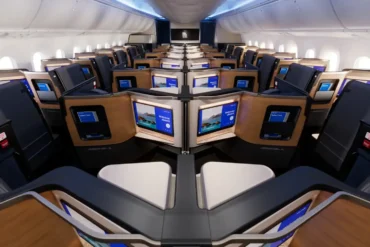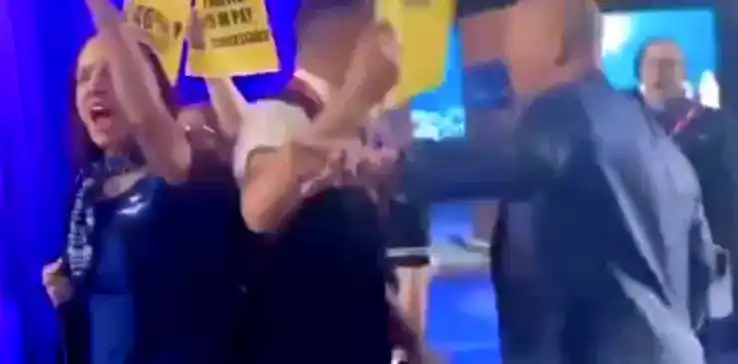
In a dramatic turn of events that underscores the growing tension between United Airlines and its flight attendant workforce, several crew members have been suspended following a disruptive protest at a company-sponsored media event in Brooklyn. The protest, which unfolded during the unveiling of United’s premium Polaris business class product, has drawn sharp scrutiny from both industry observers and labor advocates, highlighting the precarious balance between corporate branding and employee advocacy.
The incident occurred just before United executives took the stage. Roughly a dozen flight attendants entered the event without invitation, holding placards and chanting phrases like “If we don’t get it, shut it down.” Their message was unequivocal: United’s failure to deliver a new labor contract nearly four years after the previous one became amendable is no longer acceptable.
Security swiftly escorted the group out, but the aftermath has reverberated across the aviation sector. Industry insider @xJonNYC was among the first to report that the involved flight attendants had been removed from service pending an internal investigation, a claim that, though initially tentative, was later updated to “pretty confirmed” — an assessment given weight due to @xJonNYC’s consistent track record of insider accuracy.
Labor Frustrations Come to a Head
The protest reflects a culmination of mounting frustrations among United’s flight attendants. Despite public assurances from United CEO Scott Kirby, who has previously pledged an industry-leading contract, workers claim they remain underpaid relative to peers at other airlines. In stark contrast, American Airlines recently ratified a new deal with its flight attendants, increasing pressure on United to follow suit.
For United’s cabin crew, the delay is more than contractual—it’s symbolic. It speaks to a broader narrative of disenfranchisement and broken promises, a sentiment that unions such as the Association of Flight Attendants (AFA) have been voicing for months. The AFA has remained largely silent on the suspensions, but many within the union confirm the action was coordinated and intentional, with the understanding that civil disobedience might provoke disciplinary consequences.
Where Civil Disobedience Meets Corporate Control
The protest raises thorny questions about acceptable boundaries of labor activism within private companies. Civil disobedience has long been a staple of labor rights history, but critics argue that invading a corporate media event crosses a professional line. The disruption was not only a breach of decorum, but also a direct challenge to the company’s controlled public image — an image carefully curated during such media showcases.
Executives now face a difficult dilemma. On one hand, disciplinary action might seem justified from a managerial standpoint. Companies typically do not tolerate uninvited disruptions at sanctioned events, especially when media and stakeholders are present. On the other hand, terminating or severely punishing these flight attendants could inflame tensions further, worsening morale among thousands of frontline workers.
Legal and Contractual Grey Areas
The protest exists in a murky legal space. It was not a sanctioned strike and falls outside the bounds of legally protected labor action, meaning United may be within its rights to impose penalties. But legal doesn’t always mean wise. The National Labor Relations Board (NLRB) remains a looming presence, and should it determine that the suspensions constitute retaliation against protected organizing, the consequences for United could be severe.
Moreover, public perception now plays a significant role. In the age of social media, videos of the protest quickly spread online, where viewers were split between admiration for the attendants’ courage and condemnation of what some deemed “unprofessional behavior.” The polarized reaction reflects a deeper cultural divide over labor rights, corporate power, and the nature of civil protest in the workplace.
The Strategic Gamble of Disruption
From a tactical standpoint, the protest achieved its immediate goal: public attention. Few other platforms would have garnered the same media coverage or corporate visibility. By staging their protest at the exact moment United was celebrating a high-profile launch, the attendants forced executives and the public to confront the disparity between company image and internal reality.
But was the trade-off worth it? That remains to be seen. If suspensions turn into terminations, the union could view them as a declaration of war. If United softens its stance and quietly reinstates the workers, it may embolden further disruptions. Either path carries risk.
What’s clear is that labor discontent is boiling over in the airline industry. From Southwest to Delta, flight attendants across the nation are pushing harder for better pay, clearer work rules, and more consistent scheduling. United’s internal struggle is not an isolated incident — it is part of a broader labor reckoning in post-pandemic aviation.
United’s Crossroads: Flexing Power or Showing Restraint?
For CEO Scott Kirby and his leadership team, the next steps are critical. Executives must weigh the need to maintain corporate authority and event security against the longer-term consequences of escalating a confrontation with unionized labor. As one observer noted, “It’s not in management’s best interest to take extreme action here.”
United’s decision could either defuse or intensify tensions. A moderate approach — such as a brief suspension with no termination — might reaffirm authority without alienating the workforce. A heavy-handed response, however, risks setting off a chain reaction of unrest and public backlash.
The Bigger Picture: A Strained Relationship Exposed
Ultimately, this episode exposes a fragile labor-management relationship at United. The delays in contract ratification are symptomatic of deeper issues — a growing disconnect between executive priorities and frontline worker realities. While management focuses on product upgrades and investor confidence, flight attendants remain stuck in outdated agreements and rising cost-of-living concerns.
What the protestors did may have broken protocol, but it succeeded in shining a spotlight on a system that many feel is broken. The protest was not just a cry for a contract; it was an indictment of a corporate culture perceived to delay, deflect, and deny.
As the investigation proceeds and union lawyers prepare their defense, the aviation industry will be watching. So too will other labor groups, eager to see whether direct action still has a place in the heavily regulated world of modern air travel.
Conclusion: Consequences and the Path Forward
The suspension of United flight attendants following a disruptive media event protest is a flashpoint in a larger labor struggle. It forces critical reflection on how far employees can and should go in demanding fair treatment, and how employers should respond when the line between protest and insubordination is crossed.
There is no clear resolution yet. What is clear is this: the balance between employee advocacy and corporate control is more volatile than ever. How United responds will not only shape its own future labor relations but may also influence the playbook for airline unions across the country.