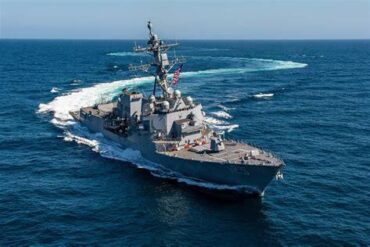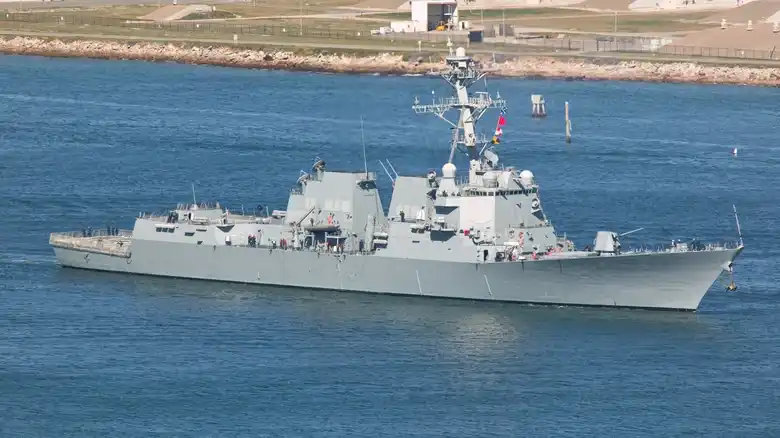
The U.S. Navy continues to expand its next-generation surface warfare fleet with the arrival of the USS Ted Stevens (DDG-128), one of the newest and most advanced Arleigh Burke-class guided missile destroyers ever built. Before its official commissioning ceremony later in 2026, the warship has already begun operating at sea, signaling a major milestone in the Navy’s ongoing modernization strategy focused on missile defense, radar superiority, and global naval dominance.
Built by Ingalls Shipbuilding in Pascagoula, Mississippi, the vessel recently departed the shipyard and started its transit toward Naval Station Norfolk in Virginia. Although the ship has not yet been formally commissioned into active naval service, this deployment-like movement highlights how close the destroyer is to becoming a fully operational combat platform within the U.S. fleet.
The USS Ted Stevens represents the newest evolution of the legendary Arleigh Burke destroyer line, a class that has formed the backbone of American naval power for decades. Unlike earlier variants, however, this ship belongs to the elite Flight III configuration, a heavily upgraded generation designed to counter increasingly sophisticated missile threats from rival powers including China and Russia.
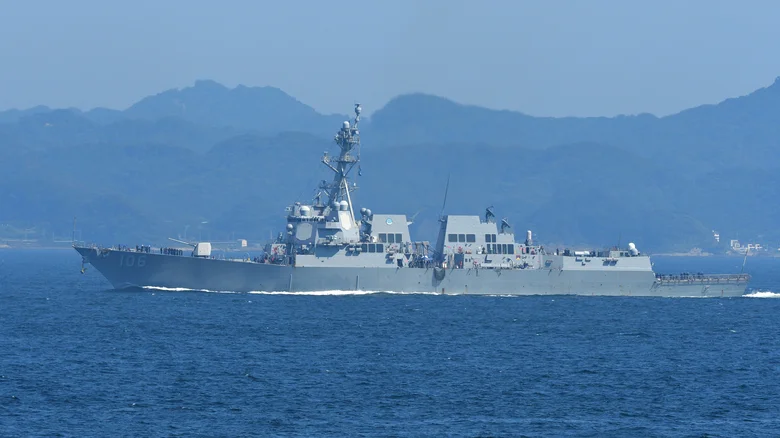
USS Ted Stevens Marks A New Era For Flight III Destroyers
The upcoming commissioning of the USS Ted Stevens is especially significant because it will become only the second Flight III Arleigh Burke-class destroyer officially placed into service by the U.S. Navy. The first ship in this category, the USS Jack H. Lucas (DDG-125), entered service in 2023 and introduced a new level of combat capability for the destroyer fleet.
Flight III destroyers are not simple upgrades of older vessels. They were engineered to support dramatically more powerful radar systems, enhanced electrical generation capacity, and advanced battle management technologies intended for future high-intensity warfare scenarios. The U.S. Navy sees these ships as critical assets for ballistic missile defense operations and long-range maritime surveillance.
The destroyer is named after Ted Stevens, the longtime U.S. Senator from Alaska who served for more than four decades and became one of the state’s most influential political figures. In recognition of his legacy, the commissioning ceremony is planned for Whittier, Alaska, making the event historically unusual. Alaska rarely hosts Navy ship commissionings, with the last major ceremony occurring in 2013 for the USS Anchorage.
Advanced Radar Technology Gives The Destroyer Exceptional Reach
Perhaps the most important feature aboard the USS Ted Stevens is the installation of the AN/SPY-6(V)1 Air and Missile Defense Radar, considered the most advanced radar ever deployed on an American surface combatant.
This radar system fundamentally changes the ship’s battlefield awareness. Compared with older SPY-series radars, the SPY-6 offers dramatically improved sensitivity and tracking range, enabling operators to detect smaller targets at greater distances while simultaneously monitoring ballistic missiles, aircraft, drones, and hostile ships.
The radar’s enhanced capability also strengthens the Navy’s integrated missile defense network, allowing Flight III destroyers to operate as major command-and-control nodes during large-scale naval operations. In modern maritime warfare, where reaction time can determine survival, the ability to identify and track threats earlier provides an enormous tactical advantage.
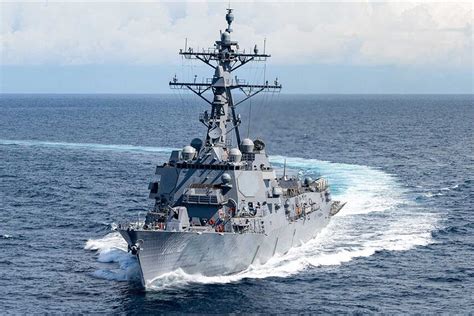
Massive Power And Heavy Weapons Define The USS Ted Stevens
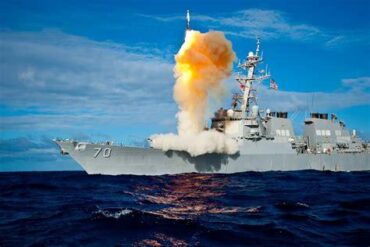
The USS Ted Stevens was designed not only for advanced detection capabilities but also for overwhelming offensive and defensive firepower. Fully loaded, the ship displaces approximately 9,496 long tons, placing it among the most formidable destroyers currently operating anywhere in the world.
The vessel measures roughly 509 feet in length, with a beam width of 66 feet. Propulsion comes from four powerful General Electric LM2500 gas turbines, collectively generating enough power to push the ship to speeds exceeding 31 knots.
Like other Arleigh Burke-class destroyers, the USS Ted Stevens carries a wide arsenal that includes:
- Guided missile systems
- Torpedoes
- Naval guns
- Close-in defensive weapons
- Machine guns for short-range protection
Its versatility allows it to conduct anti-air warfare, anti-submarine operations, missile interception missions, and surface combat engagements simultaneously.
The U.S. Navy Continues Expanding Its Next-Generation Fleet
The USS Ted Stevens is only one part of a broader naval expansion program centered around the Flight III destroyer platform. Several additional ships are already under construction at both Huntington Ingalls Industries and Bath Iron Works, including the USS Patrick Gallagher, USS Louis H. Wilson Jr., and USS Jeremiah Denton.
As geopolitical tensions continue rising across the Indo-Pacific and other contested maritime regions, the U.S. Navy is accelerating efforts to field more technologically advanced warships capable of surviving future missile-heavy conflicts.
The USS Ted Stevens now sails toward its final preparations before commissioning, but its journey already reflects the Navy’s larger strategic transformation. Equipped with next-generation radar systems, heavy missile armament, and enhanced combat survivability, the destroyer symbolizes the future of American naval warfare and the continued evolution of one of the world’s most respected warship classes.