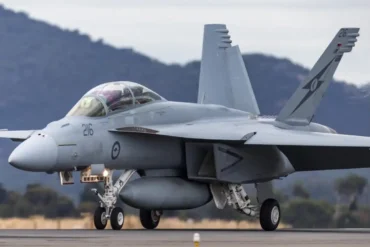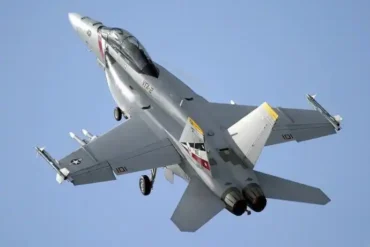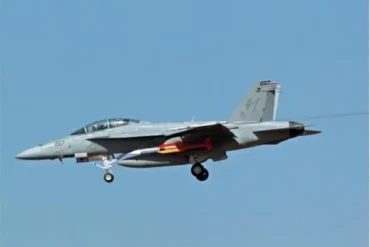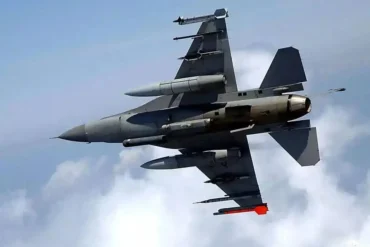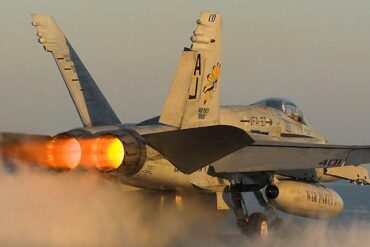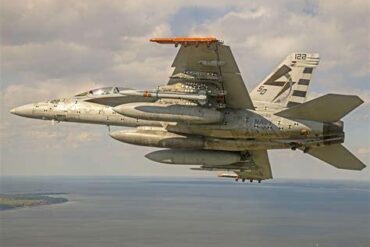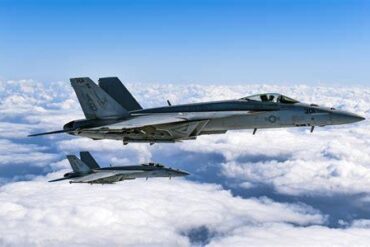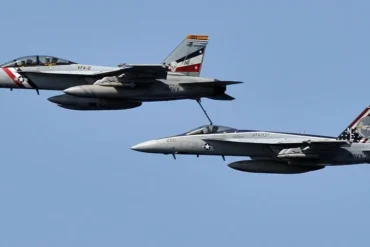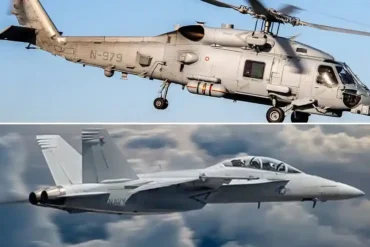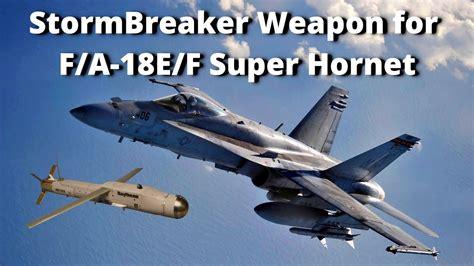
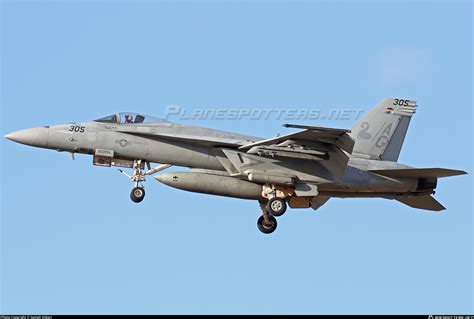
The United States Navy has formally cleared the Raytheon StormBreaker smart weapon for operational deployment aboard the F/A-18E/F Super Hornet, marking a decisive leap in carrier-based strike capability. After years of development, rigorous evaluation, and hundreds of millions of dollars in investment, the approval signals more than bureaucratic completion. It represents the arrival of a precision-guided munition designed to eliminate the battlefield’s oldest advantage: concealment.
For decades, adverse weather and low visibility have been the tactical refuge of adversaries. Heavy rain, dense fog, darkness, or battlefield smoke often limited conventional targeting systems dependent on clear visual or laser lock. The StormBreaker disrupts that equation. With its integration, Navy Super Hornet squadrons can now engage both moving and stationary targets, across land and sea, regardless of environmental conditions. This capability fundamentally reshapes operational planning for naval aviators.
The weapon’s approval follows a rapid developmental surge. In September 2025, the StormBreaker transitioned from prototype to test-ready configuration in just 50 days, a remarkable acceleration in modern defense acquisition timelines. By early 2026, operational certification was secured, underscoring the Navy’s confidence in its reliability and combat utility.
StormBreaker’s Tri-Mode Guidance: Precision Beyond Line of Sight
The defining feature of the StormBreaker bomb is its tri-mode seeker system, a layered targeting architecture that fuses three independent guidance technologies into a unified processing core. It employs:
- Millimeter wave radar for all-weather detection and tracking
- Imaging infrared (IIR) for thermal target identification
- Semi-active laser guidance for precision engagement when designated
Each sensor feeds data into a shared onboard processor capable of classifying and tracking targets in real time. If heavy clouds obscure visual cues, radar maintains lock. If radar reflections degrade, infrared imaging steps forward. The system adapts dynamically, reducing dependency on any single sensor channel.
This multi-spectral fusion allows engagement of moving vehicles, maritime threats, or fortified ground positions, even when traditional line-of-sight targeting fails. In operational terms, it closes a vulnerability that adversaries have exploited for years: maneuvering under cover of poor weather.
Extended Stand-Off Range and Tactical Efficiency
The StormBreaker’s reach extends beyond 45 miles, giving Super Hornet pilots meaningful stand-off distance from hostile air defenses. Every additional mile of separation reduces exposure to surface-to-air missile systems and radar-guided threats. That range advantage translates directly into survivability.
Its relatively compact size offers another strategic dividend. Compared to larger precision munitions, the StormBreaker’s form factor enables aircraft to carry multiple units per sortie. More weapons per jet mean fewer aircraft required to neutralize equivalent target sets. In carrier aviation, where deck space, sortie cycles, and logistics are meticulously calculated, efficiency is power.
The weapon first flew aboard the Super Hornet in 2023 and has since demonstrated consistent performance during evaluation phases. It is already cleared for the F-15E Strike Eagle and is undergoing adaptation for all variants of the F-35 Joint Strike Fighter, signaling its role as a standard component in future U.S. tactical airpower.
The Cost of All-Weather Dominance
Advanced capability carries measurable cost. A 2023 procurement order valued at $320 million for 1,500 units places the per-unit price at just over $213,000 per bomb. While substantial, defense planners argue the investment is proportional to the operational gap it fills. When adversaries exploit cloud cover or visual obstructions to evade attack, the inability to respond carries strategic consequences far exceeding unit cost.
By officially approving the StormBreaker for fleet use, the U.S. Navy has reinforced its commitment to maintaining precision strike superiority in contested environments. The battlefield is increasingly complex, layered with electronic warfare, advanced air defenses, and unpredictable weather. The StormBreaker does not eliminate that complexity, but it narrows the uncertainty window. In modern naval warfare, that margin can determine the outcome long before opposing forces ever see one another.