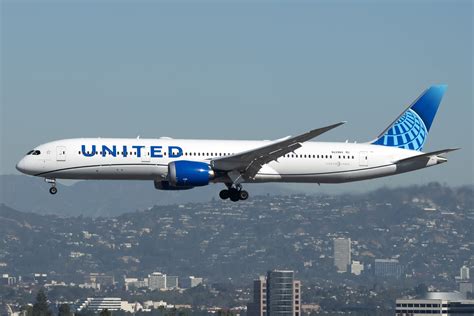
United Airlines has transformed its Boeing 787 Dreamliner fleet into one of the most powerful long-haul networks in commercial aviation. With 89 Dreamliners in service, the airline operates one of the world’s most diverse 787 fleets, including the 787-8, 787-9, and 787-10 variants. This capability allows United to connect the United States with some of the most distant destinations on Earth, including routes that push beyond 17 hours of nonstop flying.
The airline’s Dreamliner fleet includes 56 Boeing 787-9s, 21 Boeing 787-10s, and 12 Boeing 787-8s, making United one of only three airlines globally operating every version of the aircraft family. The average age of the fleet is approximately 7.2 years, giving the carrier a modern widebody platform designed specifically for long-distance international travel.
United’s longest Boeing 787 routes are not simply about distance. They represent a combination of aircraft efficiency, passenger demand, strategic airport positioning, and the airline’s effort to expand its global reach.
United Airlines’ 13 Longest Boeing 787 Routes Ranked by Flight Time
To identify United’s longest Dreamliner services, maximum block time is used as the measurement standard. Block time covers the complete gate-to-gate journey, including taxiing, airborne travel, and scheduled operational allowances.
The analysis of United’s Boeing 787 operations between August 2026 and March 2027 reveals several ultra-long-haul missions. Some include one-stop services where the same flight number continues through a connecting airport, while others are nonstop routes lasting well beyond the traditional long-haul category.
The longest Boeing 787 operation in United’s network is the Los Angeles to Bangkok service via Hong Kong, reaching an extraordinary maximum block time of 21 hours and 40 minutes. Operated daily by a Boeing 787-9, the route represents one of the most complex long-distance operations in the airline industry.
The second-longest service is also operated from Los Angeles. The Los Angeles to Ho Chi Minh City route via Hong Kong reaches up to 20 hours and 45 minutes and uses the same Boeing 787-9 aircraft type. United returned to both Bangkok and Ho Chi Minh City markets in 2025, using Hong Kong as a strategic stopover point.
The complete ranking includes:
- Los Angeles – Bangkok via Hong Kong: 21 hours 40 minutes, Boeing 787-9
- Los Angeles – Ho Chi Minh City via Hong Kong: 20 hours 45 minutes, Boeing 787-9
- San Francisco – Singapore: 17 hours 40 minutes, Boeing 787-9
- Houston – Sydney: 17 hours 35 minutes, Boeing 787-9
- Delhi – Newark: 17 hours 05 minutes, Boeing 787-9
- Johannesburg – Newark: 16 hours 25 minutes, Boeing 787-9
- San Francisco – Adelaide: 16 hours 20 minutes, Boeing 787-9
- Cape Town – Washington Dulles: 16 hours 05 minutes, Boeing 787-9
- Cape Town – Newark: 16 hours 00 minutes, Boeing 787-9
- Los Angeles – Melbourne: 16 hours 55 minutes, Boeing 787-9
- San Francisco – Melbourne: 15 hours 55 minutes, Boeing 787-9
- Newark – Seoul Incheon: 15 hours 55 minutes, Boeing 787-9
- Los Angeles – Sydney: 15 hours 30 minutes, Boeing 787-9
Although several routes sit close to the 16-hour ultra-long-haul threshold, United’s network demonstrates how the Dreamliner has changed what airlines consider commercially possible.
Boeing 787-9: The Aircraft Behind United’s Longest Flights
The majority of United’s longest routes rely on the Boeing 787-9 Dreamliner, which has become the backbone of the airline’s international expansion strategy. The aircraft offers an ideal balance between range, fuel efficiency, and passenger capacity.
Unlike earlier generations of large widebody aircraft, the 787 family was designed for long missions with lower operating costs. Its lightweight composite structure, efficient engines, and improved cabin environment allow airlines to operate routes that previously required larger aircraft or additional stops.
The 787-9 provides enough range to connect cities separated by thousands of miles while maintaining strong economic performance. This flexibility is especially valuable for routes such as San Francisco to Singapore, Houston to Sydney, and Newark to Delhi, where passenger demand exists but frequency must be carefully managed.
United’s Return to Bangkok and Ho Chi Minh City Through Hong Kong
United’s decision to restore service to Bangkok and Ho Chi Minh City was a strategic move designed to capture growing demand between North America and Southeast Asia.
The airline previously served Bangkok until 2014, while flights to Ho Chi Minh City operated through Hong Kong until 2016. Instead of launching entirely new nonstop ultra-long-haul routes from the United States, United chose to extend existing Hong Kong operations.
This approach reduced financial risk while allowing the airline to test demand in two important Southeast Asian markets. By using Hong Kong as a connecting point, United could provide access to Bangkok and Ho Chi Minh City without committing immediately to dedicated nonstop services.
The strategy also improved the performance of United’s Los Angeles-Hong Kong route. Before the extensions began, the airline’s load factor on the Los Angeles-Hong Kong market was only 63.4% during the 12 months ending September 2025.
After Bangkok and Ho Chi Minh City flights began, performance improved significantly. By November 2025, the route’s load factor increased to 85.5%, while March 2026 figures showed an increase to 95.4%.
The results suggest that adding Southeast Asian destinations helped United attract additional passengers without increasing available seat capacity on the Los Angeles-Hong Kong segment.
Ultra-Long-Haul Flying Becomes a Core United Strategy
United Airlines has increasingly focused on building a global network that connects major cities without relying exclusively on traditional hubs. The Boeing 787 has made this possible by allowing the airline to operate long-distance routes with smaller aircraft and more manageable passenger volumes.
Routes such as San Francisco to Singapore, Los Angeles to Sydney, and Cape Town to Washington Dulles demonstrate the airline’s commitment to serving niche international markets. These flights may not always carry the same passenger volume as major transatlantic routes, but they provide valuable connectivity and premium travel opportunities.
The airline’s expanding Dreamliner network also reflects a broader industry trend. Modern widebody aircraft are enabling carriers to open routes that were once considered impractical because of fuel costs or aircraft limitations.
With more than a dozen Boeing 787 routes approaching or exceeding 16 hours of travel time, United has established itself as one of the world leaders in ultra-long-haul operations.
The Future of United’s Longest Boeing 787 Flights
United’s Boeing 787 network shows how aviation is moving toward longer, more direct international connections. The Dreamliner’s efficiency allows airlines to serve destinations based on passenger demand rather than traditional aircraft limitations.
As global travel continues recovering and international markets expand, United’s longest routes could become an increasingly important part of its business strategy. The airline’s ability to combine advanced aircraft technology with carefully selected destinations positions its Boeing 787 fleet as a central element of its worldwide expansion.
The era of 20-hour commercial journeys is no longer a distant possibility. United Airlines is already operating them, proving that the modern Dreamliner has changed the definition of long-distance air travel.