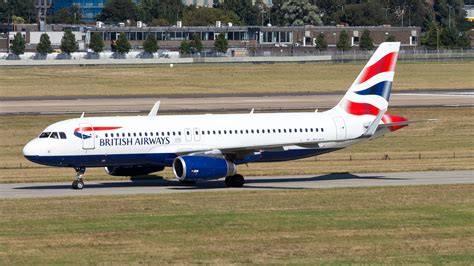
A British Airways Airbus A320 came close to a serious aviation incident during an approach to London Heathrow Airport after an air data system failure triggered stall warnings and forced the aircraft into a degraded flight control mode. The event, which involved flight BA919 from Düsseldorf Airport, has been classified as a serious incident by the UK Air Accidents Investigation Branch (AAIB).
The incident occurred on July 6, 2026, while the aircraft, an Airbus A320-232 registered G-EUUN, was preparing to land on Heathrow’s Runway 27L. Although the aircraft eventually landed safely and no injuries were reported, investigators are examining how the technical failure developed and how the flight crew responded during a demanding approach sequence.

British Airways Flight Declared Emergency After Air Data Reference Failure
According to preliminary information released by the AAIB, the aircraft suffered an Air Data Reference (ADR) failure during its initial approach. The ADR system plays a critical role in modern aircraft operations because it provides essential information including airspeed, altitude, and other flight parameters used by flight computers and cockpit displays.
The failure caused the Airbus A320’s flight control system to automatically transition from Normal Law to Alternate Law. Airbus aircraft rely on a sophisticated fly-by-wire system that uses different operating modes depending on aircraft conditions. Normal Law provides pilots with extensive protections against excessive pitch, bank angles, overspeed conditions, and aerodynamic stalls.
However, when an aircraft enters Alternate Law, some of these protections are reduced or removed. The aircraft remains controllable, but pilots must rely more heavily on their training, manual handling skills, and abnormal procedures.
Following the ADR failure, the aircraft generated a stall warning during the approach. The crew initially declared a PAN PAN, an internationally recognized urgency call indicating that the aircraft required priority assistance but was not yet in immediate danger.
The approach was discontinued, and the aircraft entered a holding pattern near Heathrow. This allowed the pilots additional time to evaluate the system failure, review procedures, and prepare for another attempt at landing.
Second Approach Triggered Stall Warning at 3,000 Feet
The most critical moment occurred during the subsequent approach. The AAIB stated that another stall warning activated when the aircraft was approximately 3,000 feet above ground level.
Investigators reported that the crew performed what was described as a “potentially abrupt recovery maneuver.” During this maneuver, the aircraft descended to approximately 2,200 feet before the pilots regained the intended instrument approach path.
At that point, the urgency level was increased from PAN PAN to MAYDAY, indicating a situation requiring immediate assistance from air traffic control.
Despite the challenging circumstances, the crew successfully stabilized the aircraft and completed a safe landing at Heathrow. No damage to the aircraft or injuries among passengers and crew were reported.
Captain Intervention Claims Remain Unverified
Following the incident, reports from The Sun suggested that the British Airways captain allegedly intervened after what unnamed sources described as a serious mistake by the first officer during the approach. The same reports claimed the aircraft came close to a possible “hull loss,” a term used in aviation to describe an aircraft being destroyed or damaged beyond economical repair.
However, these claims have not been confirmed by either the AAIB or British Airways. The official investigation has not assigned responsibility to any member of the flight crew and has not concluded that pilot error was the cause of the event.
The AAIB’s preliminary findings focus primarily on the technical failure and the operational response. Aviation investigations typically avoid determining blame at an early stage because investigators must examine multiple factors, including aircraft systems, procedures, training, environmental conditions, and crew decision-making.
It is also important to note that the presence of a stall warning does not necessarily mean the aircraft entered an aerodynamic stall. Investigators will need to determine whether the warnings accurately represented the aircraft’s flight condition or whether incorrect air data caused misleading indications.
Understanding the Role of Air Data Systems in Modern Aircraft
Air Data Reference systems are among the most important components of modern commercial aircraft. They process information collected from sensors such as pitot probes and static ports to calculate critical flight parameters.
These measurements influence numerous aircraft systems, including flight displays, autopilot functions, flight management computers, and flight control systems. If the aircraft receives unreliable air data, automated systems may respond by changing operating modes or issuing warnings to protect the aircraft.
The AAIB has not yet revealed whether the failure involved a single ADR unit or multiple air data sources. Determining the exact failure mechanism will be a major part of the investigation.
Modern aircraft are designed with redundancy, meaning multiple independent systems are available to prevent a single failure from becoming catastrophic. However, when pilots encounter conflicting information, they must quickly identify reliable sources of data while maintaining control of the aircraft.
AAIB Investigation Will Examine Crew Response and Aircraft Systems
The AAIB has opened a formal investigation into the British Airways A320 incident. A serious incident classification means that the event had the potential to become an accident but did not result in significant damage or casualties.
The purpose of such investigations is not to assign blame but to identify safety improvements that can reduce the likelihood of similar events occurring in the future.
Investigators are expected to analyze aircraft maintenance records, flight data recordings, cockpit voice recordings, air traffic control communications, and operational procedures. The final report will likely provide a detailed explanation of the ADR failure, the stall warnings, and the crew’s actions during the approach.
The incident highlights the complexity of modern aviation, where advanced automation and highly trained flight crews work together to manage unexpected situations. Even when a technical failure creates challenging conditions, proper procedures, crew coordination, and aircraft design features can prevent a serious event from becoming a disaster.
For British Airways and the wider aviation industry, the investigation will provide valuable lessons about air data failures, flight control law changes, and pilot decision-making during critical phases of flight.