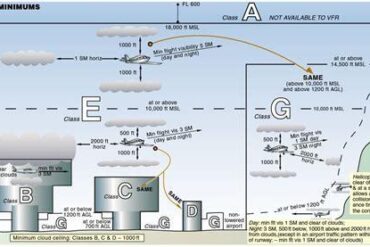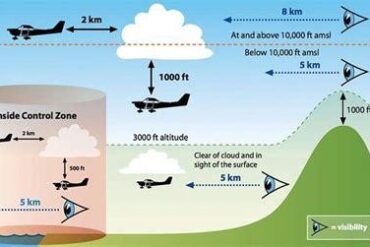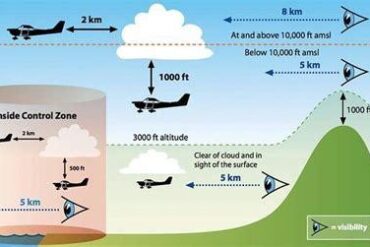
VFR over-the-top (VFR OTT) refers to flying above the cloud layer without visual ground references while following visual flight rules. This approach differs from VFR on Top, which is meant for IFR flights. It’s important to note that VFR OTT isn’t recognized as an ICAO procedure. According to Annex II: Rules of the Air, pilots must have the ground in sight when flying below 3,000 feet above mean sea level or 1,000 feet above terrain, whichever is higher, but only in airspace classes F and G.
In other situations, pilots are required to maintain a horizontal clearance of 1,500 meters and a vertical clearance of 300 feet from clouds. Some countries, like Canada and Germany, enforce stricter rules for VFR flights. For instance, Canada allows VFR OTT only if certain conditions are met: the aircraft must be at least 1,000 feet away from the clouds when flying between two layers, those layers must be at least 5,000 feet apart, and visibility should be at least five miles at cruising altitude. Additionally, the weather at the destination must not have broken or overcast clouds below 3,000 feet, and ground visibility should also be five miles or more with no thunderstorms or precipitation.
Flying above the clouds often presents better visibility and smoother conditions compared to flying below them. However, several important factors should be taken into account. For example, navigation based on ground features may become impossible. Eventually, the aircraft must descend through the clouds to land. If the clouds are positioned over the intended landing area, the flight could need to divert or take longer than planned.
Pilots might require extra fuel if the journey is extended or if they have to divert to an alternate airport. When planning to use a gap between clouds for descent, it’s crucial that this gap is at least 3 kilometers wide. Unfortunately, the available gaps may be smaller, and clouds can develop rapidly, affecting both their size and height. A pilot could find themselves in a situation where clouds rise higher than the aircraft can climb.
Moreover, using a gap to descend may lead to discovering that clouds extend all the way to the ground, making VFR flight below them impossible. Attempting to navigate through a gap without maintaining the required horizontal distance from the clouds increases collision risks. This clearance is essential for ensuring that pilots can see and avoid any IFR traffic emerging from the clouds. If there is no safe way to descend below the clouds, the aircraft may have to enter instrument meteorological conditions (IMC), which can be particularly challenging for pilots lacking an IFR rating.