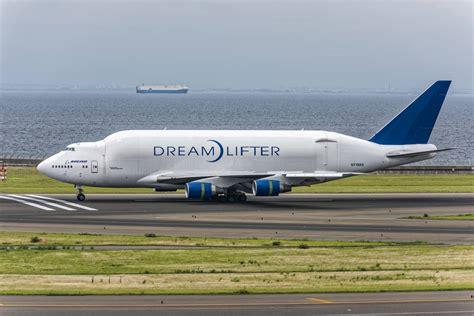
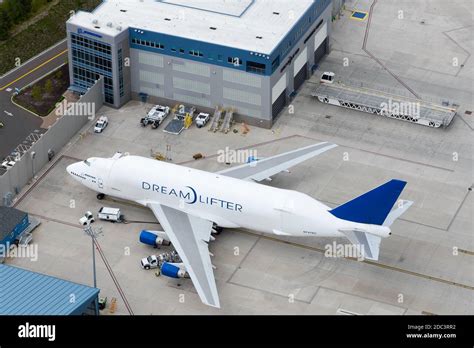
The Boeing Dreamlifter is one of the most unusual aircraft ever built. At first glance, it looks like someone inflated the upper half of a Boeing 747, turning the already massive jet into something resembling an airborne cargo whale. But that bizarre silhouette hides a very practical mission. Officially called the Boeing 747-400 Large Cargo Freighter (LCF), the Dreamlifter exists for one purpose: moving enormous aircraft components across continents faster than ships ever could.
Unlike conventional cargo aircraft designed to haul pallets or containers, the Dreamlifter specializes in transporting oversized aerospace structures. Entire fuselage barrels, wing assemblies, and composite structures for the Boeing 787 Dreamliner can be loaded inside its cavernous fuselage. With only four aircraft in existence, every flight the Dreamlifter makes carries enormous logistical importance for Boeing’s global production system.
Today, the movements of these four aircraft reveal a fascinating story about how modern aerospace manufacturing actually works. Boeing’s supply chain stretches across the United States, Japan, and Europe, and the Dreamlifter network quietly stitches these distant factories together. Tracking their routes shows a surprisingly structured pattern, with a handful of airports serving as critical nodes in one of the most specialized logistics systems in aviation.
The Origins Of The Boeing Dreamlifter
The Dreamlifter program began in the mid-2000s during the early development of the Boeing 787 Dreamliner. Boeing had made a bold decision: instead of building every component in one place, major parts of the aircraft would be manufactured by suppliers around the world.
Gigantic composite fuselage sections were produced in Japan, wing components came from Italy, and other major assemblies were built across the United States. This distributed manufacturing strategy promised efficiency but created a logistical nightmare. Many of the parts were simply too large to ship efficiently by sea if production schedules were to remain tight.
Boeing’s answer was radical: convert older Boeing 747-400 passenger aircraft into giant cargo carriers capable of swallowing entire aircraft sections.
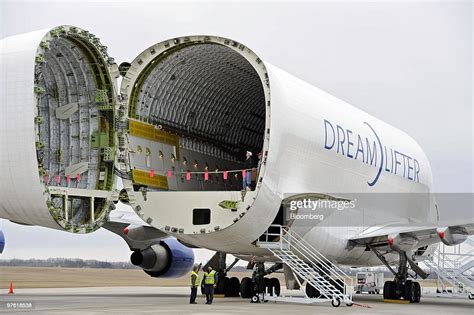
The transformation was dramatic. Engineers removed much of the original upper fuselage structure and replaced it with an enormous expanded cargo shell. The rear of the aircraft was redesigned with a swing-tail mechanism, allowing the entire aft section to pivot open so that oversized cargo could be loaded directly into the fuselage.
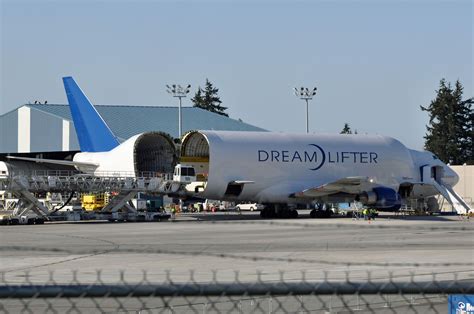
The result was an aircraft optimized not for weight but for volume. While other freighters might carry heavier loads, few can match the Dreamlifter’s ability to transport huge but lightweight aerospace structures.
Only four Dreamlifters were ultimately built. These aircraft remain operated by Atlas Air on behalf of Boeing, functioning almost like a private logistics fleet dedicated to the 787 program.
How Four Aircraft Power A Global Supply Chain
A fleet of just four aircraft might sound insignificant compared with the thousands of cargo planes flying worldwide. Yet in the context of Boeing’s production system, the Dreamlifters operate more like critical infrastructure than ordinary freight aircraft.
Each flight typically carries major aircraft components that would otherwise require weeks of shipping time by sea. By flying them directly between supplier facilities and assembly plants, the Dreamlifter compresses that timeline into hours instead of weeks.
This dramatically increases Boeing’s ability to adjust production schedules. If one supplier is delayed or if another factory suddenly needs additional components, the Dreamlifter network allows Boeing to rebalance its supply chain almost immediately.
That flexibility is essential in modern aircraft manufacturing, where the production of a single widebody jet involves millions of parts sourced globally. A delay in just one major structural component can stall an entire assembly line.
With such a small fleet, the aircraft often operate like a single coordinated system rather than four independent airplanes. When one aircraft enters maintenance, the remaining jets must rearrange their schedules to keep the supply chain flowing.
The routes they fly today reveal a surprisingly structured network spanning three continents.
Anchorage: The Pacific Gateway For Dreamlifter Flights
For flights crossing the Pacific Ocean, Ted Stevens Anchorage International Airport (ANC) plays a pivotal role in the Dreamlifter network. Located in Alaska, Anchorage has long served as a major cargo hub connecting North America and Asia, and its geography makes it ideal for long-range logistics flights.
Dreamlifters frequently operate routes linking Charleston International Airport (CHS) in South Carolina with Nagoya Airport (NGO) in Japan. These journeys are typically broken into two segments using Anchorage as a refueling and staging point.
A common routing pattern looks like this:
- Charleston (CHS) → Anchorage (ANC)
- Anchorage (ANC) → Nagoya (NGO)
- Return via the same route
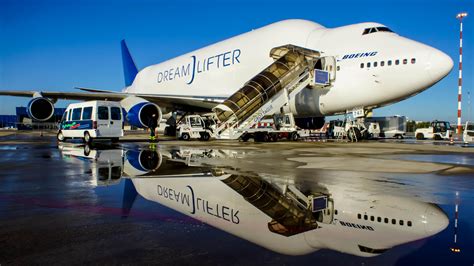
This routing structure serves several important operational purposes. The stop in Anchorage reduces the strain of extremely long transpacific flights while allowing crews to remain within duty limits. It also provides a highly capable cargo airport with excellent diversion options if weather or mechanical issues arise.
Flight tracking data frequently shows Dreamlifters rotating through these routes in sequence. One aircraft might depart Charleston while another heads west from Anchorage, creating a continuous pipeline of aircraft components moving between Japan and the United States.
Japan plays a particularly important role in the 787 program. Several Japanese aerospace companies manufacture critical composite fuselage and wing structures. The Dreamlifter effectively acts as an airborne conveyor belt connecting these factories to Boeing’s final assembly lines.
Charleston: The Operational Heart Of Dreamlifter Activity
While Anchorage is essential for long-distance flights, the true operational hub of the Dreamlifter network is Charleston International Airport in South Carolina.
Charleston hosts one of Boeing’s primary 787 final assembly facilities, making it the central point where components arriving from around the world are gathered before being integrated into completed aircraft.
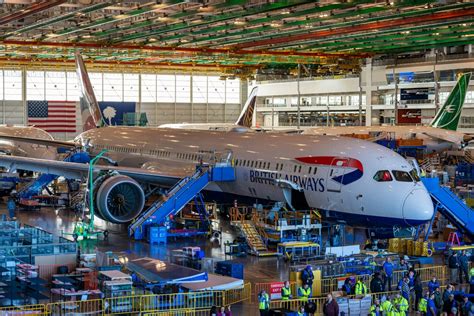
Flight activity shows that Dreamlifters regularly shuttle between Charleston and several domestic production sites. One of the most common routes connects Charleston with McConnell Air Force Base in Wichita, Kansas (IAB).
These flights are relatively short, typically lasting around two to two and a half hours, but they occur frequently enough to resemble scheduled cargo trucking routes. Massive aircraft sections arrive in Charleston, are staged temporarily, and then may be flown onward to other facilities depending on production needs.
The Dreamlifter’s schedule at Charleston often reflects the dynamic nature of aircraft manufacturing. One day an aircraft might arrive from Japan via Anchorage. The next morning, that same jet may depart for Wichita carrying different structural assemblies.
Another frequent connection involves Everett’s Paine Field (PAE) in Washington State, historically the primary Boeing widebody production site. Some flights link Charleston and Everett directly, while others include stops in Wichita to redistribute components between facilities.
This constant movement demonstrates how the Dreamlifter fleet functions as a rapid-response logistics system, constantly adapting to the needs of Boeing’s manufacturing ecosystem.
Everett And Wichita: Domestic Links In The Supply Chain
Although international flights attract the most attention, the Dreamlifter also performs an important role within the United States domestic manufacturing network.
Paine Field in Everett, Washington, remains one of Boeing’s most historically significant factories. While the 787 is primarily assembled in Charleston today, Everett still supports major aerospace production activities and occasionally requires Dreamliner components to be repositioned.
Meanwhile, Wichita serves as another critical node. The Kansas aviation hub hosts major aerospace suppliers that manufacture important structural elements and interior assemblies.
Flights between Charleston, Everett, and Wichita effectively keep these facilities synchronized. The Dreamlifter allows Boeing to shift components quickly when production plans change or when inventory imbalances appear.
Instead of waiting for slow maritime transport, entire aircraft sections can be repositioned across the country in just a few hours.
This flexibility helps Boeing avoid bottlenecks that might otherwise halt aircraft assembly lines costing millions of dollars per day in lost production.
European Missions: The Taranto Connection
While Japan and the United States form the backbone of the Dreamlifter network, Europe also appears regularly in the aircraft’s flight patterns. In particular, Taranto-Grottaglie Airport (TAR) in southern Italy frequently appears in Dreamlifter flight logs.
Taranto is home to a major Leonardo aerospace facility that manufactures composite fuselage sections for the Boeing 787. These enormous structures are precisely the type of cargo the Dreamlifter was designed to carry.
Flights between Charleston and Taranto typically take around 9 to 11 hours, making them some of the longest routes flown by the fleet.
Interestingly, not every Dreamlifter participates in the European route at the same time. Instead, Boeing appears to rotate aircraft between different missions depending on logistical priorities.
At any given moment:
- One Dreamlifter may be flying the Japan–United States corridor
- Another may shuttle between Charleston and domestic factories
- A third might operate the Italy–United States connection
This rotation allows Boeing and Atlas Air to maintain a high level of operational flexibility despite having only four aircraft available.
The fleet essentially acts as a specialized logistics task force, deploying wherever the supply chain most urgently requires capacity.
Why The Dreamlifter Remains Irreplaceable
Despite its age and extremely specialized design, the Dreamlifter continues to play an indispensable role in Boeing’s operations.
The aircraft solves a unique engineering problem: transporting structures that are too large for conventional cargo aircraft but relatively lightweight. Traditional freighters like the Boeing 747-8F or Antonov An-124 focus primarily on payload weight rather than internal cargo volume.
The Dreamlifter flips that equation. Its expanded fuselage provides a cargo hold measuring roughly three times the volume of a standard 747 freighter.
That enormous space allows it to carry:
- Full composite fuselage barrels
- Large wing assemblies
- Oversized structural components
- Specialized aerospace tooling
Few aircraft anywhere in the world are capable of transporting such cargo efficiently.
Airbus faced a similar challenge when developing the A350 program and chose to build the distinctive BelugaXL transport aircraft to move aircraft components between European factories. Boeing, however, opted to rely on its converted 747 fleet instead.
The Future Of The Dreamlifter Fleet
Looking ahead, the future of the Dreamlifter program depends largely on the long-term evolution of the Boeing 787 production system.
As long as major aircraft components continue to be manufactured across multiple continents, Boeing will need a fast method of transporting those structures between factories. The Dreamlifter fulfills that role perfectly.
However, the aircraft themselves are based on aging 747-400 airframes, meaning maintenance costs will gradually rise. Replacement parts may become harder to source as older 747 variants disappear from service worldwide.
At the same time, Boeing has periodically explored ways to simplify its supply chain, potentially reducing the need for constant intercontinental transport of aircraft sections.
If more components are produced closer to final assembly lines, the Dreamlifter might shift from a high-frequency shuttle aircraft to a more occasional strategic logistics asset used for surge operations.
For now, though, the fleet remains extremely active.
The Quiet Giants Behind Every Boeing 787
The Boeing Dreamlifter rarely attracts the same public attention as passenger aircraft or military transports, yet it plays an essential role in one of the most complex manufacturing systems on Earth.
With only four aircraft, this unusual fleet connects aerospace factories across Japan, Italy, and the United States, ensuring that massive aircraft components reach assembly lines precisely when they are needed.
Every time a Boeing 787 rolls out of the factory, chances are that at least several of its largest components once traveled across oceans inside the bulbous fuselage of a Dreamlifter.
From the busy runways of Charleston to the cargo ramps of Anchorage, the manufacturing hubs of Wichita, the factories of Everett, and the composite production lines in Taranto, these aircraft quietly stitch together the global aviation industry.
Their flights may look repetitive on a map, but each journey represents a carefully choreographed step in the construction of one of the world’s most advanced airliners.
The Dreamlifter may not carry passengers or headlines, yet without it, the modern Dreamliner production network would move far more slowly. In the intricate ballet of global aerospace logistics, these four peculiar aircraft remain indispensable giants of the sky.