The Geographic Advantage Behind Ocean Splashdowns
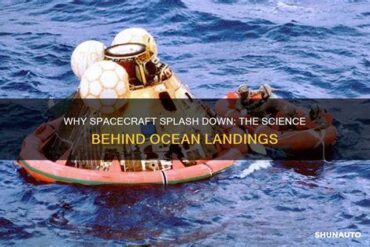
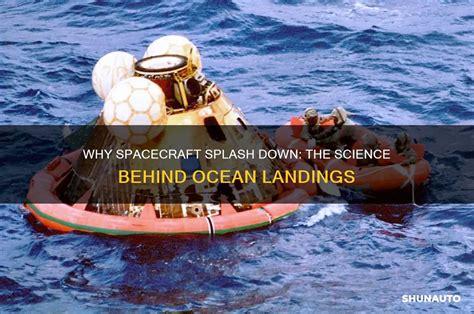
The defining reason American spacecraft land in the ocean is rooted in a simple yet decisive factor: geography. The United States is flanked by both the Atlantic and Pacific Oceans, providing vast, accessible, and relatively stable recovery zones. This geographic positioning allows NASA to design missions where spacecraft reenter Earth’s atmosphere and descend into open water, far from densely populated regions. The ocean acts as a natural buffer, minimizing risk to human life and infrastructure while offering a predictable and controlled landing environment.
From the earliest days of NASA’s Mercury and Apollo programs, engineers leveraged this advantage. Launch sites such as Cape Canaveral in Florida were strategically selected not only for their proximity to the equator but also for immediate access to open water. As a result, splashdowns became an integral part of American spaceflight design, shaping everything from capsule structure to recovery logistics.
Engineering for Water: How Splashdowns Work
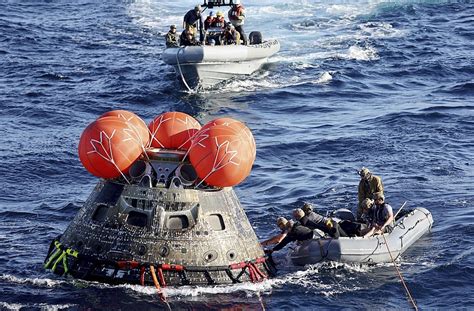
American spacecraft are specifically engineered to make ocean landings both safe and efficient. As they descend, parachutes deploy to drastically reduce velocity, but the final impact with the water still occurs at speeds around 80 feet per second. While that might sound intense, the ocean’s surface absorbs much of the force, acting as a dynamic cushion compared to rigid ground.
The recovery process is equally sophisticated. U.S. Navy vessels and specialized recovery teams are positioned in advance, ready to retrieve both the spacecraft and its crew within minutes. This coordinated effort ensures astronauts are quickly extracted and given medical evaluation, turning what could be a chaotic landing into a carefully choreographed operation.
Why Russian Spacecraft Avoid Water Landings
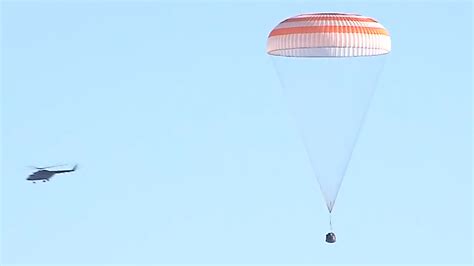
In contrast, Russian Soyuz spacecraft land on solid ground, and this choice is equally shaped by geography. Despite Russia’s extensive coastline, much of it borders the Arctic Ocean, where extreme cold, ice, and remote conditions make recovery operations dangerous and unpredictable. Instead, Russia utilizes its vast inland territories—particularly the open steppe regions of Kazakhstan—offering expansive, sparsely populated land for safe touchdowns.
This difference is not a matter of technological limitation but of environmental practicality. Launching from the Baikonur Cosmodrome, a landlocked facility, naturally leads to land-based recovery strategies. Over decades, Russia has refined this method into a reliable and repeatable system.
The Role of Retrorockets in Soyuz Landings
Landing on solid ground introduces a different engineering challenge: eliminating the harsh impact that would otherwise occur. To address this, Soyuz spacecraft are equipped with retrorockets that fire just moments before touchdown. These rockets reduce the descent speed to less than five feet per second, a dramatic slowdown compared to the velocity of American splashdowns.
Even with this technology, the experience remains physically demanding. Astronauts often describe the landing as abrupt and forceful. The capsule hits the ground with a noticeable jolt, reinforcing the need for robust internal seating and shock-absorbing systems.
Safety, Sensation, and Astronaut Experience
The contrast in landing styles also shapes the astronaut experience. Ocean splashdowns are often described as smoother and more forgiving, with the water providing a gradual deceleration. Crews frequently liken the sensation to an intense but controlled ride, emphasizing the balance between excitement and safety.
On the other hand, Soyuz landings are more abrupt, sometimes compared to a controlled crash. While entirely safe within design parameters, the difference is noticeable. This divergence highlights how engineering adapts not just to physics but to geography, infrastructure, and operational philosophy.
A Tale of Two Systems, One Goal
Ultimately, the reason American spacecraft land in the ocean while Russian ones do not is not about competition or ideology—it is about optimizing for local conditions. The United States capitalizes on its naval access and global maritime reach, while Russia leverages its expansive land resources and centralized launch infrastructure.
Both approaches are highly effective, refined through decades of innovation and experience. Whether descending into rolling waves or touching down on open plains, the goal remains identical: bringing astronauts home safely from the edge of space.