Modern jet aircraft depend on electricity more than ever before. From advanced avionics and fly-by-wire controls to cabin lighting, entertainment systems, climate control, and navigation equipment, virtually every aspect of a commercial airliner relies on a stable electrical supply. While many people are familiar with alternators because they are used in automobiles and smaller aircraft, large jets overwhelmingly rely on generators. The reason comes down to power requirements, operating conditions, efficiency, and reliability.
Understanding why jets use generators instead of alternators reveals just how sophisticated modern aircraft have become and why electrical power is one of the most critical systems onboard.
The Massive Electrical Demands of Modern Jets
A commercial jet is essentially a flying electrical network. Aircraft such as the Boeing 787 Dreamliner contain dozens of interconnected systems that continuously consume electricity throughout every phase of flight. Passenger cabins require lighting, entertainment displays, communication systems, galley equipment, and charging ports. Behind the scenes, flight computers, navigation equipment, sensors, actuators, and monitoring systems operate around the clock.
The Boeing 787, for example, contains approximately 57 miles of electrical wiring distributed throughout the airframe. This extensive network feeds power to numerous electrical buses and substations that support critical aircraft operations.
Unlike a passenger car, where electrical requirements are relatively modest, a modern jet requires an enormous and continuous supply of electrical energy. Producing that level of power demands equipment specifically engineered for aviation environments, which is where aircraft generators excel.
After all, jet engines naturally create mechanical energy rather than electrical energy. A conversion system is required to transform the engine’s rotational force into usable electricity for onboard systems.
Understanding the Difference Between Generators and Alternators
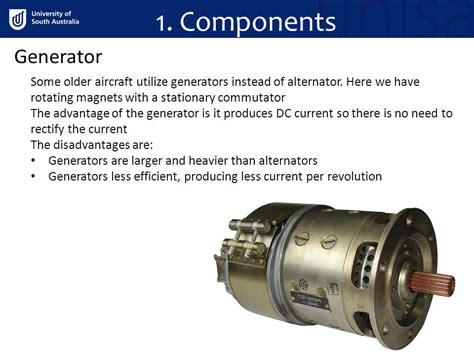
At first glance, generators and alternators appear similar because both convert mechanical energy into electrical energy. However, their design priorities and operating capabilities differ significantly.
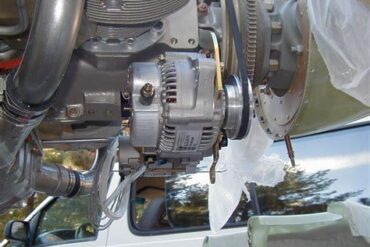
Alternators are extremely effective in automobiles and light aircraft because they are compact, lightweight, and efficient. They produce alternating current and perform exceptionally well under moderate electrical loads. For smaller piston-engine aircraft, alternators often provide more than enough electrical output.
Jet aircraft operate in a completely different category. Their electrical systems require substantially higher power levels, often delivered continuously for many hours. Under these demanding conditions, aviation generators offer advantages in durability, power generation capacity, and integration with turbine engines.
In practical terms, the question is not whether alternators are good technology. They certainly are. The issue is that the electrical appetite of a modern jet far exceeds what conventional alternator designs can comfortably support.
How Jet Engines Drive Aircraft Generators
One of the biggest reasons generators are preferred lies in the extraordinary operating speeds of jet engines.
The fan at the front of a turbofan engine may rotate between roughly 2,500 and 4,000 revolutions per minute. However, the engine core operates at dramatically higher speeds. In many modern engines, including those produced by Rolls-Royce and other major manufacturers, the high-pressure core can exceed 10,000 RPM.
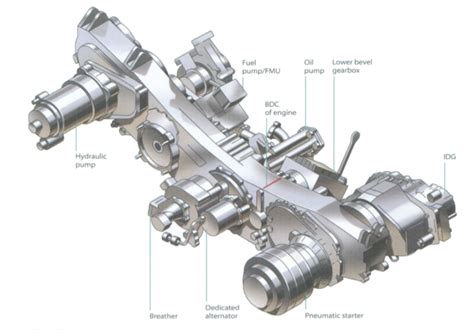
These extreme rotational speeds provide a tremendous source of mechanical power. Aircraft designers harness this energy through a component known as the accessory gearbox, often abbreviated as AGB.
The accessory gearbox acts as an intermediary between the engine and essential aircraft systems. It transfers rotational power from the engine core to drive various accessories, including fuel pumps, hydraulic pumps, and electrical generators.
Generators attached to the AGB are specifically engineered to withstand the demanding environment of turbine-powered flight. They must tolerate high rotational speeds, elevated temperatures, vibration, and continuous operation while maintaining exceptional reliability.
Why Alternators Are Not Practical for Large Jets
Theoretically, an alternator could be connected to a jet engine. In reality, doing so would create numerous engineering challenges.
Jet engines generate enormous amounts of mechanical energy that must be converted into electrical power efficiently and consistently. Conventional alternators are not optimized for the extreme speed ranges and power outputs required by large commercial aircraft.
Aircraft generators are purpose-built for these conditions. They incorporate advanced cooling systems, specialized materials, and robust construction techniques that enable them to operate under sustained high loads.
Another challenge involves power distribution. Large aircraft must transmit electricity across extensive wiring networks that span the fuselage, wings, tail section, cockpit, and cabin. Generators are designed to produce the stable, high-voltage electrical output necessary to support these complex systems without compromising reliability.
The scale of modern aviation simply pushes beyond the practical limits of the alternator designs commonly found in automobiles and smaller aircraft.
The Role of Multiple Generators in Aircraft Safety
Aviation safety depends heavily on redundancy. Critical systems are never allowed to rely on a single point of failure, and electrical power is no exception.
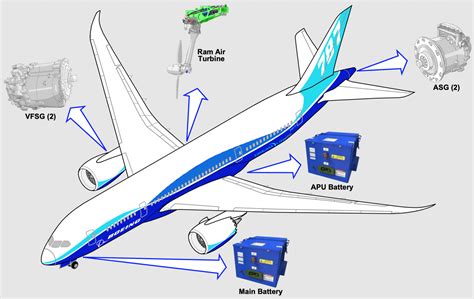
Most commercial aircraft employ multiple generators distributed throughout the aircraft’s electrical architecture. Engine-driven generators serve as the primary source of electricity during normal flight operations. If one generator fails, others can immediately assume the workload.
This layered design dramatically improves reliability and contributes to aviation’s remarkable safety record.
Electrical redundancy ensures that essential systems such as flight controls, navigation equipment, communication systems, and cockpit instruments remain operational even if a component experiences a malfunction.
Rather than depending on a single electrical source, modern aircraft maintain several independent power-generation pathways capable of supporting vital operations.
Auxiliary Power Units and Emergency Electrical Systems
Commercial jets are equipped with additional power sources beyond their main engine-driven generators.
One of the most important is the Auxiliary Power Unit, commonly known as the APU. This small turbine engine is usually located in the aircraft’s tail section and drives its own generator.
The APU serves several purposes. It provides electrical power while the aircraft is on the ground, powers systems during engine startup procedures, and acts as an important backup source if required during flight.
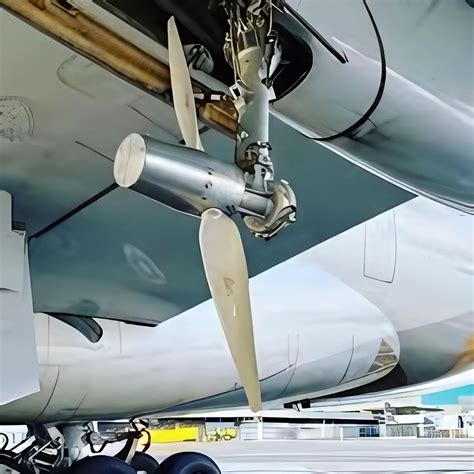
In the rare event of multiple electrical failures, aircraft have another remarkable backup system called the Ram Air Turbine, or RAT.
The RAT deploys into the airflow outside the aircraft and uses the force of the rushing air to generate emergency power. Although it cannot operate every onboard system, it supplies enough electricity to maintain critical flight functions and ensure safe aircraft control.
Why Aircraft Use 400 Hz Electrical Power
Another fascinating aspect of aircraft electrical systems is the frequency of the electricity they generate.
Most homes use alternating current at either 50 Hz or 60 Hz. Aircraft, however, typically operate on 115-volt, 400 Hz AC power.
This higher frequency provides major engineering advantages. Electrical components such as transformers, motors, and generators can be made significantly smaller and lighter while delivering the same performance.
Weight reduction is one of the most important goals in aircraft design. Every pound removed from an aircraft improves fuel efficiency, increases payload capability, and enhances overall operating economics.
By adopting 400 Hz electrical systems, aircraft manufacturers can reduce component size without sacrificing functionality, making the entire electrical infrastructure more efficient.
Conclusion
Jets use generators instead of alternators because modern aircraft require enormous amounts of reliable electrical power under extreme operating conditions. While alternators perform exceptionally well in cars and smaller aircraft, commercial jets demand far greater power output, durability, and system integration.
Driven by high-speed turbine engines through accessory gearboxes, aircraft generators convert massive amounts of mechanical energy into stable electrical power that supports everything from cockpit avionics to passenger entertainment systems. Combined with backup systems such as APUs and ram-air turbines, these generators form a highly redundant electrical network that helps make commercial aviation one of the safest forms of transportation in the world.
The choice of generators over alternators is ultimately a matter of scale. Modern airliners are electrically intensive machines, and generators provide the robust performance necessary to keep thousands of systems operating reliably at 37,000 feet.