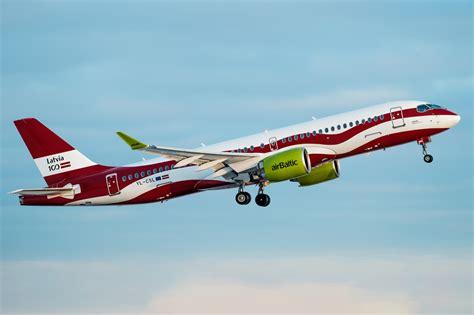
The Airbus A220 has captured the ears of aviation enthusiasts worldwide with an acoustic signature unlike anything else in the modern commercial fleet. The aircraft does not simply take off; it howls. This rising, undulating tone—often likened to the call of a whale—has become one of the most recognisable auditory quirks in contemporary aviation. We explain the aerodynamics, engineering decisions, and environmental control systems that create this unusual sound, and why it remains mostly exclusive to the A220 despite shared engine lineage with other aircraft.
The A220 began its life as the Bombardier CSeries before being absorbed into the Airbus family. While it fits neatly into Airbus’s narrowbody portfolio in terms of mission profile, the aircraft’s engineering DNA diverges significantly from the A320, A330, A350, and A380 families. The result is an airplane with unique systems architecture—most notably a cabin pressurization design that interacts with its engines and airflow in a way that produces the characteristic howl.
The aircraft earned attention for its acoustic footprint as early as 2018, when residents living near Zurich Airport lodged complaints about a strange, siren-like noise during takeoff. The irony is that the A220 is among the quietest aircraft in its category. Its Pratt & Whitney PW1500G geared turbofans produce far less fan noise than previous-generation engines, which makes a different sound—one usually buried under the roar of older turbofans—suddenly audible.
Why The A220 Doesn’t Sound Like Other PW GTF Aircraft
The A220’s engines are part of Pratt & Whitney’s GTF (geared turbofan) family, which also powers the Embraer E2 series and several Airbus A320neo variants. These engines all share the same fundamental efficiency-enhancing technology: a gearbox that allows the fan to rotate at a slower speed than the turbine. Yet only the A220 produces the unmistakable howling profile during takeoff.
The answer lies not in the core engine itself, but in how the A220 uses it.
The Role Of A Bleedless Architecture
Unlike many commercial aircraft, the A220 uses bleedless engines. Traditional engines extract hot, compressed air from the engine’s compressor stages to feed the cabin pressurization and air-conditioning systems. The A220’s design uses electric cabin air compressors (CACs) instead, located within the belly fairing. These independent compressors ingest outside air, pressurize it, and supply it to the environmental control system (ECS).
During takeoff—when ram air, airflow geometry, and compressor load are all shifting rapidly—these CACs create a resonant, flute-like tone as pressure fluctuates inside the ducting. Because the PW1500G’s fan is exceptionally quiet, this pressurization tone becomes the dominant noise source.
The Aerodynamic Interaction Behind The ‘Whale’ Howl
The howling sound is a product of airflow, pressure changes, and resonant duct acoustics. The tonal frequency typically falls between 400 and 800 Hz, rising sharply just after liftoff when the ECS packs switch to high flow.
What follows is a vivid example of aerodynamics intersecting with cabin environmental engineering. As airflow enters the belly-mounted scoop, the inlet geometry and lack of heavy acoustic damping allow vibrations to propagate through the ducts. Pratt & Whitney executives have likened the phenomenon to blowing air across the mouth of a bottle—the geometry sets the pitch, and changes in airflow modulate it.
This explains the rising-and-falling pattern that spotters describe as whale-like: the tone intensifies, peaks as the aircraft accelerates through its initial climb, and gradually fades as pressure stabilizes and the inlets modulate.
Why The Howl Is Quieter Or Absent On Other Aircraft
Aircraft such as the Embraer E2 or the Airbus A320neo use related GTF engines but produce no comparable howl. The reasons are rooted in airframe design, inlet architecture, and acoustic treatment.
Embraer’s Approach
The PW1900G-powered Embraer E2 does exhibit a hint of the same tone, but its magnitude is far smaller. Embraer designed its cabin air compressor system with more acoustic damping, softening the resonance that the A220 amplifies so clearly.
The A320neo’s NACA-Style Scoop
Airbus engineered the PW1100G-equipped A320neo using lessons learned from the early CSeries. Rather than the protruding scoop of the A220, the A320neo employs a flush NACA-style inlet on the lower fuselage that reduces turbulence and resonance. The ducting is heavier, more insulated, and inherently less prone to harmonic vibration.
Older aircraft, meanwhile, never reveal such tones because their engines are significantly louder. The howl, even if generated, would be drowned out by traditional fan and turbine noise.
The Sound As Experienced During A220 Takeoff
The most prominent phase of the howl occurs just after rotation, when airflow increases and the environmental control system demands high output. Pilots and passengers experience a brief rise in pitch that lasts roughly 10–20 seconds before tapering away. This transient acoustic event tells an engineer exactly what is happening: airflow is increasing, the CACs are ramping up, and the ECS inlet doors are modulating.
The phenomenon is not an indication of mechanical stress or engine strain. It is simply the audible byproduct of a quiet fan, a compact hull, and an energetic pressurization system.
How The A220’s Other Features Reinforce Its Distinctive Identity
While the ‘whale howl’ is the most famous quirk, the A220 possesses several other characteristics that set it apart visually and acoustically.
The aircraft’s engine diameter appears unusually large relative to its narrow fuselage. This is partly due to the geared turbofan’s wide fan diameter, but also because the fuselage itself is slim. This imbalance gives the A220 a slightly whimsical, oversized-engine look when viewed head-on.
Inside the cabin, the A220 bears resemblance to a scaled-down Boeing 787. It features:
- exceptionally large windows for a narrowbody aircraft,
- advanced climate control,
- increased cabin pressure for passenger comfort,
- spacious overhead bins,
- notably quiet cabin acoustics.
Passengers frequently remark that the interior experience feels more “long-haul” than “regional,” which has strengthened its appeal to operators crossing short- and medium-range markets.
Where The A220 Flies Today
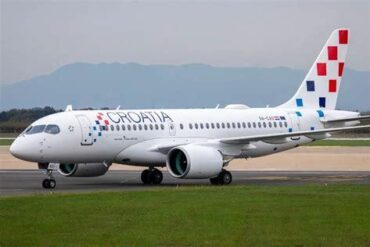
The A220 has established itself strongly in North America and Europe, with operators such as Delta Air Lines, JetBlue, Breeze Airways, Air Canada, Air France-KLM, airBaltic, SWISS, and ITA Airways adopting the type. Beyond these markets, smaller but noteworthy fleets operate in Egypt, Korea, Tanzania, Australia, Papua New Guinea, and Iraq.
These operators rely on the A220’s range of up to 3,600 nautical miles, its 25% fuel-burn improvement over previous-generation narrowbodies, and its quiet profile that fits well in noise-restricted airports.
How The A220’s Acoustic Identity Compares To The A320’s “Dog Bark”
Aviation enthusiasts often contrast the A220’s whale-like song with another Airbus signature sound—the A320 “dog bark.” This noise is produced not by cabin pressurization, but by the Power Transfer Unit (PTU), a hydraulic device that maintains redundancy between the aircraft’s hydraulic systems.
During engine start, the PTU performs self-tests that create a rhythmic, can-like barking noise beneath the cabin floor. This sound, while surprising to unaware passengers, is entirely normal. It differs fundamentally from the A220’s howl, which is aerodynamic and resonant rather than mechanical.
A220 Popularity And The Shadow Of Engine Issues
The A220 has achieved respectable commercial success with roughly 1,000 orders, though still short of Airbus’s ambitious early target of 3,000. Its efficiency, cabin comfort, and operating economics give it a strong competitive position against Embraer’s E-Jets.
Pratt & Whitney, however, has faced persistent reliability challenges with its GTF engines on A320neo aircraft. The A220’s PW1500G engines avoided significant issues for several years, but recent developments have seen some aircraft grounded due to emerging durability concerns. These issues do not relate to the acoustic behaviour of the engine; they stem from materials and component wear inside the core. Still, they have affected fleet availability and have forced operators to adjust schedules.
Why The ‘Whale Sound’ Has Become A Beloved Feature
What once drew noise complaints has now evolved into a quirky, almost charming signature of one of the most modern regional jets in the sky. The aviation community has embraced the howl as a badge of identity—an audible reminder that innovation in aircraft design can produce surprising side effects.
In a landscape where new airliners have trended toward homogenised acoustic profiles, the A220 stands out. It sings during takeoff, and enthusiasts know the tune instantly. The sound tells a story of modern engineering: of quiet engines, redesigned environmental systems, and aerodynamic behaviour that produces a character all its own.
The Lasting Acoustic Legacy Of The Airbus A220
The A220’s whale-like howl is the rare aviation quirk grounded in science, airflow, and clever engineering choices. It is neither a flaw nor a marketing gimmick—it is the audible signature of a modern, efficient aircraft whose quiet fan makes a hidden phenomenon suddenly noticeable. While other GTF-powered aircraft have been refined to mask similar tones, the A220 preserves this distinctive soundscape, giving spotters a recognizable melody and offering passengers a brief, unusual auditory moment on departure.
As the A220 fleet expands and operators continue to embrace its efficiency and passenger appeal, the familiar rising tone may one day become as well-known as the A320’s dog bark or the 777’s signature spool-up. In a field defined by precision engineering, sometimes the most memorable traits are the accidental ones—born from airflow, geometry, and the physics of a pressurized aluminum tube climbing into the sky.