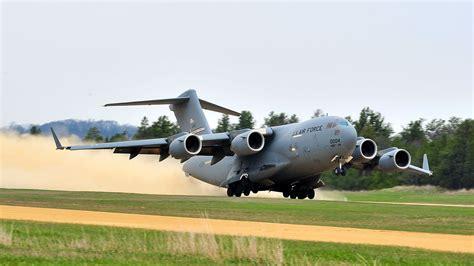
The Boeing C-17 Globemaster III remains one of the most extraordinary feats of modern aerospace engineering—not merely for its payload capacity or strategic range, but for how effortlessly it operates from short and austere runways, often under extreme conditions. This isn’t a minor capability—it’s a core function designed into the aircraft from day one, allowing it to blur the traditional boundaries between tactical and strategic airlift in ways few platforms have ever achieved.
Bridging the Tactical-Strategic Divide
During the late Cold War, the United States Air Force faced a critical operational dilemma: the existing transport fleet lacked a true hybrid between the short-runway-operating Lockheed C-130 Hercules and the payload-heavy but infrastructure-dependent Lockheed C-5 Galaxy. The former was agile but limited in reach and payload. The latter could haul massive loads globally but required long, prepared runways.
To address this gap, the C-17 Globemaster III was conceived to deliver meaningful strategic loads into rough and short forward airstrips. It had to land close to battle zones, carrying everything from armored vehicles to helicopters and artillery, all while maintaining intercontinental capability. This necessitated a radical rethinking of what a large airlifter should be.
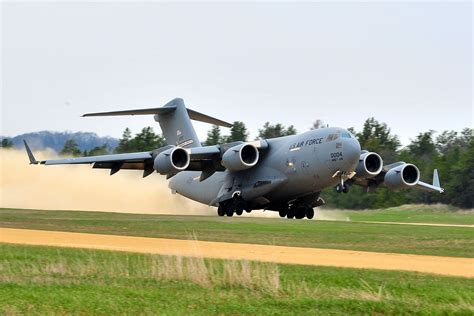
Rather than prioritize cruise efficiency, designers focused on robustness, controllability, and predictable behavior in hostile, variable environments. The result is an aircraft capable of full operations on runways just over 3,500 feet long, even while hauling tens of tons of equipment.
Aerodynamic Mastery: Wing and Flap Engineering
Central to the C-17’s exceptional takeoff and landing performance is its supercritical wing design, a feature that offers both cruise efficiency and outstanding low-speed lift characteristics. The aircraft is equipped with large, multi-slotted flaps that extend deep into the airstream, generating substantial lift during slow-speed flight phases.
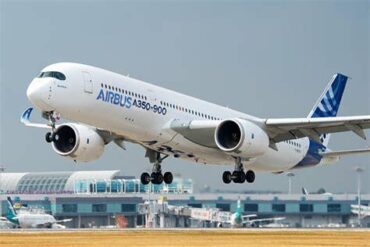
This high-lift system allows the C-17 to approach at much lower airspeeds, reducing kinetic energy upon landing and shortening the distance needed to stop. Despite its maximum takeoff weight of 585,000 pounds, the aircraft can glide in with remarkable gentleness. Only the Airbus A400M comes close to its low-speed aerodynamic efficiency, but at a much lower operational weight.
Reverse Thrust as a Tactical Weapon
What truly sets the C-17 apart is its aggressive and deliberate use of reverse thrust, not just on the ground, but also in-flight. Powered by four F117-PW-100 (PW2040 series) engines, the aircraft employs full thrust reversers as an integral part of its deceleration strategy.
Where other aircraft rely on thrust reversal as a secondary tool, the C-17 makes it central to braking performance, significantly reducing runway length requirements while easing the load on brakes. This is especially critical during hot-weather or high-altitude operations, where conventional braking would quickly overheat.
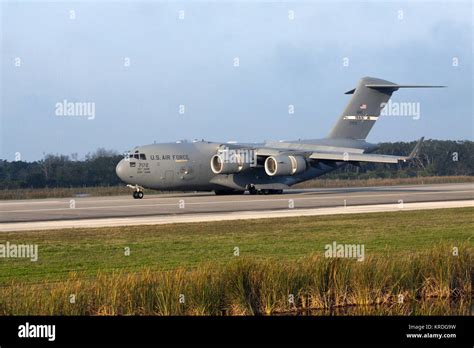
Even more impressive, the C-17 can deploy idle reverse thrust during flight, increasing drag and enabling descent rates of up to 15,000 feet per minute. This allows steep approaches into constrained landing zones, all while maintaining control. In contrast, the C-5 Galaxy can only reverse its inboard engines—and only with great caution—making the C-17 far more tactically versatile.
Fly-By-Wire: Precision in Every Movement
The C-17’s fly-by-wire flight control system is critical to its high-performance short-field capabilities. Unlike traditional mechanical systems, fly-by-wire enables software-defined behavior across flight regimes. During landing, the system prioritizes stability, responsiveness, and pilot control.
This system allows the aircraft to make steep, stabilized approaches into challenging airfields with limited margin for error. By preventing over-rotation and managing sink rates, the C-17 can land on strips flanked by terrain, buildings, or even under threat from hostile forces—all with minimal pilot workload.
Crucially, the human element remains highly refined. Pilots undergo rigorous and regular training in assault landing techniques, ensuring they are proficient in flying the aircraft to the very limits of its short-field design. This tight integration of machine precision and human expertise makes the aircraft’s capabilities reliable, repeatable, and tactically decisive.
On the Ground: Spoilers, Braking, and Load Distribution
Landing is only part of the challenge. Once the C-17 touches down, it transitions instantly into its ground stopping configuration. Its full-span spoilers deploy immediately to dump lift, ensuring the aircraft does not float down the runway. This mechanical responsiveness is vital for rapid stops on short or damaged airstrips.
Underneath, its multi-wheel landing gear spreads the aircraft’s weight over a wide footprint, which is key when operating from unpaved, uneven, or soft terrain. The braking system is designed for repeated, high-energy stops, and is paired with anti-skid technology that adjusts for wet or contaminated surfaces. These systems let pilots brake aggressively without risking aircraft integrity.
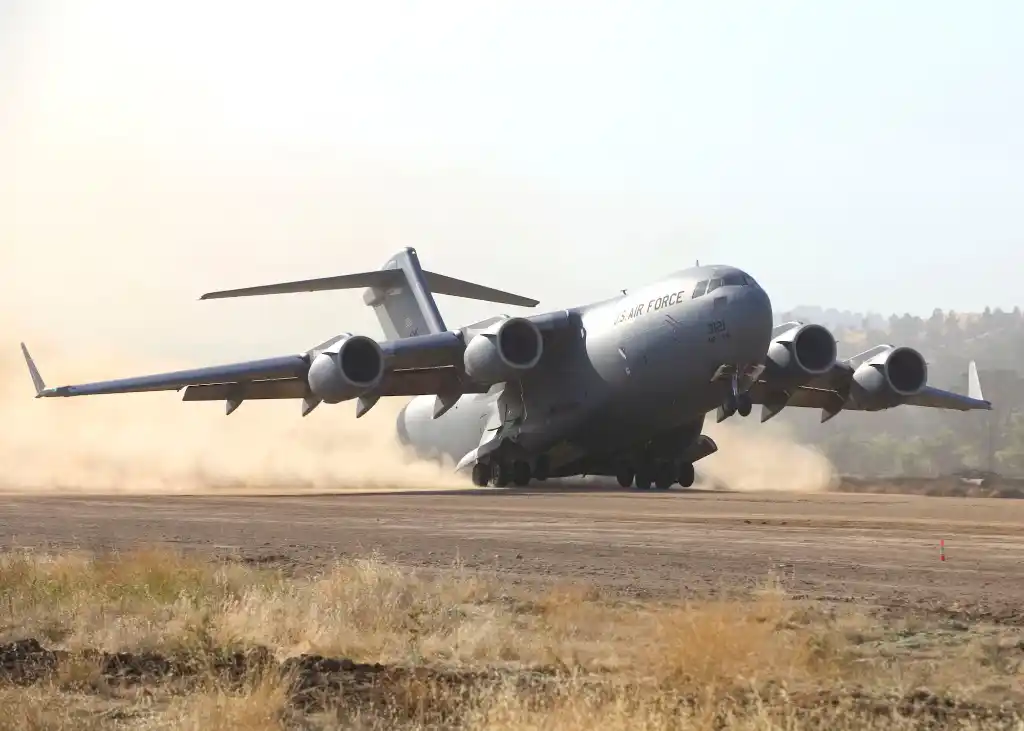
Also notable is the C-17’s structural asymmetry, a result of prioritizing operational reality over textbook design. The aircraft’s structure reflects the very specific environments it must operate in, often trading aesthetic or traditional balance for practical battlefield performance.
Real-World Impact and Strategic Implications
The C-17’s capabilities aren’t theoretical—they shape real-world logistics and battlefield reach every day. Its ability to land near the point of need, without requiring long runways or sophisticated infrastructure, reduces dependence on secondary logistics, airlift transfers, or vulnerable ground convoys.
This capability proves invaluable in humanitarian crises, allowing the delivery of relief supplies directly into disaster zones, even when airports are damaged or compromised. In combat, it enables rapid force projection, dropping heavy equipment and troops into forward zones without waiting for engineering units to prepare airstrips.
These advantages explain why the C-17 remains a backbone of U.S. and allied airlift strategy. While newer platforms like the A400M may expand the edge of short-field performance, they still operate in the design space the C-17 pioneered. The Globemaster’s legacy is not just in what it carries, but in how and where it can carry it.
Engineering Without Compromise
Unlike most military aircraft that evolve from compromises between competing requirements, the C-17 was built around a singular operational vision: deliver strategic payloads into tactical conditions. This philosophy dictated every engineering choice—from wing design and thrust vectoring to landing gear configuration and pilot interface.
It reflects a bold engineering mindset: one that values mission-centric design over theoretical optimization. The result is an aircraft that doesn’t merely fulfill a requirement but redefines what’s possible in military airlift.
Even as defense aviation continues to advance, the C-17 remains an unparalleled tool in strategic logistics. Its fusion of payload, agility, and ruggedness has yet to be truly rivaled. For its size, its ability to operate from tiny, rugged airfields is not just impressive—it’s virtually insane.