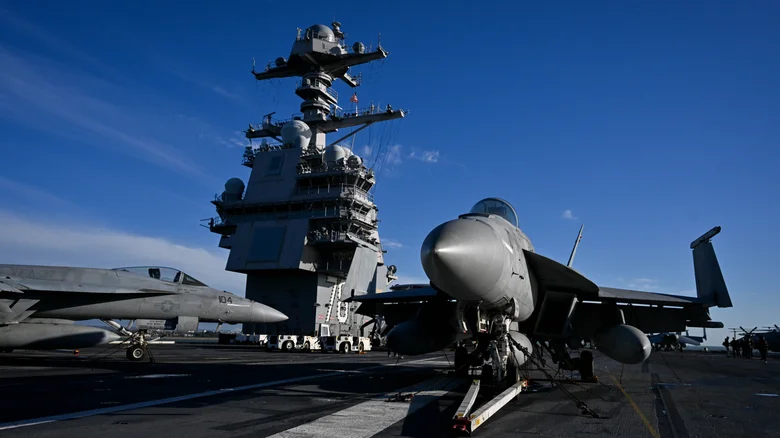
The United States Navy rarely bets small, especially when it comes to aircraft carriers. The Ford-class carriers were conceived as a generational leap, not a modest upgrade, promising more power, greater automation, and dramatically higher operational efficiency. At the center of that ambition sits a deceptively unglamorous system: the Advanced Arresting Gear (AAG). Its job is brutally simple—stop fast-moving aircraft on a pitching flight deck—but its troubled performance has become one of the most persistent technical headaches facing the Navy’s newest supercarriers.
The USS Gerald R. Ford, currently the only operational ship of its class, has spent years working through early-life defects ranging from plumbing failures to weapon elevator issues. Yet none has attracted as much scrutiny as AAG. Unlike cosmetic or habitability problems, arresting gear failures strike at the carrier’s core mission: launching and recovering aircraft at sea, reliably and repeatedly, under combat conditions.
The controversy around AAG is not about ambition. It is about execution. The system was meant to replace the venerable Mk 7 hydraulic arresting gear, a technology that, while old, had proven almost stubbornly reliable across decades of carrier operations. What the Navy received instead was a cutting-edge digital system that promised flexibility and efficiency, but has so far struggled to meet basic reliability benchmarks.
From Proven Hydraulics to Digital Complexity
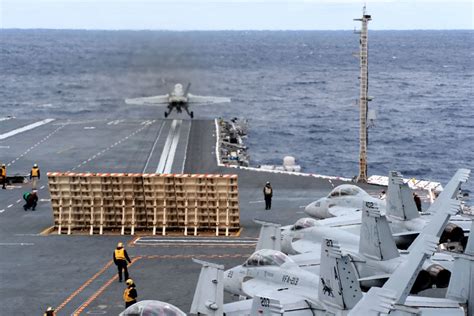
The Mk 7 system relied on hydraulics and mechanical predictability. It was heavy, maintenance-intensive, and inflexible, but it worked. AAG represents a philosophical shift away from brute force engineering toward software-driven control. Rather than dissipating energy through fixed hydraulic resistance, AAG uses energy-absorbing water turbines governed by digital control laws that adjust arresting force in real time.
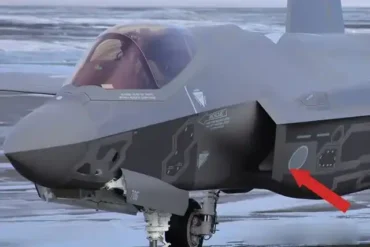
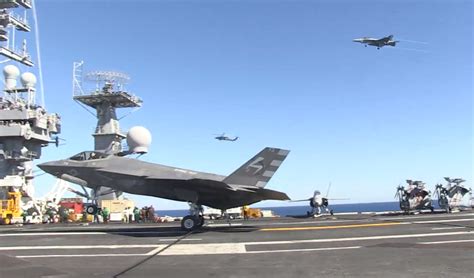
In theory, this approach offers significant advantages. The system can tailor its response to aircraft weight, speed, and configuration, reducing stress on airframes and arresting cables. This is not an abstract benefit. Modern naval aviation includes aircraft with vastly different landing characteristics, from heavy fighters like the F-35C Lightning II to future unmanned aerial vehicles that traditional arresting gear cannot safely recover.
The problem is that theory does not land airplanes. Real-world carrier operations demand ruthless reliability, especially during high-tempo flight operations when small failures cascade into deck congestion, missed sorties, and operational risk.
Why the Navy Took the Risk Anyway
The decision to introduce AAG was not reckless; it was strategic. The Navy is planning for a carrier air wing that looks very different from its Cold War predecessor. Heavier aircraft, sensitive stealth coatings, and the growing role of unmanned systems all strain the limits of legacy arresting gear.
AAG was designed to scale. Its digital architecture allows force profiles to be adjusted not only for current aircraft, but for platforms that do not yet exist. This future-proofing is critical when carriers are expected to serve for half a century. The system also supports the Navy’s ambitious goal of increasing the sortie generation rate of Ford-class carriers by roughly 33 percent compared to the Nimitz class, a leap that would fundamentally change carrier strike operations.
Those goals, however, assume a system that works consistently. That assumption has proven optimistic.
Reliability Shortfalls and Operational Impact
According to assessments cited by the Congressional Research Service, AAG has repeatedly failed to meet its required Mean Cycles Between Failure thresholds. In practical terms, the system breaks too often, especially during sustained flight operations. Hardware faults, software instability, and sensor integration issues have combined into a reliability profile that remains unacceptable for frontline deployment.
Compounding the issue is the system’s dependence on off-ship technical support. When failures occur, troubleshooting often requires specialized expertise that is not fully embedded with shipboard crews. This undercuts one of the Navy’s original selling points: reduced maintenance burden through automation.
Publicly available performance data has also grown stale. Official metrics have not been meaningfully updated since 2023, not because the system is unused, but because collecting representative data under operational conditions remains difficult. That opacity has fueled skepticism both within Congress and among naval aviation professionals.
Software, Sensors, and Too Many Failure Points
What truly separates AAG from the Mk 7 is not its mechanical design, but its systems integration. Every aircraft recovery depends on a choreography of sensors, control algorithms, power electronics, and mechanical components working in perfect synchrony. When that choreography falters, the system either shuts down or degrades performance to preserve safety.
First-generation systems of this complexity almost always struggle. AAG is effectively a prototype deployed at scale, and the carrier environment is among the harshest imaginable for delicate electronics. Salt air, vibration, shock loading, and relentless operational tempo expose weaknesses that would never appear in controlled testing.
General Atomics, the system’s prime contractor, continues to work with the Navy to refine both hardware and software. Yet fixes have often arrived incrementally, improving specific failure modes without delivering the step-change in reliability the fleet needs.
Can the Advanced Arresting Gear Be Fixed?
One proposed improvement is the retrofit of a fourth engine into the AAG system. Early Ford-class designs included this redundancy, but it was removed during cost-cutting. Restoring it could improve availability, reduce single-point failures, and increase pilot boarding rates. The idea reflects a broader realization: digital sophistication does not eliminate the need for mechanical redundancy.
Even with upgrades, AAG’s maturation timeline remains uncertain. The system is improving, but slowly, and its struggles have become a case study in the risks of fielding revolutionary technology without sufficient operational margin.
The irony is sharp. AAG embodies exactly the kind of adaptable, software-defined capability the Navy will need in future conflicts. Yet until it delivers the dull, unglamorous virtue of reliability, it remains a bottleneck on the world’s most powerful warships. The Ford-class carriers were built to redefine naval aviation. For now, their most advanced landing system is still learning how to simply do its job.