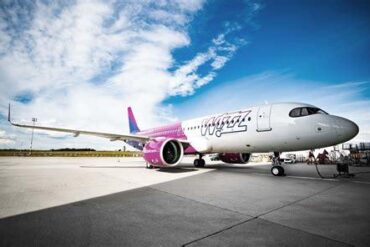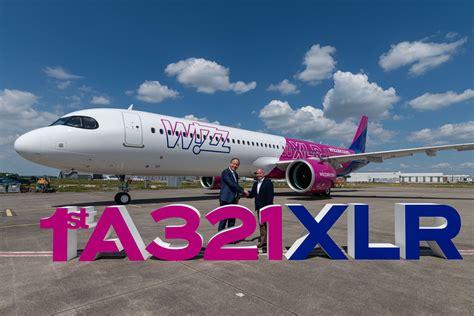
Wizz Air is taking the unusual step of removing engines from several of its brand-new Airbus A321XLR aircraft parked at Bydgoszcz Ignacy Jan Paderewski Airport in Poland. The aircraft are among the newest additions to the European low-cost carrier’s fleet, yet three examples are currently grounded with their Pratt & Whitney engines removed.
The unusual move is directly connected to the continuing reliability problems surrounding the Pratt & Whitney PW1100G geared turbofan. Wizz Air operates both the conventional Airbus A321neo and the longer-range A321XLR with the same engine family. That commonality has created an unusual opportunity: engines intended for aircraft capable of flying much longer routes can instead be transferred to A321neos that Wizz Air needs for its day-to-day network.
For an airline operating hundreds of Airbus narrowbodies, keeping aircraft in the air is critical. Wizz Air’s standard A321neos are among the most important aircraft in its operation, particularly because the carrier has built its business around high-density, low-cost flying across Europe. With almost two dozen A321neos reportedly grounded because of engine shortages and maintenance delays, a nearly new aircraft sitting idle can become a source of desperately needed spare parts.
Wizz Air’s Airbus A321XLR Fleet Faces an Unusual Problem
Wizz Air currently operates nine Airbus A321XLRs, with the oldest aircraft, registered 9H-XLA, only slightly more than a year old. The airline originally planned a much larger XLR fleet, but its strategy has changed considerably since the aircraft order was placed.
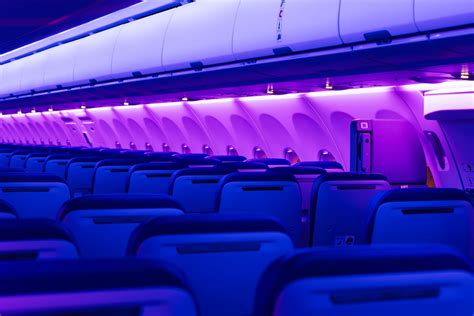
The A321XLRs are configured with 239 seats, using the same extremely dense all-economy configuration that Wizz Air employs on its A321neos. Except for exit-row areas, seat pitch is generally between 28 and 29 inches, while passengers do not receive seatback entertainment screens, power outlets, adjustable headrests, or reclining seats.
That configuration tells an important part of the story. The A321XLR was designed to allow airlines to operate routes approaching seven or eight hours with the economics of a narrowbody aircraft. But Wizz Air’s business model depends heavily on filling large numbers of seats while keeping fares low and generating additional revenue through optional services.
The aircraft therefore makes the most sense when its additional range can be used to open routes that a conventional A321neo cannot economically serve. When the XLR is instead used for a two- or three-hour European flight, much of its unique capability becomes unnecessary.
This is where Wizz Air’s current fleet situation becomes particularly unusual. Rather than simply grounding the XLRs until suitable missions become available, the airline has removed their PW1100G engines and transferred those engines to conventional A321neos.
Why Wizz Air Is Removing Engines From New A321XLRs
The immediate reason is the continuing shortage of serviceable Pratt & Whitney engines.
The PW1100G has experienced durability problems that have required frequent inspections, removals and shop visits. Pratt & Whitney has also faced limitations in both maintenance capacity and the production of replacement engines. The result has been a particularly difficult situation for airlines operating large fleets of Airbus A320neo-family aircraft.
Wizz Air has been among the operators most exposed to the problem because the PW1100G powers essentially its entire A321neo and A321XLR fleet. If an A321neo requires an engine replacement and a serviceable spare is unavailable, the aircraft can remain grounded even though the rest of the airplane is perfectly capable of flying.
An almost-new XLR provides an obvious source of engines.
Its PW1100Gs have relatively little operating time, making them valuable assets at a moment when Wizz Air needs serviceable powerplants more urgently than it needs every available XLR. Removing an engine from an XLR and installing it on an A321neo can therefore return an aircraft to commercial service without waiting months for a replacement engine to emerge from a maintenance shop.
The decision is unusual because the A321XLR itself is an expensive and strategically important aircraft. But an airplane sitting on the ground does not generate revenue, regardless of how new it is. If its engines can keep another aircraft flying, Wizz Air can effectively convert an underused asset into operational capacity.
The situation also demonstrates how severe the PW1100G supply problem has become. Airlines generally do not want to cannibalize newly delivered aircraft. Doing so indicates that the value of the available engine is temporarily greater than the value of keeping that particular aircraft complete.
Wizz Air Has Already Reduced Its A321XLR Ambitions
The engine removal would be much less significant if Wizz Air were aggressively expanding its long-haul narrowbody operation. The broader fleet strategy, however, suggests the opposite.
Wizz Air originally held 47 Airbus A321XLR orders. It subsequently converted 36 of those orders into conventional A321neos, leaving only a small number of XLRs in the future delivery pipeline. The airline is now expected to operate just 11 examples in total.
That dramatic reduction is important because it shows that the parked aircraft are not simply temporarily sidelined while Wizz Air prepares a major XLR expansion. The airline has already moved away from the strategy that produced its original large order.
The change is closely connected to Wizz Air’s decision to close its Abu Dhabi operation. The subsidiary began operating in 2021 and was expected to provide an important base for the airline’s long-range narrowbody ambitions. The A321XLR’s range appeared particularly useful for connecting Abu Dhabi with destinations that could not be served efficiently by the conventional A321neo.
In July 2025, Wizz Air announced that it would shut down the Abu Dhabi operation. The airline cited geopolitical instability, weaker engine performance in the region, regulatory difficulties and other operational constraints.
Once Abu Dhabi disappeared from the network, one of the strongest reasons for ordering dozens of XLRs disappeared with it.
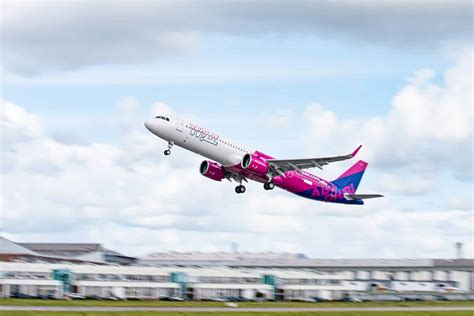
The Airbus A321XLR Is Not Simply a Longer-Range A321neo
Technically, the A321XLR and A321neo share an enormous amount of commonality. For Wizz Air, that commonality is one reason why the engines can be moved between the two aircraft types.
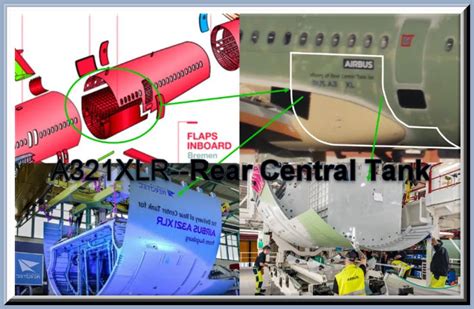
Operationally, however, the XLR carries additional structural weight because it was engineered for longer-range missions. Its integrated rear center tank allows it to carry substantially more fuel than a standard A321neo, while additional modifications support the aircraft’s higher maximum takeoff weight and long-distance operation.
Those improvements come with a cost.
The XLR is heavier than a conventional A321neo, and a heavier aircraft requires more fuel when operating on short sectors. That does not make the XLR inefficient in general. It simply means that its economics depend on using the additional capability.
For an airline flying seven-hour sectors, the additional fuel capacity can transform the route network. For an airline flying two-hour European sectors, much of that capability becomes dead weight.
Wizz Air’s current network increasingly leaves its XLRs somewhere between those two extremes. The airline’s five currently flying XLRs have primarily been used on European routes, together with some services from Italy toward the Middle East. A fourth aircraft has also been parked for maintenance.
The aircraft can obviously fly those routes. The question is whether they should.
Why the A321XLR’s Real-World Range Matters
Airbus advertises the A321XLR with a range of approximately 4,700 nautical miles, or 8,700 kilometers. That figure is useful for demonstrating the aircraft’s potential, but it should not be interpreted as a promise that every airline can fly 4,700 nautical miles with every possible cabin configuration and payload.
Wizz Air’s 239-seat configuration creates a particularly important distinction.
A dense all-economy aircraft can carry substantially more passengers than an XLR configured with a premium cabin and fewer seats. Those additional passengers represent both additional revenue and additional weight. Checked baggage, cargo, catering and other payload also affect the amount of fuel available for a particular mission.
As a result, a fully loaded Wizz Air A321XLR cannot simply be expected to reproduce the brochure range under every operating condition.
This may have become increasingly important on the longer routes Wizz Air had originally envisioned. The airline’s low-cost model also introduces another variable. Passengers on longer flights can behave differently from passengers taking short European trips, particularly when it comes to baggage.
Wizz Air traditionally keeps its headline fares low and charges separately for many extras. On longer journeys, however, passengers may be more willing to pay for checked baggage and other services. Higher baggage uptake increases payload and can reduce the amount of fuel that can be carried within the aircraft’s weight limitations.
None of this means that the A321XLR is incapable of long-haul operations. Other airlines have demonstrated precisely why the aircraft exists. Instead, it highlights the importance of matching the aircraft’s economics to the airline’s network, cabin and customer base.
Wizz Air’s Low-Cost Model Creates a Difficult Long-Haul Equation
The A321XLR’s central proposition is straightforward: it allows airlines to operate long-distance routes with a narrowbody aircraft while avoiding many of the costs associated with a larger widebody.
That proposition can work extremely well when an airline has the right network and revenue model.
But Wizz Air’s strategy is built around low fares, high aircraft utilization and high-density seating. Long-haul flying introduces costs that are difficult to eliminate, regardless of how efficiently the aircraft is operated.
A seven-hour flight requires considerably more fuel than a two-hour European sector. Crew costs rise because the aircraft spends more time in the air. Aircraft utilization becomes more complicated, and disruptions can have larger consequences because the aircraft and crew remain tied to a route for much longer.
At the same time, an A321XLR cannot generate the same amount of premium-cabin revenue as a widebody configured with business class, premium economy and economy cabins.
This is especially significant because Wizz Air does not operate a traditional premium cabin. Its XLRs remain configured entirely around economy passengers.
Wizz Air’s chief commercial officer has said that the aircraft does not fit the company’s business model without a premium cabin, while the airline’s chief executive has discussed limitations involving range and payload. These comments help explain why the carrier has progressively reduced its XLR ambitions.
Other airlines have reached different conclusions. Aer Lingus and Iberia, for example, operate A321XLRs on long-distance routes and have business-class products that can generate substantially more revenue from a limited number of premium seats.
The aircraft itself has not changed between those operators. The surrounding business model has.
Why A321neos Are More Valuable to Wizz Air Right Now
The most revealing part of the situation may therefore be the aircraft receiving the removed engines.
Wizz Air’s conventional A321neo fleet is enormous, with roughly 200 aircraft in service depending on the precise fleet accounting used. These aircraft form the backbone of the airline’s high-density European operation.
When an A321neo is grounded because of an engine problem, Wizz Air loses hundreds of seats and an aircraft that can be deployed across a huge number of routes. Reinstalling a serviceable PW1100G can therefore restore a highly flexible piece of capacity.
By contrast, an A321XLR without an engine has fewer immediate deployment options. Its principal advantage is its ability to fly much farther, but Wizz Air currently has fewer routes where that capability is essential.
That makes the decision to strip the XLRs more understandable from an operational perspective. It is not necessarily a statement that the aircraft has failed. Rather, it reflects a mismatch between the aircraft’s capabilities and Wizz Air’s current network requirements.
The irony is hard to miss: one of Airbus’s newest and most advanced narrowbody aircraft is being used as an engine donor for an older-generation version of essentially the same airplane.
What Happens to Wizz Air’s A321XLRs Next?
The long-term role of the aircraft remains uncertain, but the broader direction of Wizz Air’s fleet strategy is clearer than it was several years ago.
The airline has reduced its XLR order book, closed Abu Dhabi, and shifted its focus toward the conventional A321neo. It also expects substantial future growth through new A321neo deliveries, making the standard aircraft central to its expansion plans.
The XLRs could eventually return to longer routes if Wizz Air identifies markets where their economics work. They could also be deployed on selected Middle Eastern or other longer European services where the additional range provides a genuine advantage.
For now, however, the aircraft parked in Poland illustrate a broader lesson about the aviation industry: having the newest aircraft does not automatically mean having the right aircraft for the network.
The A321XLR remains one of Airbus’s most capable narrowbody aircraft, offering airlines the ability to open routes that previously required larger aircraft or could not support a nonstop service at all. But that capability has value only when an airline has routes capable of exploiting it profitably.
For Wizz Air, the immediate priority is keeping its core A321neo fleet operational while Pratt & Whitney works through its engine supply and maintenance challenges. That priority explains why engines have been removed from aircraft that, on paper, should have been among the most valuable assets in the fleet.
The three A321XLRs at Bydgoszcz Airport therefore represent more than an unusual maintenance story. They are physical evidence of two problems converging at once: the prolonged PW1100G engine crisis and Wizz Air’s changing view of long-haul narrowbody flying.
For an aircraft only recently introduced to commercial service, being turned into an engine donor is an extraordinary outcome. Yet from Wizz Air’s current network perspective, the logic is surprisingly straightforward. The airline needs reliable A321neos today, while its A321XLRs have not yet found enough missions where their extra range can justify their additional weight and complexity.
In aviation, the newest aircraft does not always get the highest priority. The aircraft that can earn money today does.