The global airline network looks chaotic on a flight map, but when you zoom in on actual passenger capacity, a few corridors glow like supernovas. These are the routes where aircraft take off every few minutes, where widebodies are sometimes used on flights shorter than an hour, and where air travel has quietly replaced rail and road as the default form of mass transport. Using OAG’s 2025 seat-capacity data, the picture that emerges is not just about aviation, but about population density, geography, culture, and economic gravity.
At the very top of the list sits a route so busy that even seasoned aviation watchers still underestimate it. The Jeju–Seoul Gimpo air corridor does not merely lead the world; it overwhelms every other route by a staggering margin. With over 14.3 million annual seats and more than 100 daily flights, it operates more like an airborne metro system than a traditional airline route.
This dominance is not an accident. It is the product of South Korea’s population distribution, Jeju Island’s role as a year-round leisure magnet, and the simple fact that flying is the only realistic way to connect the island to the mainland at scale.
Why Jeju–Seoul Gimpo Is the World’s Busiest Airline Route
The flight between Jeju International Airport (CJU) and Seoul Gimpo Airport (GMP) is barely an hour long, yet it generates traffic volumes that dwarf famous intercontinental routes. The reason lies in concentration. South Korea’s population is heavily centered around the Seoul metropolitan area, while Jeju Island functions as the country’s default escape valve for tourism, business retreats, and domestic travel.
Unlike many island destinations, Jeju has no rail tunnel or bridge connection. Air travel is not a luxury here; it is infrastructure. Airlines schedule departures every few minutes during peak hours, often with multiple carriers competing head-to-head using high-density Airbus A321s and Boeing 737s.
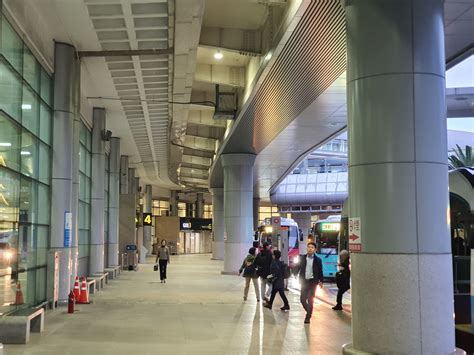
What makes this even more remarkable is that demand is still around 20% below pre-pandemic levels. Even in a depressed state, the route maintains a tempo that no other city pair on Earth can match. A single half-hour window at Jeju can show a dozen flights bound for Seoul, an operational rhythm closer to commuter rail than commercial aviation.
Asia’s Grip on the World’s Busiest Domestic Routes
Once Jeju–Seoul Gimpo claims the crown, the rest of the global top ten continues to tell an Asia-centric story. Japan alone places multiple routes near the top, including Sapporo–Tokyo Haneda and Fukuoka–Tokyo Haneda, both serving dense urban regions with limited high-speed rail substitution over long distances.
China and India also appear prominently, with Beijing–Shanghai Hongqiao and Mumbai–Delhi reflecting massive internal travel demand driven by economic centralization. These routes thrive because they link political capitals, financial centers, and industrial hubs, where time savings matter more than ticket price.
What stands out is that all of the world’s ten busiest airline routes are domestic. Border controls, visa regimes, and international regulations impose friction that simply does not exist within national airspaces. Domestic routes can scale faster, schedule more aggressively, and adapt capacity with fewer constraints.
The Busiest International Airline Routes Still Lag Behind
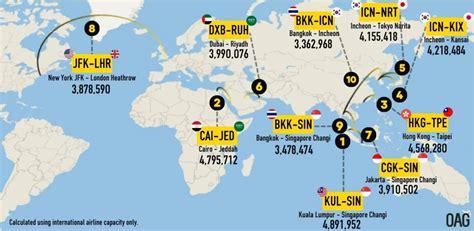
International routes tell a different story. The busiest cross-border corridor in the world, Hong Kong–Taipei, offers fewer than half the annual seats of the Jeju–Seoul route. Even so, it remains a titan, sustained by deep economic ties, family connections, and the absence of efficient alternatives.
Other heavyweights such as Kuala Lumpur–Singapore and Cairo–Jeddah reflect regional mobility rather than long-haul prestige. These are routes where flying replaces long road journeys or congested land crossings, and where frequency matters more than aircraft size.
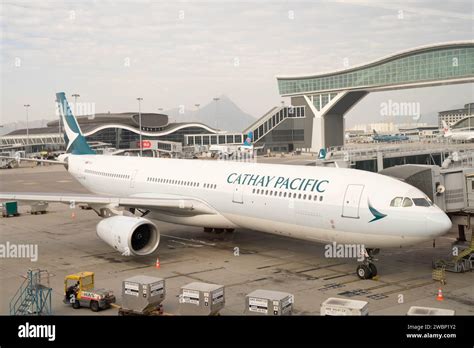
The appearance of New York JFK–London Heathrow near the bottom of the international top ten is particularly revealing. Despite its fame, premium cabins, and cultural status, its seat count remains modest compared to Asia’s regional workhorses. Global visibility does not equal raw volume.
Why the United States Looks Small by Global Standards
Within the United States, routes like JFK–LAX, LAX–SFO, and LGA–ORD dominate domestic rankings. These are undeniably busy corridors, supported by business travel, tourism, and airline competition. Yet the numbers tell a humbling story.
The busiest U.S. domestic route carries less than one quarter of the seats of the Jeju–Seoul Gimpo corridor. Geography plays a role here. The U.S. population is spread across a vast landmass, alternative transport modes are stronger on short distances, and no single city pair monopolizes demand in the way Seoul and Jeju do.
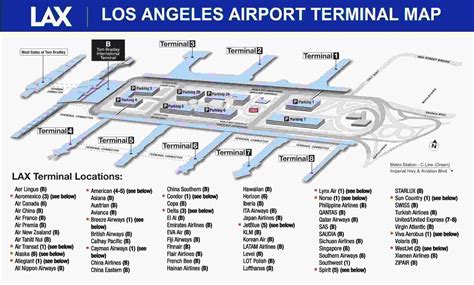
This dispersion limits how dense any single route can become, even in the world’s largest aviation market by fleet size.
What These Routes Reveal About Modern Air Travel
The world’s busiest airline routes are not about glamour, long distances, or international intrigue. They are about necessity, density, and repetition. They flourish where flying becomes routine, where passengers care less about the airline brand and more about the next available departure.
These corridors also expose how aviation adapts to local realities. In some regions, aircraft replace trains. In others, they replace highways or ferries. The aircraft themselves become tools of urban planning, quietly absorbing mobility demands that no other system can handle at scale.
Bottom Line
The title of the world’s busiest airline route belongs, decisively, to Jeju–Seoul Gimpo, a corridor that operates at a tempo unmatched anywhere else on the planet. Its 100+ daily flights and massive seat capacity highlight how aviation can function as essential infrastructure rather than discretionary travel.
Equally telling is what does not appear at the top. International prestige routes and famous long-haul flights fade into the background when measured against sheer volume. The busiest air routes are not the ones people talk about most, but the ones millions quietly rely on every year.