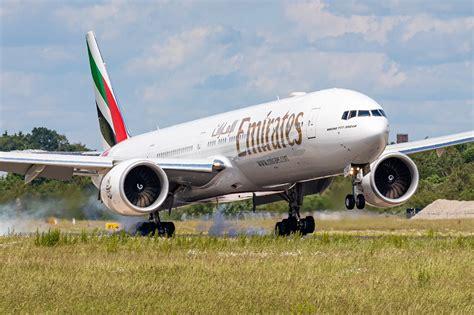
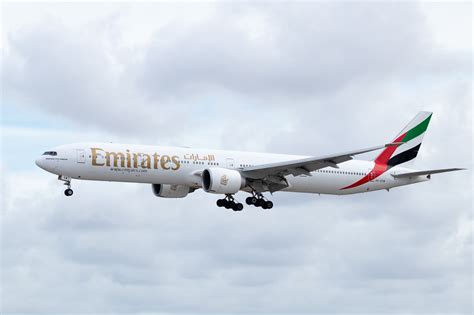
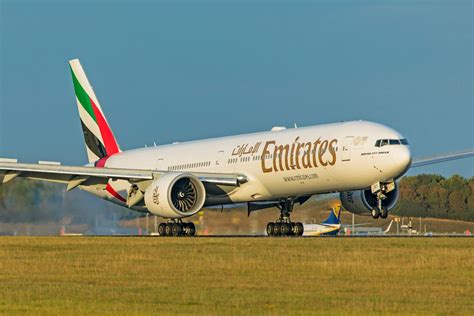
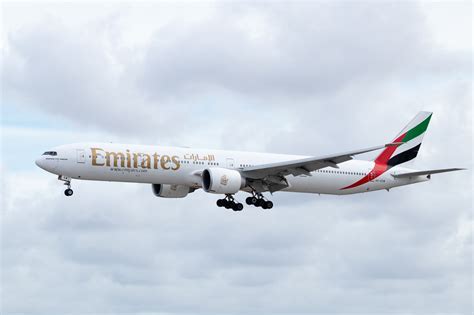
Emirates continues to assert its dominance in global aviation with its extensive utilization of the Boeing 777-300ER. As of 2025, the airline operates 119 Boeing 777-300ERs, making it not only the backbone of the Emirates fleet but also positioning Emirates as the world’s largest operator of the 777-300ER. This aircraft, known for its long range and high payload capabilities, plays a vital role in both high-demand and underserved markets across the globe.
Emirates’ Boeing 777-300ER: Backbone of the Fleet
While Emirates may be famous for the grandeur of its Airbus A380s, the Boeing 777-300ER has quietly powered the airline’s vast intercontinental network. The 777-300ER allows Emirates to operate with high efficiency on both long-haul and shorter regional routes, providing flexibility that larger aircraft like the A380 cannot always offer.
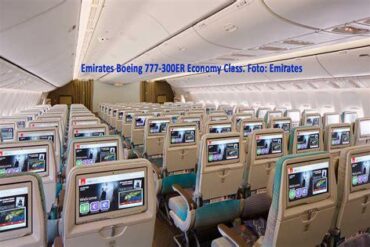
Among the 119 aircraft, configurations vary significantly. From ultra-premium layouts featuring just 324 seats to densely packed 421-seat cabins, Emirates has tailored its 777-300ER fleet to meet diverse market demands. Most notably, nine of these aircraft feature Emirates’ “Game Changer” first class suites, offering unprecedented privacy and luxury with floor-to-ceiling doors.
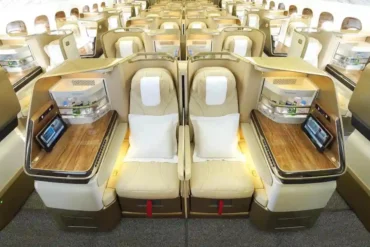
Emirates has begun equipping 81 of its 777-300ERs with premium economy, further enhancing comfort across cabin classes. These retrofitted jets also feature upgraded business class seating, mirroring the design seen on its newer Airbus A350s.
South Asia: Emirates’ Most Frequent 777-300ER Routes
Nowhere is the frequency of the 777-300ER more visible than in South Asia, a region that underpins much of Emirates’ daily operations. In 2025, the single busiest route operated with the 777-300ER was between Dubai and Delhi’s Indira Gandhi International Airport, with a staggering 1,460 flights each way, averaging four daily round trips.
Close behind is Dubai to Male, the capital of the Maldives, with 1,444 flights each way in 2025. Despite the Maldives being a relatively small destination in terms of population, it remains a luxury leisure hotspot, demanding high-frequency, widebody service.
Routes to other major Indian cities such as Chennai and Hyderabad followed, each clocking 1,095 flights, tying them with Dubai to Manila for the fourth-busiest 777-300ER route. Even Mumbai, despite being served by A380s as well, saw 959 Boeing 777-300ER flights each way, proving the aircraft’s critical role in this corridor.
Additional South Asian destinations like Dhaka (Bangladesh), Karachi (Pakistan), and Colombo (Sri Lanka) further reflect the aircraft’s versatility in connecting high-volume expatriate and VFR (visiting friends and relatives) markets with Dubai.
Middle East Regional Efficiency
Intra-Gulf and Middle Eastern flights often challenge widebody aircraft utilization. Emirates, however, has turned this into an advantage. By operating the 777-300ER on shorter regional routes, the airline maximizes aircraft productivity during bank schedules at Dubai International Airport.
The most prominent regional route in 2025 was Dubai to Riyadh, with 1,177 flights each way, making it the third-busiest 777-300ER route overall. This high frequency underscores the route’s corporate and diplomatic significance.
Similarly, Kuwait City (952 flights) and Dammam (918 flights) were major 777-300ER destinations. These flights often serve both business traffic and labor movement, and Emirates exclusively uses the 777-300ER on these sectors, ensuring consistent premium service even on short sectors.
Emirates’ decision to use such a large aircraft on these routes allows for fleet simplification, eliminating the need for a regional subfleet while aligning with the airline’s hub-and-spoke model.
Southeast Asia and African Network Expansion
Moving eastward, Southeast Asia presents a different kind of demand profile—high leisure volume and increasing premium demand. The Philippines is a clear standout. Dubai to Manila saw 1,095 777-300ER flights each way, matching some of the busiest Indian routes.
Jakarta, another densely populated hub in Indonesia, received 730 Boeing 777-300ER flights, averaging two per day. These high-volume routes reinforce Emirates’ role as a connector between Southeast Asia and the Middle East, especially for migrant labor and family travel segments.
In Africa, Emirates maintains a significant footprint with the 777-300ER. The standout city is Johannesburg, which received 765 flights, often supplementing A380 frequencies. Cape Town, on the other hand, is served exclusively by the 777-300ER, with 730 flights in 2025, reinforcing the aircraft’s flexibility in balancing premium capacity with cargo needs.
European Operations: Bridging Continents With Flexibility
Europe remains a cornerstone of Emirates’ global strategy. While the Airbus A380 continues to dominate flagship routes such as London Heathrow and Paris Charles de Gaulle, the 777-300ER plays a vital role in secondary markets.
Dublin leads the 777-300ER operations in Europe with 790 flights in 2025. It is followed closely by Frankfurt, Geneva, Lisbon, and London-Stansted, each receiving 730 flights annually, or approximately two per day. These routes often supplement or entirely operate in place of A380 services, based on airport capacity and market demand.
Notably, Emirates operates its premium “Game Changer” first class suites on select 777-300ER flights to Geneva. Other cities receiving these exclusive cabins include Brussels, Chicago, Kuwait City, Melbourne, and Tokyo-Haneda, showing the airline’s intent to offer differentiated service even beyond A380 flagship routes.
Strategic Fleet Deployment and Network Synergy
Emirates has optimized its use of the 777-300ER through intelligent scheduling and operational efficiency. By utilizing the aircraft on both regional and long-haul routes, Emirates avoids having aircraft sit idle during off-peak times. Instead, bank structures at Dubai International Airport ensure quick turnaround and high aircraft utilization.
As the airline continues introducing Airbus A350s, some 777-300ERs are being reassigned or upgraded. These newer A350s often take over routes to smaller European cities like Oslo, Lyon, and Edinburgh, where premium economy and right-sized capacity are essential. The A350s lack first class, enabling Emirates to right-size premium offerings while maintaining consistency in business and economy cabins.
Despite these transitions, the Boeing 777-300ER remains a central pillar of Emirates’ network strategy. With premium economy upgrades, increased reliability, and deployment flexibility, it is uniquely equipped to serve the dual role of workhorse and luxury carrier.
Conclusion: The 777-300ER Still Rules the Sky for Emirates
In a time when new aircraft like the Airbus A350-900 and the anticipated Boeing 777X are making headlines, Emirates’ Boeing 777-300ER continues to prove its worth. By deploying this aircraft on a wide spectrum of high-demand routes, from the busiest cities of India and the Middle East to strategic European and African destinations, Emirates ensures a reliable and luxurious experience for millions of passengers.
Whether it’s handling four daily rotations to Delhi, complementing A380s to Johannesburg, or pioneering luxury first class suites to Geneva, the 777-300ER remains a cornerstone of Emirates’ operational success in 2025—and likely beyond.