Before any commercial airplane earns its certification to carry passengers, it must pass an extreme regulatory hurdle: the Federal Aviation Administration (FAA) mandates that a full evacuation be completed within 90 seconds, using only half of the aircraft’s emergency exits. This high-stakes requirement may seem excessive, but when disaster strikes, every second counts. A critical part of this rapid response system is the airplane emergency escape slide—a marvel of aviation safety engineering that, despite its inconspicuous presence, has played a pivotal role in saving lives.
These inflatable slides, often mistaken by the public as simple safety accessories, are in fact precision-engineered life-saving devices that deploy in mere seconds. They are designed to operate under immense stress and adverse conditions, from crash landings to engine fires, even over water. In some of the most dramatic emergency landings in modern aviation history, escape slides have proven not only useful, but absolutely vital.
How Emergency Escape Slides Deploy in Seconds
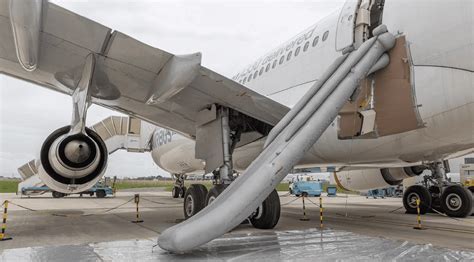
Next time you board an airplane, glance at the bulging, inconspicuous compartments around the doors—these contain the emergency escape slides, tightly packed and primed for deployment. In normal operations, these systems remain dormant. Flight attendants must “disarm” the slides upon arrival and “arm” them before takeoff to avoid unintentional deployment. Mistakenly opening a door while the slide is armed can lead to a costly and dangerous activation, which is why crew protocols include meticulous checks of arming levers.
When an emergency dictates a rapid evacuation, the slide deployment mechanism kicks into action. Once the cabin door is opened and the lever engaged, the slide pack falls outward, triggering an inflation sequence that is nothing short of ingenious. Inside each pack is a canister of compressed gas—typically nitrogen or a nitrogen-carbon dioxide mix—stored under pressures as high as 3,000 psi. When released, this gas rushes through narrow nozzles, activating what is known as the Venturi effect.
The Venturi effect creates a low-pressure zone that pulls in ambient air to rapidly expand the slide. In fact, only about one-third of the slide’s inflated volume comes from the compressed gas; the remaining two-thirds is ambient air, drawn in almost instantly. Within six seconds, the slide inflates fully, forming a rigid, sloped chute that can support dozens of people descending in succession.
These slides are crafted from urethane-coated nylon fabrics and carbon fiber reinforcements, making them both lightweight and incredibly resilient. To ensure functionality during fires, many slides are also coated with fire-resistant paint. Their reliability is so critical that they are tested in various configurations to ensure rapid inflation, durability, and usability even in hostile conditions.
From Theory to Reality: When Escape Slides Saved Lives
The functionality of escape slides has been proven time and again—not in simulations, but in high-stakes, real-world emergencies. One of the most iconic examples is US Airways Flight 1549, widely known as the “Miracle on the Hudson.” On January 15, 2009, Captain Chesley “Sully” Sullenberger was forced to land his Airbus A320 on the Hudson River after a bird strike disabled both engines shortly after takeoff.
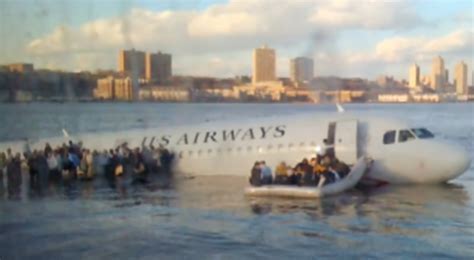
The aircraft landed successfully on water, and the emergency exit slides doubled as flotation rafts, giving the 155 occupants something to cling to in the freezing water until rescue teams arrived. While Captain Sully’s calm demeanor and skill were rightly praised, it was also the rapid deployment of the slides—and their dual-functionality as life rafts—that helped prevent any loss of life.
Equally harrowing was the emergency landing of China Airlines Flight 120 on August 20, 2007, in Naha, Japan. The Boeing 737-800 had landed normally, but as it taxied, leaking fuel ignited a fire under the right wing. Within moments, the entire fuselage was engulfed in flames. Quick action by the flight crew and immediate deployment of the emergency escape slides enabled all 165 occupants to evacuate moments before a fireball consumed the aircraft.
Another dramatic use occurred during Air France Flight 358 in 2005. The Airbus A340 overran the runway during a storm while landing at Toronto Pearson International Airport. The aircraft burst into flames, and the evacuation was complicated by terrain and weather. Yet, thanks to the effective deployment of the emergency slides, all 309 passengers and crew made it out alive.
The Engineering Marvel Behind Modern Slides
Emergency escape slides are more than inflated cushions. Their deployment involves automated triggers, high-strength inflation systems, and material science designed to withstand sharp debris, high heat, and repeated use. For widebody aircraft like the Boeing 777 or Airbus A380, slides can measure over 40 feet long and must support evacuation at a steep angle—sometimes up to 60 degrees.
For aircraft capable of over-water operations, such as the Boeing 787 Dreamliner, many slides are designed as slide/raft hybrids, meaning they serve double duty. These models are equipped with survival kits, inflation valves, locator lights, and seawater stabilizers to ensure passengers can stay afloat for hours if not days.
Training protocols ensure flight attendants know how to use these tools under duress. Airlines around the world conduct regular evacuation drills, many of which include simulated fires, blocked exits, and disabled passengers. The 90-second rule isn’t just theoretical—it’s practiced and drilled relentlessly.
The Risks of Accidental Deployment
Despite their clear utility, emergency escape slides are not without risks—especially when triggered accidentally. A premature deployment can cost an airline tens of thousands of dollars and result in injuries. That’s why gate agents and crew are trained to treat the doors with utmost caution during boarding and deplaning.
Several incidents have seen escape slides deploy inadvertently, sometimes injuring ground crew or damaging the aircraft. These events, while rare, have spurred innovations such as automatic arming indicators, redundant safeties, and visual alarms to reduce the likelihood of human error.
What Happens After Deployment?
Once deployed, escape slides are inspected, removed, and sent to specialized maintenance and re-packing centers. Slides are not reusable without inspection and servicing. Airlines usually maintain an inventory of spare slide units, allowing aircraft to return to service quickly after an incident. Each slide unit includes serial tracking, deployment history, and scheduled overhaul intervals to ensure compliance with safety standards.
Manufacturers like Collins Aerospace, Zodiac Aerospace (now part of Safran), and EAM Worldwide are leaders in producing certified slides for a wide range of aircraft. These companies constantly refine materials and deployment systems to make slides even faster, lighter, and more reliable.
Emergency Escape Slides in the Military and Business Aviation
While most associated with commercial airliners, escape slides are also critical for military transport aircraft and private jets. Aircraft like the Lockheed C-130 Hercules or the Gulfstream G650 are often outfitted with evacuation systems that suit their unique mission profiles. For VIPs, slides may even include additional survival gear, such as radio beacons, signal mirrors, and thermal blankets.
In military use, evacuation drills can include hostile environments, necessitating faster deployment and higher durability. The same engineering principles apply—fast inflation, rugged construction, and ease of use under pressure.
Final Approach: Why These Slides Still Matter
Emergency escape slides are one of the few pieces of equipment on an airplane that you hope never to use—but are immensely grateful for when needed. They exemplify the behind-the-scenes dedication to passenger safety that the aviation industry is built on. While advanced avionics, reinforced fuselages, and better weather forecasting play their parts, the humble escape slide is what makes survival possible when all else fails.
From the freezing waters of the Hudson to the flaming tarmac of Naha Airport, these inflatable chutes have done more than just provide a quick exit—they have preserved lives. So the next time your flight attendant reviews the safety card and points to the exits, take a second look. That slide could be the most important piece of equipment on your entire journey.