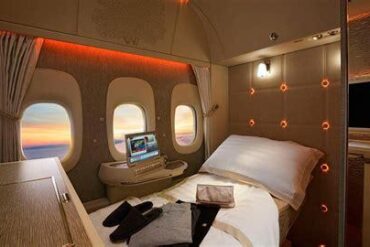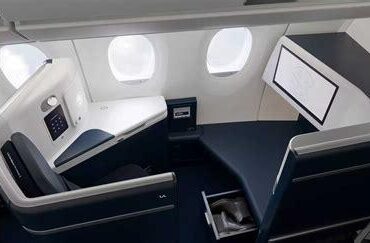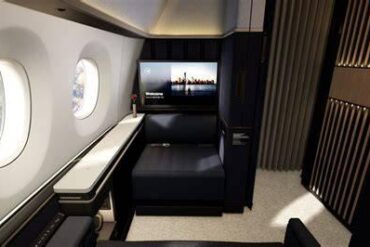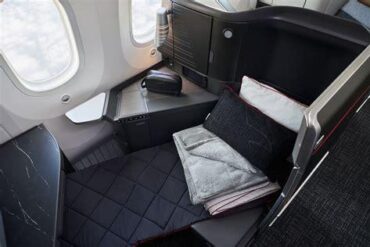
Long-haul business class has evolved far beyond the traditional promise of a lie-flat seat, better meals, and a little extra legroom. The industry’s most ambitious airlines are now designing private spaces within the aircraft, using doors, tall walls, enclosed shells, and dramatically wider seating areas to create an experience that feels closer to a private room than a conventional premium cabin.
That shift matters most on flights lasting 10, 12, or even 16 hours. A passenger can tolerate a busy cabin for a short flight, but during an overnight journey, constant movement in the aisle, neighboring passengers, cabin lights, and conversations can make genuine rest surprisingly difficult. The best business class suites address that problem by changing what passengers see, hear, and experience around their seats.
The Asian airline market has been particularly influential in this transformation. Qatar Airways, All Nippon Airways (ANA), Japan Airlines (JAL), and Cathay Pacific have all invested heavily in privacy-focused premium cabins, while Singapore Airlines has helped establish the region’s reputation for unusually spacious and individualized seating. These products do not all pursue privacy in exactly the same way, but they share one central idea: premium travel should give passengers control over their personal environment.
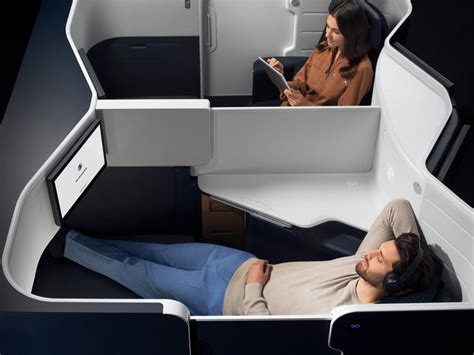
The five suites below represent some of the clearest examples of that philosophy. Each creates a degree of separation that can make the rest of the aircraft feel remarkably distant, whether through a fully closing door, an exceptionally wide personal footprint, or a wraparound shell that blocks much of the surrounding cabin.
5. Cathay Pacific Aria Suite: A Wraparound Private Haven
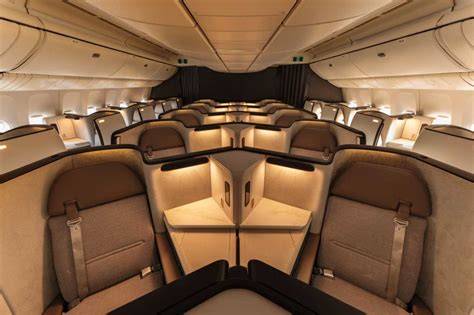
Cathay Pacific’s Aria Suite represents the airline’s latest attempt to redefine its long-haul Business Class experience around privacy rather than simply comfort. Installed on selected Boeing 777-300ER aircraft, the suite replaces the more conventional open business class arrangement with a wraparound personal space and dedicated privacy door. The result is an environment that feels considerably more enclosed once the passenger closes the door and settles in for the flight.
The architecture is arguably the Aria Suite’s most important feature. Instead of relying primarily on a small divider between neighboring passengers, Cathay Pacific surrounds the passenger with a substantial structure that blocks much of the visual activity taking place elsewhere in the cabin. This distinction becomes particularly noticeable during nighttime flights. When the cabin is quiet and dark, being able to shut the door and eliminate much of the movement around you can make the aircraft feel surprisingly removed.
Cathay Pacific has also equipped the suite to function as a complete personal environment rather than a seat that happens to have a door. A 24-inch 4K entertainment display provides an expansive viewing experience, while the lie-flat bed allows the suite to transition from a working space into a sleeping environment. Storage areas help keep personal belongings organized rather than scattered around the seat, reinforcing the impression that the passenger has been given a defined room of their own.
There is still an important distinction between an airline suite and an actual private cabin. The Aria Suite remains part of a shared Business Class environment, and passengers can obviously hear and interact with the wider aircraft when necessary. Yet the visual separation created by the wraparound design is substantial enough to change the psychology of the journey. Instead of constantly being reminded that dozens of other passengers are sitting nearby, travelers can close the door and focus almost entirely on their own space.
4. Japan Airlines A350-1000 Business Class Suite: Privacy With Japanese Precision
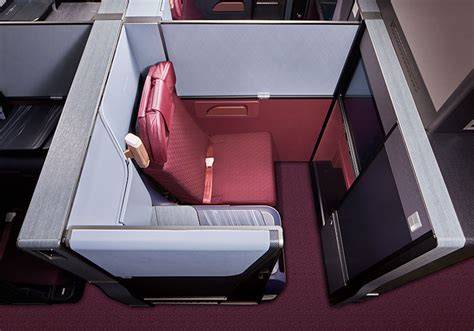
Japan Airlines took a major step forward with its Airbus A350-1000 Business Class Suite, introducing doors to Business Class for the first time in the airline’s history. The result is a product built around a simple but powerful concept: every passenger should have direct aisle access while also having the ability to create a genuinely private environment.
The suite uses a 1-2-1 configuration, ensuring that passengers do not have to climb over a neighboring traveler when accessing the aisle. The seat itself can reach approximately 22 inches (56 centimeters) in width, while the fully flat bed stretches to around 78 inches (198 centimeters). Those figures would already make the product competitive with many premium Business Class seats, but the enclosure is what fundamentally changes the experience.
JAL gives the suite walls reaching approximately 52 inches (132 centimeters) in height. That is considerably different from the relatively low partitions found on older Business Class products. When the door is closed, the passenger is surrounded by a much taller structure that limits sightlines into the cabin. The effect is especially powerful for solo travelers who want to work uninterrupted or sleep without seeing every movement in the aisle.
The airline has also included a personal wardrobe and dedicated storage, allowing passengers to keep more of their belongings within the suite itself. That might sound like a minor detail, but thoughtful storage contributes significantly to the feeling of having a personal room. A cluttered seat can undermine even the most sophisticated privacy architecture; JAL’s approach instead keeps the passenger’s immediate environment relatively clean.
Another clever feature is the privacy partition available for travelers sitting together. The suite can therefore feel enclosed when solitude is the priority but become more socially open when passengers want to communicate. A 24-inch entertainment screen and fully flat bed complete the experience, while the positioning of overhead storage on the window side contributes to a less visually crowded cabin.
JAL’s A350-1000 suite therefore achieves something that is difficult to engineer: it can feel simultaneously private and spacious. The passenger is separated from the cabin without being placed inside a cramped box, which is precisely the balance modern premium travelers increasingly expect.
3. ANA THE Room FX: A 787-9 Suite That Feels Much Bigger Than It Should
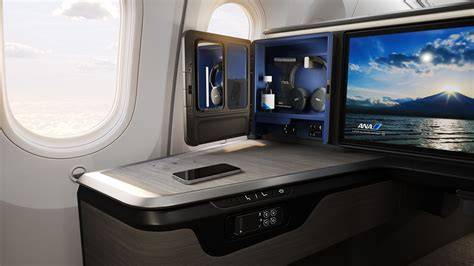
ANA THE Room FX is perhaps the most fascinating product on this list because it takes an unusually spacious suite concept and adapts it to the smaller Boeing 787-9. Introduced in 2025 and progressively deployed from 2026, THE Room FX carries the philosophy of ANA’s famous original THE Room into a medium-sized widebody aircraft.
The name is not accidental. ANA designed the product around the idea that a Business Class seat should provide an actual room-like spatial experience, rather than simply placing a passenger in a slightly wider chair. The alternating forward- and rear-facing layout helps make that possible, while a privacy door at every seat allows passengers to close themselves away from the cabin.
Its dimensions are remarkable. THE Room FX reaches a maximum width of approximately 41.5 inches (105 centimeters), with a waist width of about 27 inches (69 centimeters) and a maximum length of around 76.5 inches (194 centimeters). Seat pitch reaches approximately 103 inches (2.6 meters). These numbers explain why the suite can feel dramatically more expansive than a conventional 1-2-1 Business Class seat.
The unusual width also changes how passengers use the space. There is room to sit, work, dine, relax, and eventually sleep without every activity feeling as though it must happen within the narrow footprint of a traditional airline seat. A 24-inch display, integrated storage, and a fully flat bed reinforce the idea that the passenger has been given a compact personal living area.
ANA has also made an interesting compromise in the evolution from the original THE Room. The newer FX version uses slimmer doors, backrests, and dividers to reduce weight. Importantly, that weight reduction does not eliminate the enclosed architecture that defines the product. Passengers can still close the door when they want solitude and open the space when they want interaction.
That flexibility gives THE Room FX an unusual psychological advantage. The suite does not force isolation on passengers; it gives them control over when to be private. During dinner or a conversation with a flight attendant, the space can feel open. Once the passenger wants to work quietly or sleep, the surrounding cabin can largely disappear behind the door.
2. ANA THE Room: The Business Class Suite That Changed Expectations
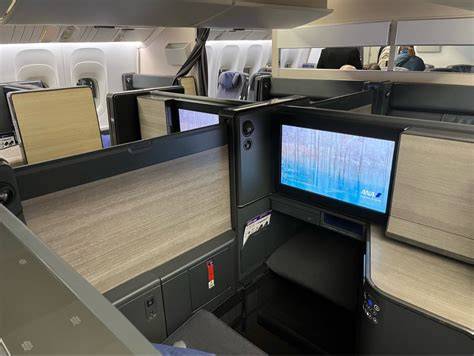
Before THE Room FX arrived, ANA had already demonstrated that Business Class could be radically different with its original THE Room on the Boeing 777-300ER. The product became famous for its enormous seat, substantial walls, and privacy door, creating a personal environment that looks almost oversized compared with conventional airline seating.
THE Room’s defining characteristic is not simply that it has a door. Plenty of modern premium seats now offer doors. What makes ANA’s original product remarkable is the amount of space behind that door. The passenger receives a wide environment that feels more like a lounge than a conventional airline seat, and that environment can then be transformed into a fully flat bed.
The design also uses an alternating seating arrangement to maximize personal space while preserving direct aisle access. When the passenger converts the seat into bed mode, there is no need to climb over another traveler. The surrounding shell simultaneously limits the visual connection with adjacent passengers, creating an unusually strong feeling of separation.
That distinction is important because privacy and space are not exactly the same thing. A narrow suite with a door can technically be private, but if the passenger feels boxed into a tiny compartment, the psychological benefit is reduced. THE Room approaches the problem from the opposite direction, combining exceptional width with enclosure so that the passenger can feel both isolated and unrestricted.
The product also helps explain why ANA has become one of the airlines most associated with premium cabin privacy. Its design philosophy goes beyond adding features to an existing seat. Instead, the aircraft’s interior is reorganized around the passenger’s personal environment.
Singapore Airlines has followed a somewhat related philosophy, although its long-haul Business Class products generally do not include doors. Its 2017 Airbus A380 Business Class seat, for example, used a large carbon-fiber shell and a seat approximately 25 inches wide, producing a cocoon-like environment while retaining a more open cabin feel.
That difference highlights an important point: privacy does not necessarily require a door. However, doors provide the strongest physical and psychological boundary, which is why products such as THE Room have become reference points for the modern premium cabin.
1. Qatar Airways Qsuite: The Business Class Suite That Made Privacy Famous
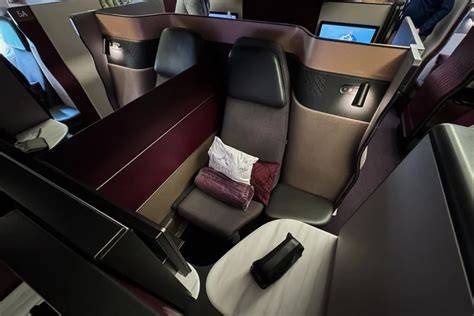
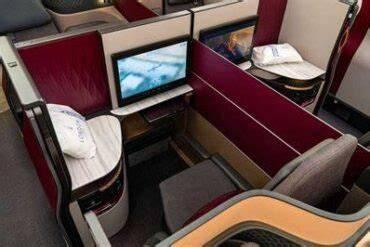
At the top of the list is Qatar Airways Qsuite, the product that arguably turned fully enclosed Business Class from a niche concept into one of the industry’s most influential premium-cabin trends. Introduced in 2017, Qsuite did something particularly ambitious: it made privacy flexible rather than fixed.
For a solo passenger, the suite can function as a highly secluded personal space. The passenger can close the dedicated door, use the surrounding structure to block sightlines, and settle into a lie-flat seat with direct aisle access. Instead of merely offering privacy from the person sitting beside you, Qsuite creates a meaningful boundary between the passenger and the broader cabin.
But Qsuite becomes truly unusual when passengers are traveling together. The movable center panels can be rearranged to create a shared private space, allowing two passengers to interact more naturally. In certain configurations, four center seats can be transformed into a private group area, creating what is effectively a small social room in the middle of the aircraft.
The possibility of a double bed in Business Class is perhaps Qsuite’s most famous innovation. Two passengers traveling together can transform the appropriate center-seat arrangement into a shared sleeping environment, something that was almost unheard of in commercial Business Class before Qsuite appeared.
This flexibility is what separates Qsuite from many competing products. Most private suites are designed primarily around individual passengers. Qsuite can become a solitary retreat, a space for two, or a larger private environment for a group. Qatar Airways therefore did not simply create another Business Class seat; it created a new way of thinking about what a premium cabin could do.
For solo travelers, however, the greatest appeal remains wonderfully straightforward: close the door. Once that happens, the visual presence of the rest of the cabin becomes dramatically less important. Adjustable lighting, high surrounding structures, direct aisle access, and the lie-flat bed complete an environment that can make a long flight feel much more personal.
Why Private Business Class Suites Are Becoming the New Luxury Standard
The rise of these five products reflects a broader transformation in long-haul aviation. Airlines once competed primarily on seat width, pitch, meal quality, entertainment systems, and bed length. Those features remain important, but premium travelers increasingly value something less tangible: control over their surroundings.
A passenger cannot control how many people are in the aircraft, how often someone walks through the aisle, or when a neighboring traveler decides to get up. A well-designed suite cannot eliminate those realities completely, but it can dramatically reduce how much of them the passenger experiences.
That is why doors have become such a powerful feature. They create a psychological boundary as much as a physical one. Closing a door tells the passenger that the space immediately around them belongs to them for the duration of the journey.
Qatar Airways helped popularize this approach with Qsuite, while ANA pushed the concept toward extraordinary personal dimensions with THE Room. JAL brought enclosed suites to its A350-1000, Cathay Pacific developed the wraparound Aria Suite, and ANA’s THE Room FX demonstrates that this design philosophy can be adapted even to a Boeing 787-9.
The result is a new definition of Business Class luxury. The most impressive product is no longer necessarily the one with the biggest meal service or the most elaborate amenity kit. Increasingly, it is the one that allows a passenger to close the door, stretch out, switch off the cabin around them, and genuinely forget that hundreds of other people are traveling on the same aircraft.
For travelers facing an overnight transcontinental or intercontinental flight, that can be more valuable than almost any other premium feature. A private door does not make the aircraft disappear physically—but the best business class suites can make it disappear psychologically.