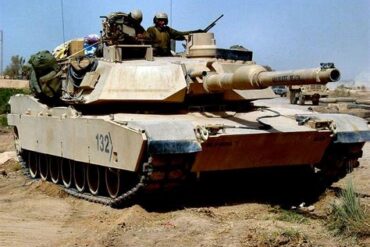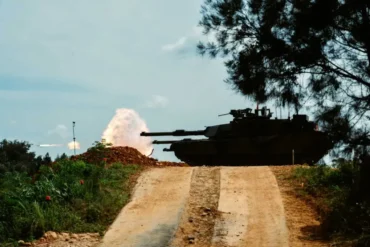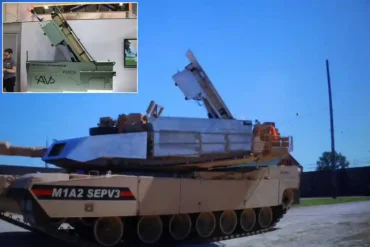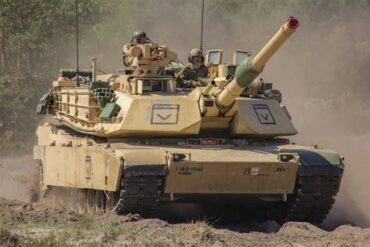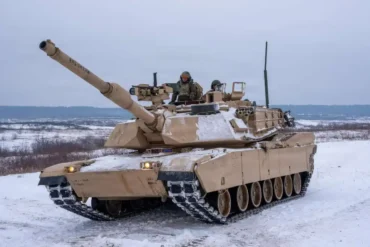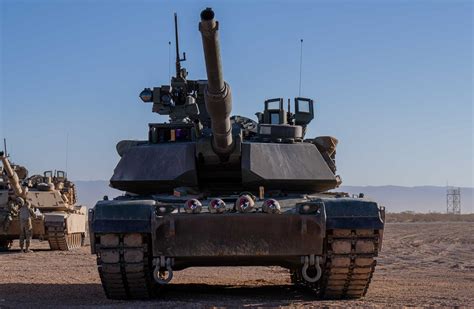
The M1 Abrams is famous for combining heavy armor, a powerful main gun, advanced fire-control systems, and remarkable mobility in one massive package. Since entering U.S. Army service in the early 1980s, the Abrams family has evolved through multiple upgrades, but one characteristic has remained especially notable: speed. Powered by the 1,500-horsepower Honeywell AGT1500 gas turbine, the M1 Abrams can reach roughly 45 mph on favorable terrain, an impressive figure for a vehicle that can weigh more than 60 tons.
Yet 45 mph is not the upper limit for tracked armored vehicles. Tank designers have repeatedly explored the advantages of reducing weight, increasing engine output, or designing vehicles around mobility rather than maximum protection. The result is a fascinating collection of machines that can move faster than the Abrams, although several achieve that speed by occupying a very different place in the armored-vehicle spectrum.
Speed alone, however, does not make one tank more capable than another. A heavily armored main battle tank has very different requirements from a lightweight reconnaissance vehicle or a World War II tank destroyer. The Abrams is designed to survive and fight in extremely demanding environments, so comparing its speed with much lighter vehicles requires some context. Still, if the question is simply which tracked armored vehicles can move faster, several remarkable examples stand out.
The following five vehicles range from a relatively compact Argentine medium tank to one of the fastest armored fighting vehicles ever deployed in combat. Their specifications also demonstrate a basic rule of armored warfare: weight has an enormous influence on mobility.
Tanque Argentino Mediano: A Lightweight Tank With 46.6-Mph Speed
Argentina’s Tanque Argentino Mediano, usually abbreviated as TAM, occupies an unusual position in modern armored warfare. Introduced in 1979, the TAM was developed as a medium tank rather than a traditional main battle tank. Its comparatively modest weight of about 30.5 tons allowed its designers to emphasize mobility without requiring the enormous power needed to move a modern heavy MBT.
The TAM uses an MTU MB 833 Ka-500 six-cylinder diesel engine producing approximately 720 horsepower. On suitable flat terrain, that combination gives the vehicle a reported top speed of around 46.6 mph, putting it just ahead of the M1 Abrams in a simple top-speed comparison.
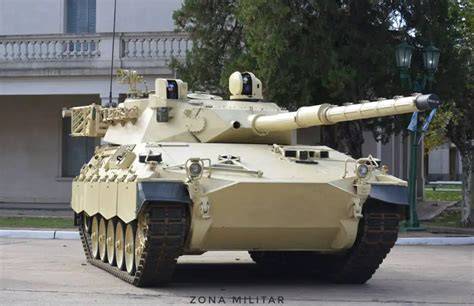
The difference becomes even more interesting when considering the TAM family as a whole. Argentina did not design the platform solely around the tank configuration. The same basic chassis was adapted for infantry fighting, artillery, mortar, command, rocket-launching, and medical roles. This modular approach allowed Argentina to build a broad family of armored vehicles without developing a completely separate chassis for every mission.
The TAM’s speed is therefore closely connected to its relatively low combat weight. At less than half the weight of some Abrams configurations, it does not need a turbine producing 1,500 horsepower to achieve strong battlefield mobility. Its design demonstrates how a lighter armored vehicle can sacrifice some protection and mass while gaining substantial maneuverability.
China’s Type 100 MBT: A New Generation Built Around Mobility
China’s Type 100 MBT attracted considerable attention after appearing during the country’s 2025 military parade commemorating the 80th anniversary of the end of World War II in the Pacific. The vehicle represents a significant departure from the very heavy main battle tanks that have dominated armored development for decades.
Exact specifications remain difficult to establish because China does not publicly disclose every technical detail of its newest armored vehicles. Available assessments place the Type 100’s weight somewhere around 35 to 40 tons, considerably below the weight of an Abrams. Its propulsion system reportedly combines a diesel engine with electric motors and batteries, creating a hybrid-style arrangement that could produce approximately 1,500 horsepower.
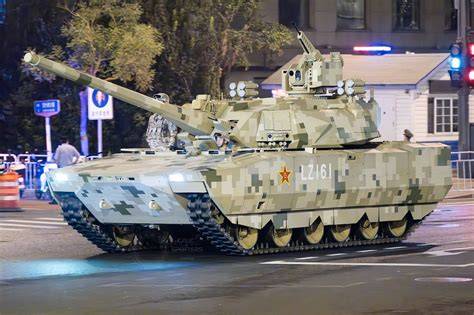
Based on those reported characteristics, the Type 100 could reach approximately 50 mph on flat terrain. That figure would put it clearly above the M1 Abrams while illustrating how modern propulsion technology can change the relationship between power and weight.
The Type 100 is also notable for more than its potential speed. Its design reportedly incorporates extensive automation, allowing a three-person crew rather than the four-person crew traditionally associated with tanks such as the Abrams. The vehicle has also been associated with augmented-reality systems and artificial-intelligence-assisted interfaces intended to provide the crew with more information while reducing their workload.
Because many of the vehicle’s specifications remain unconfirmed, its reported performance should be treated as an estimate rather than a settled specification. Nevertheless, its appearance highlights a continuing trend toward lighter, highly automated armored vehicles that place substantial emphasis on mobility.
FV101 Scorpion: The 51.1-Mph British Light Tank
The FV101 Scorpion is where the distinction between a tank and an armored reconnaissance vehicle becomes especially interesting. Britain developed the Scorpion as a highly mobile light armored vehicle during the 1960s, and it entered service with the British Army during the 1970s. Its compact dimensions and low weight were deliberate choices designed to make it easy to transport and highly maneuverable.
At approximately 7.8 tons, the Scorpion is dramatically lighter than an M1 Abrams. Early vehicles used a Jaguar J60 4.2-liter gasoline engine, while later configurations received different powerplants. Its lightweight construction, including extensive use of aluminum armor, helped produce an extraordinary power-to-weight ratio.
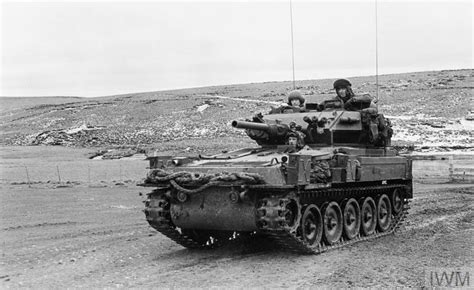
The Scorpion has a reported top speed of approximately 51.1 mph. In 2002, Guinness World Records recognized a Scorpion variant as the world’s fastest tank after a modified vehicle reached that speed during a closed-track run. The exact circumstances matter, but the achievement illustrates the extraordinary mobility built into the platform.
The Scorpion also proved that high speed could have genuine military value. During the Falklands War, British forces used Scorpions in difficult terrain where mobility was extremely important. Its combination of a tracked chassis, compact dimensions, and a powerful gun allowed it to perform reconnaissance and combat missions that would have been difficult for a much heavier tank.
More than 3,000 Scorpion-family vehicles were ultimately produced. Although Britain eventually retired the type, examples continued to serve with foreign militaries, making the Scorpion one of the most recognizable fast light tanks of the modern era.
T-14 Armata: Russia’s 50-to-55-Mph Main Battle Tank
The T-14 Armata represents a completely different approach. Unlike the Scorpion, it is intended to function as a full-fledged main battle tank. Unlike the TAM, it is also designed around a modern heavily protected combat architecture rather than a medium-tank concept.
Russia unveiled the T-14 publicly in 2015, drawing attention to its unmanned turret, armored crew capsule, and highly automated systems. Its reported weight is approximately 48 to 55 tons, depending on configuration, which still makes it considerably lighter than the heaviest Abrams variants.
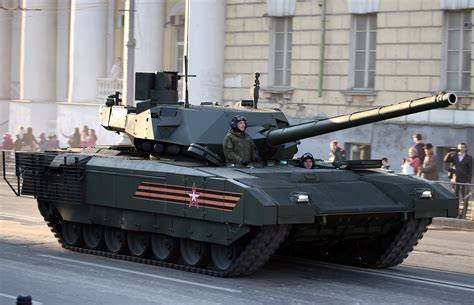
Reported specifications have suggested a top speed somewhere between 50 and 55 mph on suitable terrain. However, the exact figure remains uncertain because Russia has not provided comprehensive, independently verified technical data for every aspect of the vehicle.
The T-14’s mobility comes from its combination of relatively low weight and an engine generally reported to produce around 1,500 horsepower. That gives the tank a power-to-weight ratio that helps explain why it can potentially move faster than the Abrams despite carrying substantial armor and sophisticated equipment.
The Armata’s operational history also deserves caution. Although the vehicle has attracted considerable attention since its debut, its limited production and restricted operational use mean that many claims surrounding its battlefield capabilities remain difficult to independently verify. Its theoretical speed is therefore more firmly established than its real-world performance under sustained combat conditions.
M18 Hellcat: The 60-Mph World War II Speedster
The fastest vehicle on this list is also the oldest. The M18 Hellcat was an American tank destroyer developed during World War II specifically around the idea that speed could compensate for relatively light armor. Officially designated the 76mm Gun Motor Carriage M18, it was not technically a main battle tank, but its tracked configuration, turret, cannon, and battlefield role make it an important part of any discussion about fast tanks.
The Hellcat weighed approximately 16.76 tons, less than one-third the weight of many Abrams configurations. It used the same basic Continental R975 radial engine family found in some M4 Sherman variants, producing around 400 horsepower.
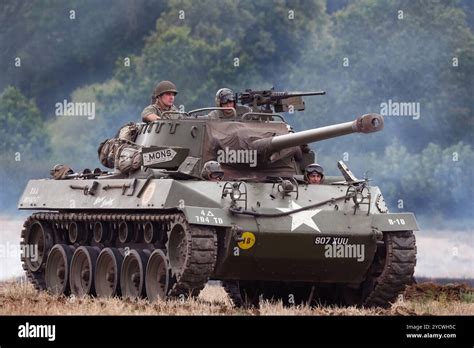
That combination allowed the M18 to reach an extraordinary 60 mph on flat terrain. The speed was not merely a marketing feature. It was central to the vehicle’s tactical concept. American planners wanted a tank destroyer capable of rapidly moving into position, engaging enemy armor, and relocating before the opponent could respond effectively.
The Hellcat’s thin armor made direct confrontations with heavily protected enemy tanks dangerous, but its speed and 76mm gun gave American crews a useful combination of mobility and firepower. The vehicle saw extensive combat during World War II and remained in service during the Korean War.
Calling the Hellcat the fastest tank in history can produce arguments over terminology because it was officially a tank destroyer rather than a main battle tank. But the distinction does not change its measured speed. At 60 mph, the M18 was substantially faster than the M1 Abrams and remains one of the most remarkable examples of high-speed tracked combat vehicle design.
Why the M1 Abrams Is Not the Fastest
The five vehicles above reveal why raw top speed does not tell the entire story of armored vehicle performance. The M1 Abrams was never designed simply to become the world’s fastest tracked vehicle. Its enormous weight reflects requirements for armor protection, firepower, ammunition, crew survivability, electronics, fuel, and battlefield endurance.
The Abrams’ gas turbine also gives it exceptional acceleration and mobility for a vehicle in its weight class. Its roughly 45-mph top speed is therefore only one part of a much broader performance package. A 60-mph Hellcat cannot provide the same protection, ammunition capacity, sensors, or survivability as a modern Abrams, just as a lightweight Scorpion occupies an entirely different tactical role.
That distinction is what makes these vehicles so interesting. The TAM, Type 100, Scorpion, T-14 Armata, and M18 Hellcat each demonstrate a different solution to the same fundamental engineering problem: how to make a tracked armored vehicle move quickly without compromising the mission it was designed to perform.
From the lightweight aluminum-armored Scorpion to the high-powered M1 Abrams, tank development has always involved trade-offs. Sometimes the winning formula is more armor and power. Sometimes it is a smaller chassis and extraordinary agility. And in the case of the M18 Hellcat, a radically different tactical philosophy made speed itself one of the vehicle’s most important weapons.