The Royal Air Force has fewer distant outposts than it did during the height of the British Empire, but its remaining remote stations still reveal how geography shapes military power. Some are conventional airbases, while others are radar sites, joint facilities, or overseas operating locations that RAF aircraft use without being permanently based there. Together, they extend British airpower far beyond the United Kingdom and create a network of staging points, surveillance nodes, and defensive positions.
Distance is only one measure of remoteness. A station can be isolated by ocean, geography, or the specialized mission it performs. The RAF’s remote infrastructure therefore matters less for its size than for the strategic geography it occupies.
Seven locations below illustrate that range. From Scotland’s northern coast to the South Atlantic and Indian Ocean, each contributes to a different part of Britain’s air-defense, surveillance, mobility, or overseas-security architecture. Several are not technically RAF stations, a distinction, but they remain relevant because RAF aircraft or personnel use them as part of British and allied operations.
7. RAF Lossiemouth: Scotland’s Northern Quick Reaction Alert Hub
RAF Lossiemouth is not remote in the same sense as an island base in the South Atlantic, yet its position in northeast Scotland makes it one of the RAF’s most geographically isolated major fast-jet stations on the British mainland. It is also the only operational RAF station in Scotland following the closure of RAF Leuchars as an RAF fast-jet base. Lossiemouth also sits close to important northern air approaches.
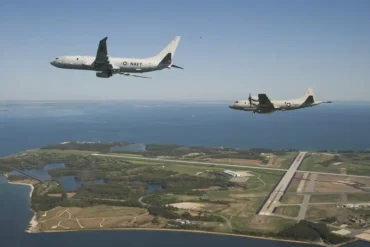
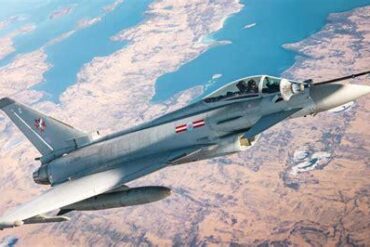
The station hosts Typhoon squadrons and the RAF’s Poseidon maritime patrol force, linking air defense with maritime surveillance. RAF Lossiemouth operates one of Britain’s Quick Reaction Alert commitments, with Typhoons maintained at readiness around the clock. RAF guidance states that QRA aircraft can launch without notice when scrambled, while Poseidon aircraft can also be tasked at short notice. That combination makes Lossiemouth much more than a fighter base. It is a northern node connecting British air defense with the North Atlantic and maritime security missions.
Its location also makes it valuable for training. The surrounding airspace provides room for demanding fast-jet activity, while the station regularly supports exercises involving British and international forces. Its remoteness is therefore relative: it is distant from southern Britain while remaining close to northern approaches.
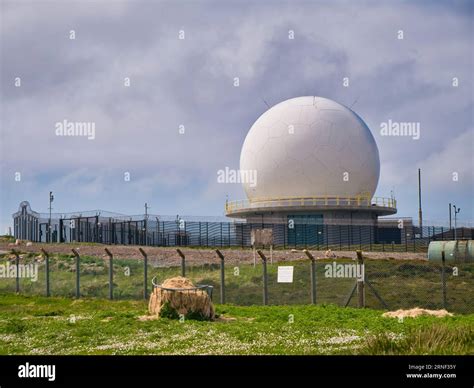
6. RRH Benbecula: A Remote Radar Eye Over the North Atlantic
RRH Benbecula is an unusual entry because it is not currently a conventional RAF airbase with permanent flying squadrons. Instead, it is a remote radar installation in the Outer Hebrides, where its geographical isolation is directly connected to its military purpose. The site forms part of the United Kingdom’s Air Surveillance and Control System, the network used to maintain awareness of activity in and around British and NATO airspace.
Benbecula’s value comes from what it can see rather than what it can launch. Its long-range radar coverage helps monitor air approaches across the North Atlantic and the strategically important Greenland-Iceland-United Kingdom-Norway region. Aircraft approaching from the north can therefore be tracked as part of a larger surveillance architecture.
Benbecula also demonstrates how modern air defense has changed. During the Cold War, remote airfields could be associated with squadrons, shelters, and large support communities. Today, advanced sensors can perform a critical mission with a much smaller footprint. Its remoteness places a sensor in a useful position without requiring a full combat airbase.
5. RAF Gibraltar: A Strategic Gateway Into the Mediterranean
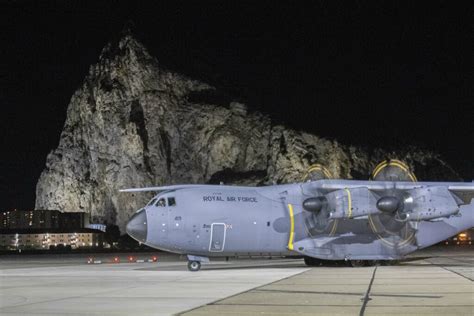
RAF Gibraltar is more than 1,000 miles from the United Kingdom and occupies one of the most recognizable strategic locations in the world. The airfield sits beside the Strait of Gibraltar, the narrow maritime gateway linking the Atlantic Ocean with the Mediterranean Sea. That geography has given Gibraltar military significance for centuries, and the location remains useful to British forces even though no RAF combat aircraft are permanently stationed there.
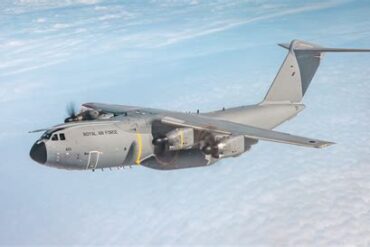
The airport is a joint civil and military facility, with the civilian terminal operated by the Government of Gibraltar. For the RAF, its principal value is as a staging, transit, and support point. Military transport aircraft such as the A400M Atlas and C-17 Globemaster III can use the airfield when moving between Britain, Africa, the Mediterranean, and the Middle East. The small airfield can therefore become an important link in a much larger air mobility network.
The ability to receive and support aircraft there can shorten logistical chains and provide flexibility during overseas operations.
4. RAF Akrotiri: Britain’s Forward Airbase in the Eastern Mediterranean
RAF Akrotiri is roughly 2,000 miles from the United Kingdom and occupies a different strategic environment from Gibraltar. Located within the UK’s Sovereign Base Area on Cyprus, the station provides Britain with a permanent military foothold close to the Eastern Mediterranean and Middle East. The base was retained when Cyprus became independent in 1960, preserving a strategically important British position outside the mainland.
The RAF describes Akrotiri as a busy Permanent Joint Operating Base and a forward mounting base for overseas operations in the Middle East. It also supports fast-jet training and a range of intelligence, surveillance, reconnaissance, transport, tanker, and support activities. Its helicopters contribute to search-and-rescue duties in cooperation with Cypriot authorities, giving the station responsibilities that extend beyond combat operations.
Akrotiri’s greatest strategic advantage is proximity. Aircraft operating from Britain may require extensive tanker support and long transit times to reach the Middle East. Akrotiri places a military airfield much closer to those operating areas, allowing aircraft to stage, train, recover, and support missions from a location with established British infrastructure. RAF personnel and aircraft can therefore respond to regional requirements without depending entirely on access to foreign bases.
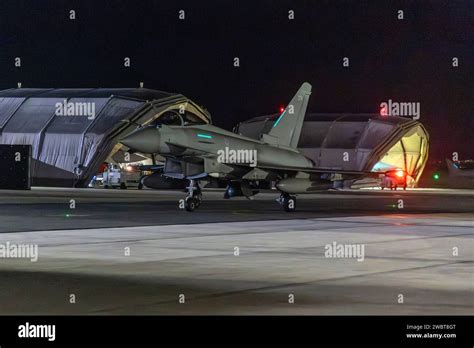
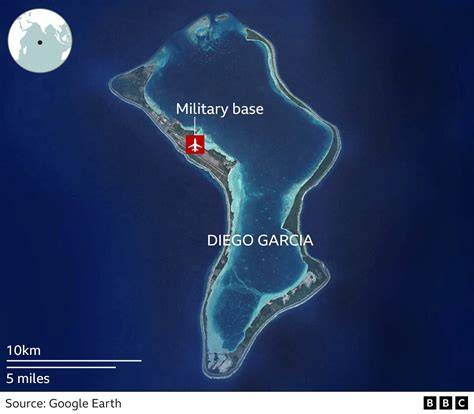
3. Naval Support Facility Diego Garcia: The Indian Ocean Staging Point
Diego Garcia is the most technically complicated location on this list because it is not an RAF station. The facility is a joint UK-US military base in the British Indian Ocean Territory, and the United States operates the main air and naval infrastructure. British personnel remain present, while RAF aircraft can use the facility under the arrangements governing access to the base. The UK government continues to describe the installation as strategically important to British and allied security.
Its strategic importance comes from geographic reach. Diego Garcia lies in the central Indian Ocean, far from the population centers and political boundaries that define most European military infrastructure. From this isolated atoll, the United States and United Kingdom can support operations across the Indian Ocean, Middle East, and wider Indo-Pacific region. The British government has described the base as strategically critical and emphasized its role in supporting UK and allied security objectives.
The island’s remoteness is part of its military value. Surrounded by thousands of miles of ocean, it provides a staging platform for long-range aircraft and maritime forces. It can support aircraft movements, logistics, communications, and broader power-projection missions without requiring a dense network of bases in every surrounding country.
In May 2025, the UK and Mauritius signed an agreement intended to secure continued operation of the UK-US base. Official UK statistics in 2026 continue to treat Diego Garcia as part of the British Indian Ocean Territory while the wider sovereignty arrangements evolve.
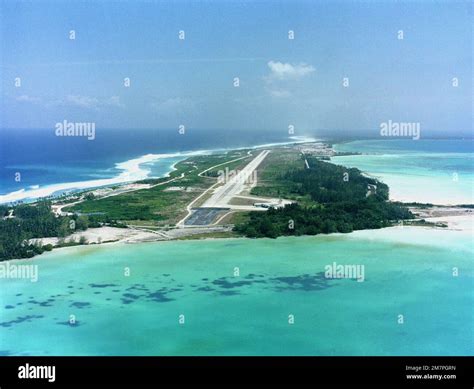
2. RAF Ascension Island Base: The Mid-Atlantic Bridge
Ascension Island Base sits about 4,000 miles from both the United Kingdom and the Falkland Islands, making it one of the RAF’s most important South Atlantic staging locations. The volcanic island lies roughly halfway between Africa and South America, and its position gives British aircraft a valuable intermediate point between Europe and the South Atlantic territories.
The RAF states that the station’s role includes deterring military aggression against the UK’s South Atlantic Overseas Territories and maintaining British sovereignty. It is also a staging post for flights between the United Kingdom and the Falkland Islands. The airfield divides an enormous journey into manageable segments and provides opportunities for refueling, maintenance, cargo handling, and crew support.
Ascension also supports communications, space-related infrastructure, humanitarian activity, and logistics. Its joint operation with the United States also makes it a platform for allied cooperation.
The island’s strategic value became particularly clear during the Falklands War, when Ascension served as a crucial intermediate point for the British military effort. Its importance has continued long after the conflict because the fundamental geography has not changed: Britain remains thousands of miles from its South Atlantic territories, and Ascension remains positioned between them.
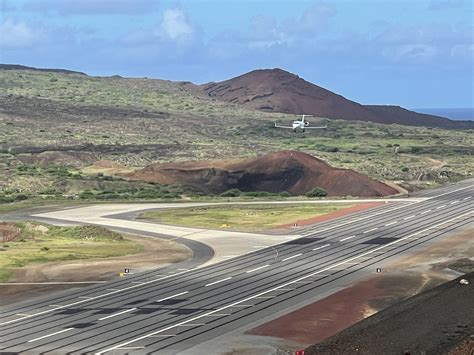
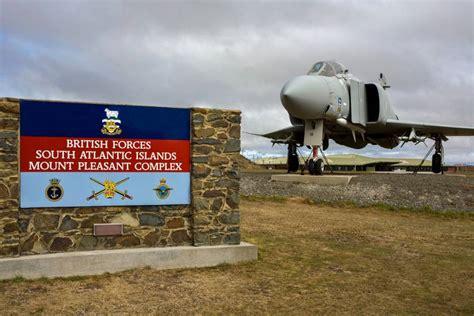
1. RAF Mount Pleasant: The Falklands’ Remote Air Defense Fortress
Mount Pleasant is approximately 8,000 miles from the United Kingdom and is a clear example of a base shaped by strategic geography. Opened in 1985 after the Falklands War, the Mount Pleasant Complex established a permanent British fighter and transport presence in the islands. It remains central to British Forces South Atlantic Islands.
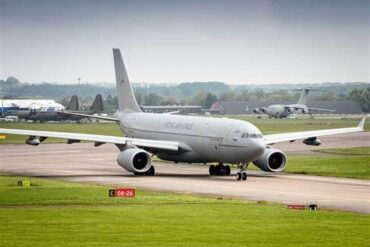
The RAF currently lists No. 1435 Flight at Mount Pleasant with four Typhoon FGR4 fighters, alongside No. 1312 Flight operating a Voyager tanker and an A400M Atlas. Ground personnel support the fighters through radar, weapons, engineering, and other specialist functions. This combination gives Britain a self-contained air-defense capability thousands of miles from the homeland.
Mount Pleasant also supports the wider logistics of the Falkland Islands. Regular RAF flights connect the complex with RAF Brize Norton in the United Kingdom, creating an air bridge that links the isolated territory with Britain. The station therefore serves two purposes simultaneously: it provides a military shield and acts as a logistical lifeline.
Its location creates unavoidable logistical challenges. Aircraft, personnel, spare parts, fuel, and supplies must cross enormous distances, with Ascension providing an important staging point. This makes Mount Pleasant an example of how a remote military base must be designed around resilience, sustainment, and rapid response rather than proximity to a major domestic support network.
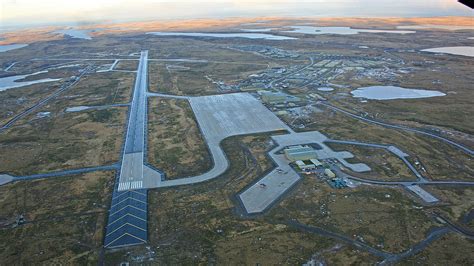
Why These Remote RAF Locations Still Matter
The seven locations demonstrate how the RAF’s overseas geography has evolved rather than disappeared. Some defend British airspace, watch distant approaches, support overseas territories, or provide transoceanic logistics.
The most important feature shared by these bases is not their distance from London. It is their position relative to strategic routes. Lossiemouth watches the northern approaches; Benbecula strengthens remote radar coverage; Gibraltar sits at the entrance to the Mediterranean; Akrotiri places British airpower close to the Middle East; Diego Garcia provides an Indian Ocean platform; Ascension bridges the Atlantic; and Mount Pleasant anchors British defense in the Falklands.
That geography explains why remote bases remain relevant even as modern aircraft become more capable. Long-range fighters, tankers, transports, maritime patrol aircraft, satellites, and advanced sensors have reduced some of the limitations imposed by distance, but they have not eliminated geography. A runway, radar site, or support facility in the right place can still change how quickly and efficiently military forces can operate across thousands of miles.
For the RAF, the result is a relatively small but geographically diverse network connecting air defense, surveillance, logistics, sovereignty, and allied operations across the North Atlantic, Mediterranean, Indian Ocean, and South Atlantic.