
Air Canada and Air Transat are preparing a significant expansion of their transatlantic networks, with five new routes set to connect Canada with Europe and the Canary Islands during the upcoming winter season. The additions are heavily focused on leisure travel, giving Canadian passengers more nonstop options for escaping colder weather while allowing the airlines to explore secondary European markets that can support relatively thin long-haul demand.
The five routes will operate from Toronto Pearson International Airport (YYZ), Montréal-Trudeau International Airport (YUL), and Istanbul Airport (IST), with the Canary Islands accounting for four of the new Canada-Europe connections. Rather than relying exclusively on large widebody aircraft, the airlines are increasingly using long-range narrowbodies such as the Airbus A321XLR and A321LR, illustrating how modern aircraft are changing the economics of transatlantic flying.
Air Canada Expands to Tenerife
Air Canada will introduce two new services to Tenerife South Reina Sofía Airport (TFS) in the Canary Islands. Both routes will be operated by the airline’s Airbus A321XLR, an aircraft designed specifically to make long-distance routes to smaller markets more commercially viable.
The Montréal-Tenerife service is scheduled to operate once weekly on Saturdays, beginning October 31 and continuing through April 24, 2027. The Toronto-Tenerife route will offer a stronger schedule, with two weekly flights on Thursdays and Sundays from October 25 through April 29, 2027.

The A321XLR gives Air Canada an important tool for serving destinations that may not generate enough demand for a larger widebody aircraft. Its long-range capability allows the carrier to connect eastern Canada directly with Tenerife while maintaining a more manageable seat supply.
Air Canada’s A321XLR configuration features 14 Business Class seats and 168 Economy seats, creating a 182-seat aircraft ideally suited to a route where leisure traffic is expected to dominate. The aircraft also gives passengers a nonstop alternative to connecting through larger European hubs.
Air Transat Targets Gran Canaria
Air Transat is following a similar strategy by launching two new services to Gran Canaria (LPA), another major destination in Spain’s Canary Islands. The carrier will connect Gran Canaria with both Montréal and Toronto using its Airbus A321LR fleet.
The Montréal-Gran Canaria service will operate weekly on Saturdays, while Toronto-Gran Canaria flights will operate every Sunday. Both routes are scheduled to begin in mid-December and continue until early April, matching the peak winter period when demand for warm-weather destinations typically increases.

Air Transat’s A321LRs are configured with 12 Business Class seats and 187 Economy seats, providing a total of 199 seats. That higher-density layout makes the aircraft particularly appropriate for leisure-oriented routes where keeping unit costs under control is essential.
The Gran Canaria additions also demonstrate the competitive overlap between Canada’s two major leisure and network carriers. Air Canada is targeting Tenerife, while Air Transat is adding Gran Canaria, giving Canadian travelers more choice across the Canary Islands without requiring a connection in mainland Europe.
Montréal–Istanbul Adds a Different Dimension
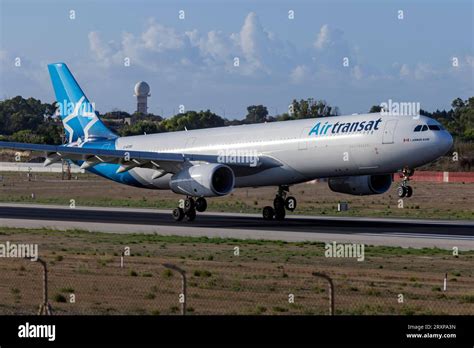
The fifth new route takes Air Transat beyond the Canary Islands. The airline will launch a new Montréal-Istanbul service, linking Québec’s largest city with one of Europe’s most important international aviation hubs.
Flights are scheduled to begin on October 29 and operate twice weekly, on Tuesdays and Thursdays. Unlike the Canary Islands services, this route will be operated by Air Transat’s Airbus A330 widebody aircraft, reflecting the greater network potential and longer-haul profile of the Istanbul market.
Istanbul also offers passengers opportunities beyond the destination itself. As a major connecting point between Europe, Asia, the Middle East, and Africa, the route could attract both leisure travelers and passengers visiting family or continuing onward.
Five Routes Reflect a Changing Transatlantic Market
The broader Canada-Europe market remains exceptionally important to Canadian airlines. In August 2026, scheduling data indicates that Canadian airports are set to see 4,651 departures to Europe. Air Canada accounts for 1,647 of those flights, while Air Transat operates another 860. WestJet follows with 498 departures.
The scale of this market explains why airlines continue experimenting with new destinations even as traditional European hubs remain highly competitive. The growth of long-range narrowbody aircraft is particularly significant because it enables carriers to test routes with smaller capacity and lower operating costs than conventional widebody aircraft.
For Canadian travelers, the result is a broader map of nonstop European possibilities. Tenerife, Gran Canaria, and Istanbul are not simply additional destinations; they represent a shift toward more specialized, seasonal transatlantic services designed around changing passenger demand.
As the winter 2026–27 schedules take shape, Air Canada and Air Transat’s five additions could therefore become an important example of how Canadian airlines are reshaping long-haul networks. Instead of concentrating every European flight through the continent’s largest gateways, both carriers are increasingly using modern aircraft to reach distinctive destinations directly from Canada’s biggest cities.