Air Canada is preparing for a notable shift in how it deploys long-haul aircraft, and the arrival of the Airbus A321XLR sits at the center of that transformation. The Canadian flag carrier has long relied on widebody aircraft for intercontinental flying, but this new generation narrowbody brings something unusual to the airline’s toolkit: transatlantic range with narrowbody economics. That combination allows Air Canada to experiment with routes that would otherwise be too thin for larger aircraft.
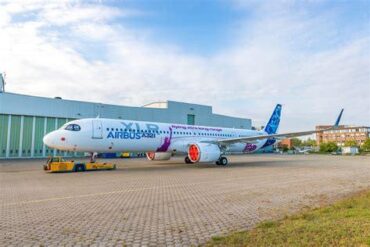
The A321XLR represents a leap forward in the evolution of the single-aisle airliner. Airbus designed the aircraft with an extended range exceeding 4,700 nautical miles, allowing airlines to connect city pairs that previously required widebodies or were not viable at all. For a network carrier like Air Canada, which operates major hubs in Toronto Pearson (YYZ) and Montreal Trudeau (YUL), this means opening secondary European destinations while maintaining frequency and profitability.
Air Canada’s fleet plan reflects confidence in the aircraft’s potential. The airline has 30 Airbus A321XLRs on order, and the first examples will gradually integrate into the network beginning in 2026. According to scheduling data from aviation analytics firm Cirium, the airline intends to deploy the aircraft on 12 routes during its first operational year, spanning domestic services, transatlantic links, and one strategic route into the United States.
Domestic Routes Launch the A321XLR Era
Airlines almost always introduce new aircraft types on familiar routes before sending them across oceans. Air Canada is following the same logic by initially deploying the 182-seat Airbus A321XLR on domestic flights from Montreal. These early routes allow pilots, ground crews, and maintenance teams to become comfortable with the aircraft while exposing passengers to its updated onboard product.
The first domestic route scheduled for the A321XLR connects Montreal Trudeau International Airport (YUL) with Calgary International Airport (YYC). The aircraft will begin flying this route from May 1 through May 15, before returning later in the summer for a longer stretch of daily operations between June 15 and October 24. Calgary represents a strategic domestic market linking eastern Canada with the country’s energy and business hub in Alberta.
Later in the summer, Air Canada plans to deploy the aircraft between Montreal and Vancouver International Airport (YVR). Beginning on August 1, the route will see daily A321XLR operations until September 7. This transcontinental flight spans nearly the entire width of Canada and serves as a practical proving ground for the aircraft’s long-range capabilities within the domestic network.
Air Canada executives see the aircraft as a stepping stone toward broader global growth. Mark Galardo, the airline’s Executive Vice President and Chief Commercial Officer, described the jet as a “revolutionary narrowbody aircraft” capable of unlocking routes that previously required much larger planes.
A New Wave of Secondary Transatlantic Routes
While domestic flights serve as a warm-up, the real strategic play begins across the Atlantic. Air Canada plans to operate the majority of its A321XLR flights on secondary European routes, destinations with steady demand but not enough traffic to justify widebody aircraft year-round.
From Toronto Pearson International Airport, the A321XLR will operate three routes into Europe. Service to London Heathrow (LHR) is scheduled to begin on August 31, bringing the aircraft into one of the world’s busiest aviation markets. While Heathrow already sees widebody flights from Air Canada, the narrowbody deployment allows the airline to maintain flexibility and potentially add frequency.
Later in the year, Toronto will gain two additional A321XLR destinations. Flights to Manchester Airport (MAN) are expected to begin on October 25, connecting Canada’s largest city with northern England’s industrial and cultural center. Just two days later, on October 27, the aircraft will launch service to Copenhagen Airport (CPH) in Denmark, extending Air Canada’s reach into Scandinavia.
Montreal, however, will be the real hub of A321XLR transatlantic experimentation.
Montreal’s Expanding European Network
Air Canada has long maintained strong ties between Montreal and France, reflecting both linguistic and cultural connections between Quebec and French regions. The A321XLR will strengthen those links by enabling several direct routes that would have been difficult to sustain with widebody aircraft.
The first of these routes will connect Montreal with Toulouse-Blagnac Airport (TLS) starting June 1. Toulouse is globally known as the headquarters of Airbus, making the route symbolically fitting for the debut of Airbus’s newest narrowbody in Air Canada’s fleet.
Two additional French destinations follow later in the year. Service to Nantes Atlantique Airport (NTE) is scheduled to launch on July 15, opening a direct connection to western France. Meanwhile, flights to Lyon-Saint Exupéry Airport (LYS) will begin on September 8, linking Montreal with one of France’s most important economic and cultural hubs.
Beyond France, the aircraft will connect Montreal with several other European cities. Berlin Brandenburg Airport (BER) will receive A321XLR service between July 2 and October 10, while Porto Airport (OPO) in Portugal will see intermittent flights beginning June 15 and continuing through October 23.
Another notable addition is Edinburgh Airport (EDI) in Scotland. The A321XLR will operate a short seasonal run here, completing seven round-trip flights between June 16 and June 30. Although limited in duration, the route demonstrates the aircraft’s role as a tool for testing niche transatlantic demand.
A Strategic Transborder Route to Los Angeles
Not all A321XLR flights will cross the Atlantic. Air Canada also plans to deploy the aircraft on a key Canada–United States route, connecting Montreal with Los Angeles International Airport (LAX).
Scheduled for daily service between October 1 and October 24, this route highlights the aircraft’s versatility. The flight distance between Montreal and Los Angeles is substantial for a narrowbody aircraft, yet the A321XLR handles it comfortably while offering airlines lower operating costs compared with widebody alternatives.
The route also taps into strong demand for travel between eastern Canada and the U.S. West Coast, including tourism, entertainment industry connections, and technology sector travel.
Cabin Configuration and Passenger Experience
Air Canada’s A321XLR configuration leans toward efficiency. The aircraft will carry 182 passengers, making it relatively dense compared with some competing airline layouts. Within that total, 14 seats will be dedicated to business class, while the remaining 168 seats will be in economy class.
Despite the higher density, the aircraft will feature an upgraded cabin environment. Modern Airbus Airspace interior design, larger overhead bins, and improved lighting systems aim to create a more comfortable long-haul experience even within the confines of a narrowbody fuselage.
This configuration signals how Air Canada views the aircraft: not as a luxury flagship, but as a precision tool for route expansion.
Why the Airbus A321XLR Matters for Air Canada
The broader story behind these twelve routes is about network flexibility. Traditionally, airlines faced a blunt choice: deploy a large widebody aircraft or abandon a route altogether. The A321XLR dissolves that constraint, allowing airlines to test markets, launch seasonal services, and build new international connections with far lower risk.
For Air Canada, the aircraft opens the door to dozens of potential routes linking mid-sized European cities with Canadian hubs. If these initial services perform well, the airline could rapidly expand its narrowbody long-haul network in the years ahead.
In the grand chessboard of airline strategy, the Airbus A321XLR is not merely another aircraft type. It is a range-stretching, market-opening machine, and Air Canada’s 2026 route plan offers the first glimpse of how that machine will reshape the carrier’s global map.