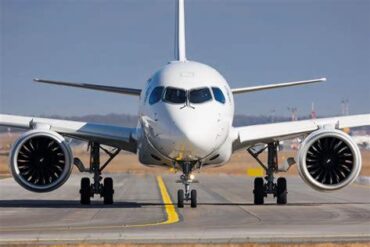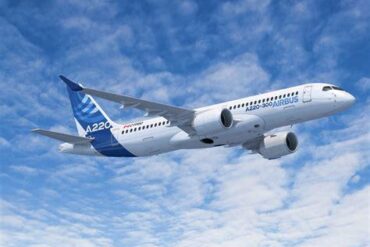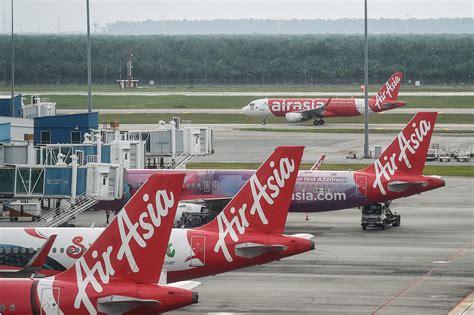
AirAsia’s massive commitment to the Airbus A220 family has reignited one of the aviation industry’s most persistent questions: Will Airbus finally launch the A220-500? The Malaysian low-cost giant has not only ordered 150 A220-300 aircraft, but it has also openly signaled its willingness to purchase another 150 aircraft if Airbus develops the stretched variant many airlines have quietly wanted for years.
The move places Airbus in a strategic position. The manufacturer must now decide whether the market demand for a larger A220 is strong enough to justify development costs, supply-chain adjustments, and the potential risk of competing against its own A320neo family. With AirAsia CEO Tony Fernandes publicly challenging Airbus to move forward, the pressure surrounding the A220-500 has never been higher.
The timing is particularly significant because the A220 program is entering a more mature phase after years of production ramp-up struggles, engine reliability concerns, and profitability challenges inherited from Bombardier’s original CSeries project. Airlines, meanwhile, continue searching for fuel-efficient narrowbody aircraft capable of carrying more passengers on medium-haul routes without the operating costs associated with larger jets.
AirAsia’s latest order may ultimately become the catalyst that transforms the A220-500 from industry speculation into reality.
After announcing the order, Fernandes made his intentions unmistakably clear by describing the A220 platform as an aircraft that was “built to be stretched.” His comments were directed toward Airbus Commercial Aircraft CEO Lars Wagner, effectively turning a commercial aircraft order into a public challenge.
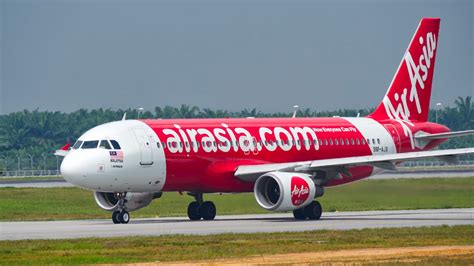
Why AirAsia Wants the Airbus A220-500
For AirAsia, the appeal of the A220-500 is straightforward. The airline operates one of the world’s largest low-cost networks and depends heavily on maximizing seat capacity while minimizing fuel burn and operational expenses. A stretched A220 capable of carrying around 185 passengers would fit neatly between regional aircraft and traditional narrowbody jets.
That figure is especially important because it approaches the seating capacity of high-density Airbus A320 configurations while potentially offering superior economics on thinner or medium-demand routes. Fernandes has repeatedly hinted that the aircraft could become a cornerstone of AirAsia’s future expansion strategy across Asia-Pacific markets.
AirAsia is already set to become the launch customer for a revised high-density cabin layout on the A220-300. Airbus is modifying the aircraft to accommodate 160 seats through the installation of additional overwing exits. This development alone reveals how aggressively Airbus and AirAsia are pushing the limits of the A220 platform.
The existing A220 lineup currently includes the smaller A220-100 and the larger A220-300. Traditionally, the A220-300 has accommodated between 120 and 150 passengers, though the new AirAsia configuration expands those limits considerably.
A stretched A220-500 would take that philosophy even further.
Fernandes openly stated that if Airbus builds the aircraft, AirAsia would immediately commit to another order of 150 jets. In aviation manufacturing terms, that is not just interest — it is a powerful commercial incentive.
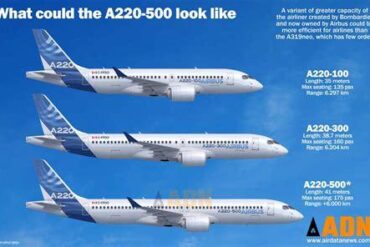
What the Airbus A220-500 Could Look Like
Although Airbus has not officially confirmed specifications, industry expectations surrounding the A220-500 have become increasingly detailed. The aircraft would almost certainly involve a fuselage stretch of the A220-300 while retaining much of the existing aircraft architecture.
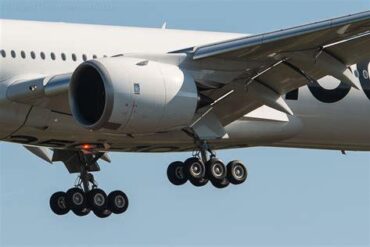
Keeping the current wing design and Pratt & Whitney PW1500G geared turbofan engines would significantly reduce development costs and certification complexity. Airbus is unlikely to redesign major structural systems such as the landing gear or flight deck because doing so would undermine the financial logic of the project.
Instead, the manufacturer appears focused on a relatively conservative stretch strategy.
Industry analysts believe the aircraft could seat anywhere from 165 to 185 passengers depending on cabin layout. Given that the upgraded A220-300 already reaches 160 seats, the upper end of that estimate now seems increasingly plausible.
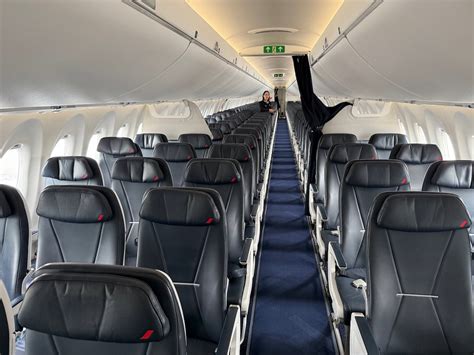
The challenge, however, lies in balancing passenger capacity with aircraft range and performance. A longer fuselage and denser cabin inevitably increase weight, potentially reducing the aircraft’s maximum range compared to the A220-300.
Reports from aviation consultancy Leeham News suggest the A220-500 could experience roughly a 13% reduction in range. Even so, the aircraft would still likely maintain strong capabilities for regional and medium-haul operations throughout Europe, Asia, and North America.
Airbus may also introduce aerodynamic refinements to compensate for the increased weight and preserve takeoff performance. These changes could include minor wing adjustments or software optimizations rather than expensive structural redesigns.
Such an approach would align with Airbus’ broader strategy of controlling development costs while accelerating entry into service.
Airlines Already Interested in the A220-500
AirAsia is far from the only airline interested in a stretched A220. Several major carriers have hinted at strong interest over the years, particularly airlines seeking a modern replacement for aging Airbus A319s and Boeing 737-700 aircraft.
Air Canada has publicly described the A220-500 as “very interesting,” a notable statement considering the carrier already operates the A220 family extensively. Air France has also discussed the potential role of a larger A220 in its future fleet plans.
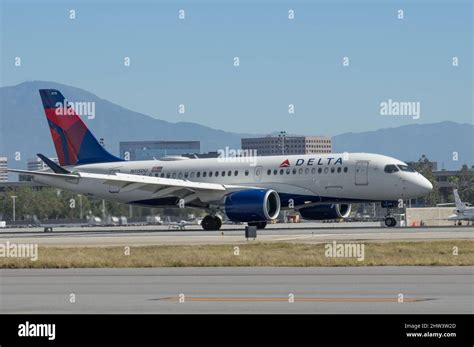
Delta Air Lines is widely considered another prime candidate. The US carrier already operates one of the world’s largest A220 fleets and has consistently praised the aircraft’s passenger comfort and operating efficiency.
Meanwhile, Latvia’s airBaltic has openly supported both a stretched version and increased fuel capacity. The airline has used its A220 fleet on surprisingly long routes, including services between Riga and Dubai, demonstrating the aircraft’s operational flexibility.
The broader appeal of the A220-500 comes from its ability to occupy a unique market niche. Airlines increasingly want aircraft that are more efficient than larger narrowbodies but still capable of carrying substantial passenger volumes.
That demand has become even more relevant as airlines focus on route optimization and fuel efficiency in an era of fluctuating fuel prices and environmental pressures.
Not everyone is convinced, however. AerCap CEO Aengus Kelly recently stated that he does not see sufficient market demand for a stretched A220. His skepticism reflects concerns that the aircraft could overlap too heavily with the Airbus A320neo, potentially limiting its commercial potential.
Why Airbus Has Delayed the Program
Airbus’ hesitation has never been about whether the A220-500 is technically possible. The real issue has always centered on timing, industrial readiness, and profitability.
Since acquiring the CSeries program from Bombardier, Airbus has spent years stabilizing production and improving financial performance. The company has repeatedly insisted that the program needed to reach “cruising altitude” before launching additional variants.
The A220 program has also faced serious engine-related disruptions. Pratt & Whitney’s geared turbofan problems caused widespread aircraft groundings across multiple operators. At one stage, more than 22% of the global A220 fleet was reportedly affected by corrosion inspections and maintenance issues linked to the PW1500G engine family.
These problems created production delays, strained airline relationships, and complicated Airbus’ expansion plans.
At the same time, Airbus has struggled with broader supply-chain pressures affecting the global aerospace sector. The manufacturer recently lowered its expected A220 production ramp-up target from 14 aircraft per month to 12 by 2026.
Launching a new variant while dealing with ongoing industrial bottlenecks would carry significant risks.
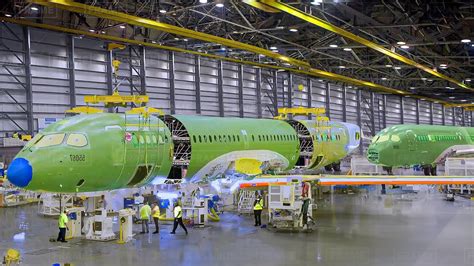
Airbus executives have nevertheless begun signaling that serious internal work on the A220-500 is underway. CEO Guillaume Faury recently acknowledged “ongoing work” involving suppliers, financing, industrial planning, and technical evaluations.
Those comments represented one of the clearest public indications yet that Airbus is actively preparing for a possible launch.
Could the A220-500 Launch Soon?
Industry speculation increasingly points toward a formal announcement within the next one to two years, with major aerospace events such as the Farnborough International Airshow viewed as possible launch venues.
AirAsia’s order may accelerate that timeline considerably. Aircraft manufacturers often rely on strong launch customers to justify investment decisions, and AirAsia has effectively offered Airbus both commercial validation and substantial order volume.
The manufacturer still faces a delicate balancing act. Airbus must ensure the A220-500 complements rather than cannibalizes the A320neo family. That internal competition has long been one of the largest strategic concerns surrounding the project.
Yet market dynamics appear to be shifting in favor of the larger A220. Airlines increasingly value aircraft flexibility, lower trip costs, and fuel efficiency over sheer size. The A220-500 could become an ideal aircraft for high-frequency regional routes, secondary international markets, and lower-demand long-haul services.
Airbus now appears closer than ever to making a decision that could reshape the narrowbody market for the next decade.
If the company moves forward, AirAsia will likely be waiting first in line.