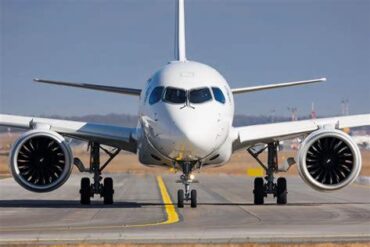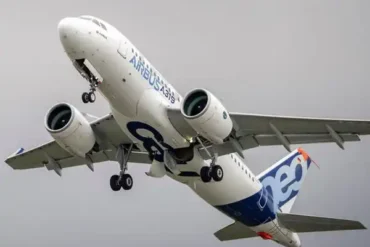
The transformation of the Airbus A220 from a niche experimental aircraft into a cornerstone of airline profitability in North America is one of the most compelling aviation success stories of the decade. What was once viewed as a risky clean-sheet design has evolved into a financial powerhouse, delivering a rare combination of operational efficiency, passenger appeal, and network flexibility. Airlines that once hesitated are now doubling down, and those that adopted early are reaping measurable rewards across their balance sheets.
At its core, the A220’s success is not accidental. It represents a deliberate shift toward right-sized aviation, where capacity aligns precisely with demand rather than chasing scale for its own sake. In an era of volatile fuel prices, shifting travel patterns, and increasingly fragmented route demand, this aircraft has proven that smaller, smarter, and more efficient can outperform traditional narrowbody giants.
The numbers tell a clear story. With up to 25% lower fuel burn per seat, reduced maintenance complexity, and the ability to operate profitably on thinner routes, the A220 is redefining what airlines expect from a narrowbody aircraft. But beyond the raw metrics lies a deeper shift: this jet is enabling entirely new strategies that were previously uneconomical.
The Economics of Precision: Why the A220 Prints Margins
The defining advantage of the Airbus A220 lies in its ability to strike a precise balance between capacity and cost. Traditional narrowbodies like the Boeing 737 or Airbus A320 were designed for higher-density routes, often forcing airlines to either overcapacity or underperform on less predictable demand patterns. The A220 disrupts that equation by delivering mainline comfort with regional economics.

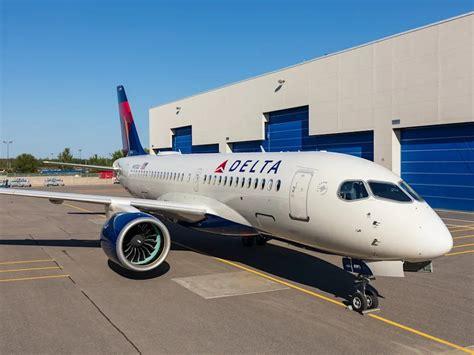
Delta Air Lines offers one of the clearest case studies. By integrating nearly 100 A220 aircraft into its fleet, the airline has systematically replaced aging Boeing 717s and Embraer E190s. The result is not just modernization—it is margin protection at scale. The A220-300 delivers a 12% cost-per-seat advantage over competing aircraft like the 737 MAX 7, allowing Delta to maintain high-frequency service without sacrificing profitability during off-peak periods.
This matters more than it might seem. Airlines live and die by load factors and unit costs, and flying a half-empty larger jet can quickly erode margins. The A220 avoids that trap. Its lower trip cost means it can break even with fewer passengers, giving airlines a critical buffer against demand fluctuations.
At the same time, its advanced aerodynamics and lightweight composite structures ensure that efficiency is not achieved at the expense of performance. The aircraft’s Pratt & Whitney Geared Turbofan engines deliver double-digit fuel savings, turning what was once a major cost center into a competitive advantage.
Fleet Simplification and the Hidden Profit Engine
Beyond fuel savings, the A220 is quietly transforming airline cost structures through fleet simplification. Operating multiple aircraft types typically introduces inefficiencies—separate pilot training programs, maintenance procedures, spare parts inventories, and scheduling complexities all add up.
By scaling the A220 across their operations, airlines like Delta and Air Canada are unlocking economies of uniformity. Training becomes standardized, maintenance workflows streamline, and operational disruptions decrease. These indirect savings rarely make headlines, but they significantly impact long-term profitability.
The aircraft also integrates seamlessly into modern airline strategies that prioritize premium-heavy configurations. With fewer seats but higher comfort levels, airlines can increase yield per passenger rather than chasing sheer volume. The A220 becomes not just a cost-saving tool, but a revenue optimization platform.
Breeze Airways and the Power of Underserved Routes
If legacy carriers demonstrate how the A220 enhances existing networks, Breeze Airways shows how it can build entirely new ones. The airline has leveraged the aircraft to execute a bold strategy: dominate underserved city pairs that larger aircraft cannot profitably serve.
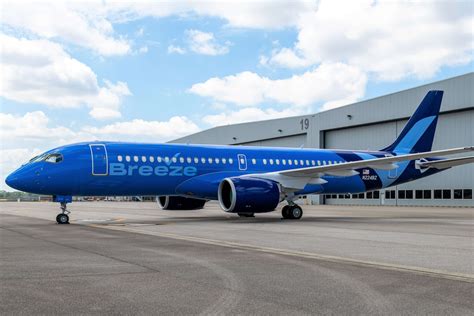
As of 2026, approximately 90% of Breeze’s routes face no nonstop competition. This is not luck—it is a direct consequence of the A220’s economics. With lower operating costs and long-range capability, Breeze can connect mid-sized cities like Charleston and Providence without relying on congested hub airports.
This approach has delivered tangible results. Breeze achieved full-year profitability in 2025, an almost unheard-of milestone for a young airline. The A220’s ability to break even with fewer passengers provides a safety net when launching new routes, reducing the financial risk that typically cripples startups.
Equally important is the shift away from the traditional hub-and-spoke model. By focusing on point-to-point travel, Breeze avoids high landing fees, minimizes delays, and offers passengers a more convenient experience. The A220 is not just supporting this strategy—it is enabling it.
Range Redefined: Unlocking Long and Thin Markets
One of the most transformative features of the A220 is its 3,400 nautical mile range, which effectively redraws the map of viable airline routes. This capability allows airlines to operate long and thin routes—flights that cover significant distances but do not generate enough demand to fill larger aircraft.
Routes like Richmond to Los Angeles, once considered marginal, are now economically viable. The A220 can operate these flights profitably with as few as 100 passengers, opening up a new layer of connectivity across North America.
Air Canada has capitalized on this flexibility by deploying the A220 on routes linking major cities like Montreal and Toronto to secondary destinations in the United States and Central America. Instead of overcommitting larger aircraft, the airline can right-size capacity, ensuring that each flight operates at optimal efficiency.
Operationally, the benefits extend beyond route planning. The A220’s design allows for faster turnaround times, thanks to efficient boarding layouts and smaller cabin sizes. Saving even 10–15 minutes on the ground can significantly increase daily aircraft utilization, translating directly into higher revenue per aircraft.
Passenger Experience as a Revenue Multiplier
Profitability in aviation is not purely about cost control—it is also about revenue generation, and this is where the A220 quietly excels. Passengers consistently rate the aircraft highly, and that preference translates into measurable financial gains.
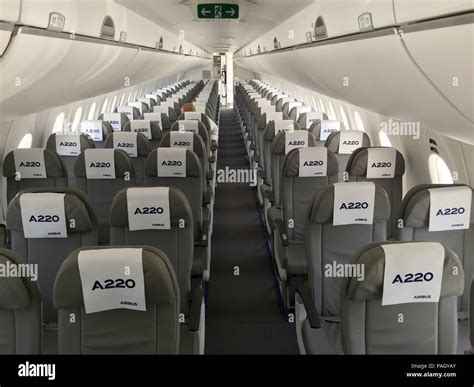
The A220’s 2-3 seating configuration eliminates the dreaded middle-seat dominance found on traditional narrowbodies. With 80% of seats offering either a window or aisle, the aircraft provides a noticeably more comfortable experience. Travelers are increasingly aware of this difference, often choosing flights based on aircraft type.
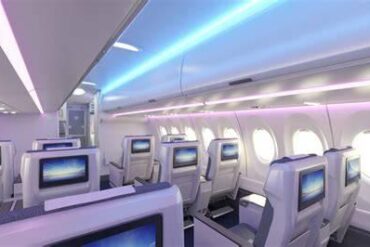
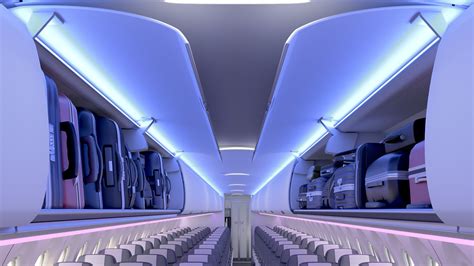
Airlines have responded by leveraging this preference to command higher fares. The introduction of the Airbus Airspace cabin further enhances the appeal, featuring larger overhead bins, advanced lighting systems, and the largest windows in its class. The result is a cabin environment that feels closer to a widebody than a regional jet.
This passenger-driven demand creates a virtuous cycle: better experience leads to higher yields, which reinforces the aircraft’s profitability. In a competitive market, that edge is invaluable.
The A220-500: A Potential Game-Changer
The aviation industry is now turning its attention to the anticipated A220-500, a stretched variant expected to enter service later in the decade. This model could carry up to 180 passengers, placing it squarely in competition with the Airbus A320neo and Boeing 737 MAX 8.

The implications are significant. A larger A220 would deliver even better seat-mile economics, spreading fixed costs across more passengers while retaining the efficiency advantages of the existing design. For airlines, this means the possibility of operating a single aircraft family across a wide range of route types.
Such flexibility would simplify fleet planning and reduce operational complexity, allowing carriers to scale capacity up or down without introducing new aircraft types. If realized, the A220-500 could redefine the competitive landscape of narrowbody aviation.
Overcoming Engine Challenges and Stabilizing Operations
No success story is without its setbacks, and the A220 has faced its share—most notably with the Pratt & Whitney GTF engines. Between 2024 and 2025, reliability issues led to widespread groundings, temporarily undermining the aircraft’s economic advantages.
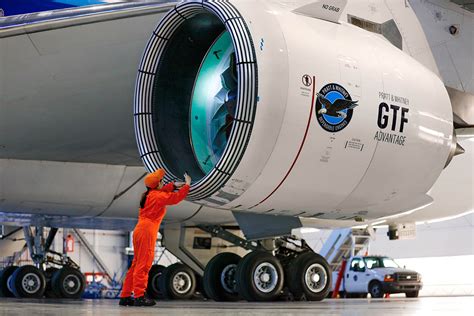
However, the situation has improved significantly. Enhanced maintenance programs, updated components, and long-term service agreements have reduced aircraft-on-ground incidents. Airlines like JetBlue have reported substantial declines in downtime, restoring confidence in the platform.
These improvements are critical because the engine remains central to the A220’s value proposition. Delivering up to 20% better fuel efficiency than previous-generation engines, the GTF is too important to abandon. With reliability stabilizing, airlines are finally able to fully realize the aircraft’s earning potential.
A Defining Aircraft for the Next Decade
The rise of the Airbus A220 signals a broader shift in aviation strategy. Airlines are moving away from one-size-fits-all solutions and embracing aircraft that align precisely with market realities. In this new environment, the A220 stands out as a perfectly calibrated tool—efficient, flexible, and highly adaptable.
Its impact is visible across the industry. Legacy carriers are using it to refine their networks, low-cost entrants are building entire business models around it, and passengers are actively seeking it out. Few aircraft achieve this level of cross-functional success.
As the program surpasses 1,000 orders and continues to expand globally, the A220 is no longer an underdog. It is a benchmark. A proof point that in modern aviation, profitability is not driven by size alone, but by precision, efficiency, and strategic design.
The conclusion is difficult to ignore: the Airbus A220 is not just another narrowbody—it is the aircraft that is quietly rewriting the economics of flight in North America.