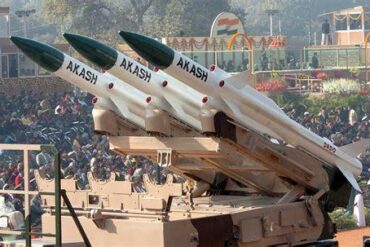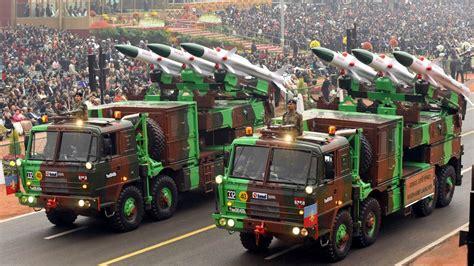
The Akash missile, named after the Sanskrit word for Sky, is a medium-range, mobile surface-to-air missile (SAM) system developed by India’s Defence Research and Development Organisation (DRDO) and produced by Bharat Dynamics Limited (BDL) and Bharat Electronics Limited (BEL). This indigenous missile system has been a critical component of India’s air defense architecture since its induction in 2009, providing robust protection against a wide spectrum of aerial threats, including fighter jets, drones, and helicopters. The Akash system has become a cornerstone of the Indian military’s air defense strategy, saving approximately ₹34,500 crore in foreign exchange and fulfilling a vital role in self-reliance for defense technology.
Service History and Operational Deployment
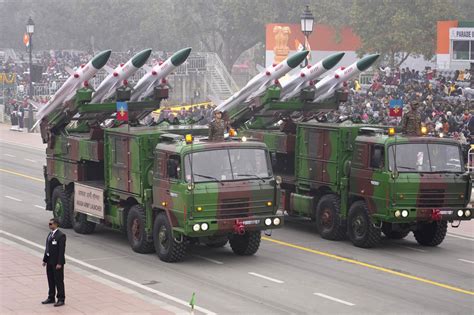
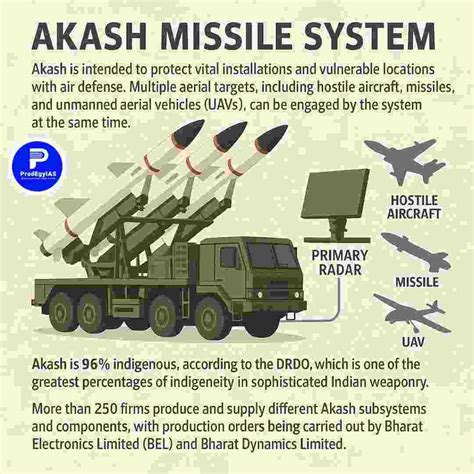
The Akash missile has seen extensive deployment across the Indian Army and Indian Air Force (IAF), with more than 15,500 missiles produced to date, each costing around ₹2.5 crore. These missiles form the backbone of India’s medium-range air defense network, providing comprehensive coverage over vast areas. Each battery comprises a sophisticated Rajendra PESA 3D radar and four launchers, each carrying three Akash missiles. This configuration allows the system to track up to 64 targets and engage 12 simultaneously, offering unparalleled battlefield flexibility.
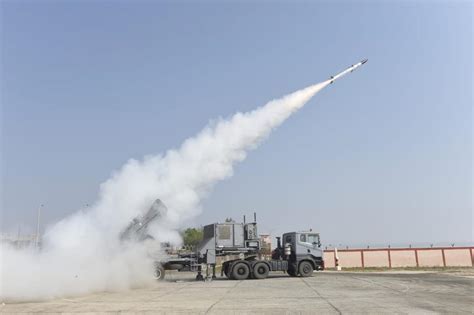
Akash batteries are fully mobile, mounted on either T-72 chassis for the Army or Tata LPTA 8×8 trucks for the Air Force, enhancing their operational reach. The system’s mobility ensures rapid deployment and redeployment, critical for modern warfare. A single Akash battery can effectively protect a 2,000 km² area, making it an essential asset for defending high-value assets and convoys on the move.
System Architecture and Command Structure
The Akash missile system operates within a hierarchical command structure, organized into batteries, squadrons, and regiments. Each battery is supported by a Group Control Centre (GCC) and a network of surveillance radars, including 3D CAR (Central Acquisition Radar) and BSR (Battery Surveillance Radar), providing layered airspace coverage. These radars offer early warning at ranges of 150 km and 100 km respectively, ensuring ample response time against incoming aerial threats.
Advanced features like automated target classification, multi-radar data fusion, and real-time threat prioritization allow the system to achieve a remarkable 88% single-shot kill probability, which rises to 98.5% when two missiles are fired at the same target. This high success rate underscores the precision and reliability of the Akash system, which is essential for modern, high-intensity air defense operations.
Missile Specifications and Performance
The Akash missile itself is a formidable piece of engineering, weighing 720 kg, measuring 5.78 meters in length, and 35 cm in diameter. It carries a 60 kg high-explosive, pre-fragmented warhead equipped with a radio proximity fuse, designed to detonate in close proximity to the target for maximum destructive impact. The missile’s propulsion system uses an integrated ramjet-rocket sustainer, enabling it to achieve speeds between Mach 1.8 and Mach 2.5. Its effective engagement range is 25 to 30 km, with a maximum altitude ceiling of 20 km, providing versatile coverage against a wide range of airborne threats.
Radars and Guidance Systems
At the heart of the Akash’s accuracy is the Rajendra BLR (Battery Level Radar), a sophisticated 3D radar capable of tracking targets at ranges up to 60 km and guiding up to 8 missiles simultaneously against 4 separate targets. The broader Battery Surveillance Radar (BSR) can track up to 40 targets at 100 km, while the 3D CAR extends this reach to 180 km and can monitor up to 200 targets. This multi-layered radar architecture ensures comprehensive situational awareness and seamless target tracking across a wide operational spectrum.
Development and Variants
The Akash system has undergone significant upgrades since its initial deployment. Key variants include:
- Akash Mark-I: The original model, with extensive testing from 1990 and first simultaneous intercept capability demonstrated in 2005.
- Akash-1S: Tested in May 2019, this variant features an indigenous seeker and extended 30 km range.
- Akash Prime: Introduced in 2021, incorporating a Ku/X-band seeker for enhanced accuracy under extreme conditions.
- Akash-NG (Next Generation): Approved in 2016, this version features a dual-pulse motor for extended 70–80 km range and cutting-edge AESA radar for improved tracking and targeting.
Global Reach and Export Potential
Beyond its service in India, the Akash system has seen export interest from various countries, including Sudan, Philippines, UAE, and others. In 2024, Armenia became the first international customer, receiving a battery on November 12, 2024. This growing export potential underscores the Akash’s reputation as a cost-effective, high-performance air defense solution.
Conclusion
The Akash missile system stands as a testament to India’s indigenous defense capabilities, blending advanced technology with robust operational performance. Its ongoing evolution, marked by continuous upgrades and increasing export prospects, ensures that it will remain a critical asset for air defense well into the future.