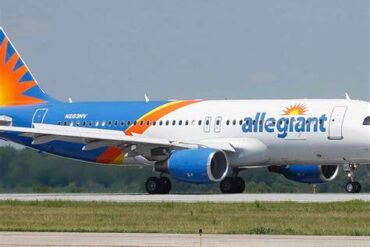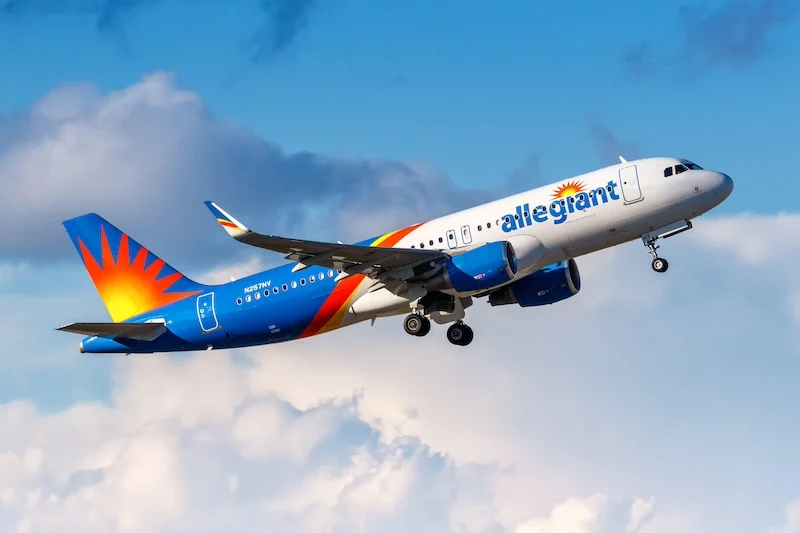
Allegiant Air is undertaking one of its most notable network adjustments in recent years, removing 61 routes from its schedule while introducing 49 new services across the United States. The changes, identified through analysis of OAG scheduling data comparing July 2025 and July 2026 operations, reveal a carrier increasingly focused on refining profitability, consolidating resources, and prioritizing markets that align with its ultra-low-cost business model.
Rather than signaling a broad retreat, the restructuring illustrates how the airline continues to evolve in response to changing passenger demand, operational efficiency goals, and competitive realities. While dozens of routes have disappeared from the map, Allegiant is simultaneously expanding into selected new destinations and strengthening its presence in strategically valuable regions.
Allegiant Air’s Route Network Undergoes Major Transformation
The scale of the network revision is substantial. A total of 61 previously operated routes will no longer be available in July 2026, while 49 new routes have been introduced during the same period. The result is a carefully recalibrated network designed to emphasize leisure-focused traffic patterns and maximize aircraft utilization.
A key driver behind these reductions is Allegiant’s decision to completely withdraw service from several airports. The airline has ceased operations at Los Angeles International Airport (LAX), Oakland International Airport (OAK), Minneapolis–Saint Paul International Airport (MSP), and Norfolk International Airport (ORF), among others. The elimination of service at these airports alone accounts for approximately 43% of all route cancellations.
These decisions highlight Allegiant’s longstanding preference for serving underserved leisure markets rather than competing aggressively at large, congested hubs dominated by legacy carriers.
Los Angeles International Airport Records the Highest Number of Cuts
The airline’s departure from LAX represents the most dramatic aspect of the restructuring. Fourteen separate routes connected to Los Angeles have disappeared, making the airport the single largest contributor to Allegiant’s route reductions.
Services eliminated from LAX include flights to:
- Bellingham
- Cedar Rapids
- Cincinnati
- Spokane
- Grand Rapids
- Indianapolis
- Little Rock
- McAllen
- Northwest Arkansas
- Omaha
- Sioux Falls
- Springfield
- Tulsa
- Wichita
Although these cancellations reduce Allegiant’s footprint in Southern California, the airline continues serving certain affected communities through alternative airports. Travelers from Bellingham, Cincinnati, Grand Rapids, Indianapolis, and Spokane can still access Allegiant flights through Burbank or Orange County, preserving limited connectivity within the broader Los Angeles metropolitan area.

Additional Airports Experience Significant Service Reductions
Beyond LAX, several airports witnessed notable declines in Allegiant operations. Norfolk International Airport lost six routes, while Fort Lauderdale-Hollywood International Airport experienced the removal of five services.
Meanwhile, Oakland International Airport and Orlando Sanford International Airport each recorded four eliminated connections, demonstrating the carrier’s willingness to scale back even within traditionally important leisure gateways.
Other airports facing multiple cuts include:
- Las Vegas Harry Reid International Airport
- Savannah Hilton Head International Airport
These changes reinforce Allegiant’s disciplined approach to route management, where underperforming markets are routinely reassessed regardless of historical importance.
Gulf Shores Experiment Illustrates Allegiant’s Flexible Strategy
One example of Allegiant’s responsiveness to market conditions can be found in Gulf Shores, Alabama. The destination welcomed its first scheduled commercial flights in May 2025, with Allegiant serving as the sole airline operator.
However, the route linking Houston Hobby Airport and Gulf Shores survived for only a short period. Operating twice weekly with Airbus A319 and A320 aircraft, the service struggled to generate sufficient demand. Data from the US Department of Transportation showed that only 43% of available seats were filled.
The disappointing performance made the decision straightforward. Despite Gulf Shores remaining part of Allegiant’s broader strategy, the Houston connection was swiftly removed from the schedule.
Cincinnati to Los Angeles Was the Longest Route Eliminated
Among all discontinued services, the route between Cincinnati and Los Angeles stood out due to both its length and historical significance.
Stretching 1,651 nautical miles (3,058 kilometers), it represented the longest of the 61 eliminated routes. Allegiant operated the service from November 2017 through January 2026, transporting approximately 272,000 round-trip passengers during that period.
Interestingly, demand remained relatively strong. The route achieved a 91% seat occupancy rate, significantly exceeding industry averages. Allegiant’s average one-way base fare on the route stood at $88, excluding taxes and ancillary fees.
The challenge lay in economics rather than popularity. The route exceeded Allegiant’s typical stage length by 119%, increasing operational complexity and limiting the low-cost advantages that underpin the carrier’s business model.
Average Route Length Suggests Strategic Refocusing
The 61 eliminated routes averaged 831 nautical miles (1,539 kilometers), making them approximately 10% longer than Allegiant’s remaining scheduled services.
At first glance, rising fuel costs and geopolitical instability might appear to explain these decisions. Yet many of the longest routes ended before more recent disruptions emerged, indicating that broader strategic considerations played a larger role.
Allegiant’s network has historically favored shorter, leisure-oriented flights connecting smaller cities directly to vacation destinations. The latest restructuring appears to reinforce that philosophy.
Allegiant Will Serve More Airports Despite Route Reductions
Despite eliminating numerous services, Allegiant’s overall airport count is actually increasing.
The airline served 119 airports during July 2025. By July 2026, that number will rise to 120 airports, reflecting a modest but symbolically important expansion.
New additions include:
- Fort Myers
- Huntsville
- Atlantic City
- La Crosse
- Burbank
- Trenton
- Philadelphia International Airport
- Columbia, Missouri
The introduction of Philadelphia International Airport is particularly noteworthy. As one of the nation’s busiest aviation gateways, Philadelphia becomes another major market within Allegiant’s portfolio and demonstrates the airline’s willingness to selectively enter larger airports when strategic opportunities emerge.
What These Changes Mean for Travelers
For passengers, Allegiant’s latest route adjustments underscore an important reality of ultra-low-cost travel: flexibility remains central to the business model.
Routes that consistently generate strong demand and sustainable returns tend to endure, while weaker performers can disappear quickly. Travelers in affected markets may need to shift to nearby airports, consider alternative airlines, or adapt their vacation planning accordingly.
At the same time, the addition of new destinations ensures that Allegiant continues expanding access to affordable leisure travel. The carrier’s evolving network reflects an airline focused less on size and more on efficiency, profitability, and maintaining its distinctive position within the competitive US aviation landscape.
As July 2026 approaches, Allegiant’s revised route map offers a revealing snapshot of how airlines continuously reshape their operations to match changing market realities while pursuing long-term growth.