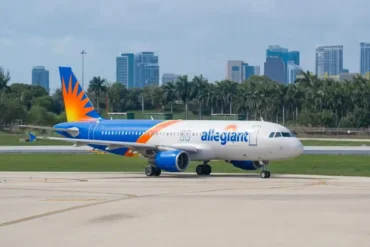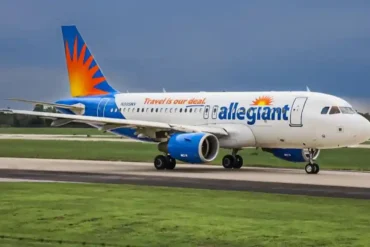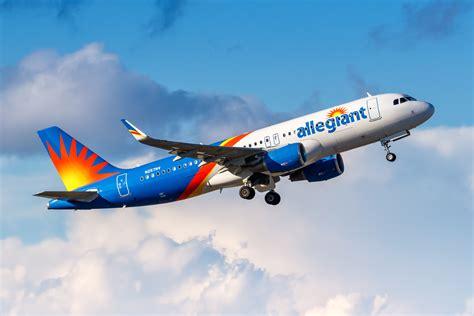
At 14:12 local time on Monday, June 2nd, a routine departure from Huntington Tri-State Airport (HTS) turned critical when an Airbus A320 operated by Allegiant Air suffered an engine failure shortly after takeoff. The aircraft, en route to St. Petersburg, Florida, was carrying 140 passengers. Within 15 to 20 minutes of being airborne, the flight crew declared an emergency and safely returned the aircraft to HTS for an emergency landing.
Emergency Response and Initial Investigation
According to Brent Brown, director of Huntington Tri-State Airport, emergency procedures were executed with precision, and all passengers were evacuated safely after the landing. The aircraft was promptly grounded for inspection, and a secondary flight was arranged to complete the travelers’ journey.
Allegiant Air’s technical response team performed immediate post-landing diagnostics, confirming a serious engine malfunction. The airline opted to ground the aircraft pending an in-depth maintenance evaluation to ensure airworthiness and mechanical safety. Given Allegiant’s status as a ULCC (Ultra-Low-Cost Carrier), aircraft utilization rates are typically high, making such an unplanned grounding operationally disruptive.
A320 Engine Issues: A Broader Industry Concern
This incident echoes a troubling pattern across the aviation sector, especially involving Airbus A320-family aircraft. Engine reliability, particularly with the Pratt & Whitney Geared Turbofan (GTF) series, has remained a thorn in the side of several airlines.
Earlier in 2025, Spirit Airlines reached a $150 million USD compensation deal with Pratt & Whitney after prolonged engine-related grounding disrupted their fleet operations. These issues affected aircraft models including the A320neo, A321neo, A220, and Embraer E190-E2, many of which remain sidelined.
A July 2023 technical advisory from Pratt & Whitney warned of long-term engine wear, urging operators to return engines for early inspection. The downstream impact has been severe: hundreds of aircraft across global fleets have faced groundings, delaying route expansions and pressuring airline financial performance.
Allegiant Air’s Fleet Pressure and Operational Strategy
At the core of Allegiant’s operations is the Airbus A320ceo, which makes up 85 of its 129 aircraft. This heavy reliance on a single model amplifies the consequences of even isolated mechanical issues. Earlier in 2025, Allegiant announced 44 new routes and service to three new U.S. cities. These additions were expected to be served primarily by the A320ceo.
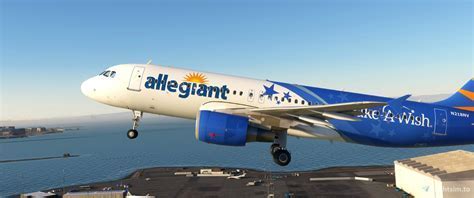
However, the optimism of expansion was tempered by route cancellations and the closure of the LAX crew base, a move indicating reactive cost management. By shifting aircraft and crew to more profitable bases, Allegiant has attempted to preserve operational efficiency amid unpredictability. The grounding of any aircraft, especially a high-capacity A320, represents a significant disruption to this delicate balancing act.
The Aircraft: An Operationally Diverse Past
The aircraft involved in the HTS incident, registered N230NV, has had a globally diverse operational history. First delivered in 2001 to Lotus Air in Egypt, the jet was leased out to various operators over the decades:
- Air 200 Limited (UK) for under a year.
- Ghana Airways for a three-month contract.
- Spring Airlines (China) under GECAS lease for seven years.
- Vueling Airlines (Spain) until 2017.
- Acquired by Allegiant in 2017, where it has flown under the airline’s signature sun-streaked livery.
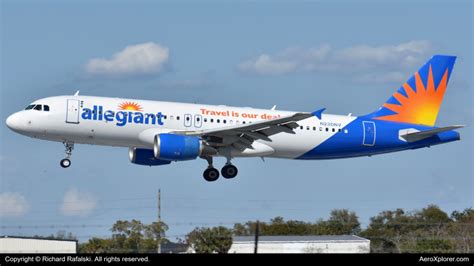
Aircraft of this age often require meticulous maintenance and rigorous scheduling to maintain airworthiness. While Allegiant has a reputation for extending the lifespan of older airframes through proactive servicing, an engine failure so soon after takeoff raises concerns about systemic mechanical stress or latent defects.
Engine Type and Known Technical Concerns
While Allegiant’s A320ceo aircraft do not utilize the newer GTF engines found in A320neos, they are still subject to performance limitations of older CFM56 or IAE V2500 powerplants. These engines, though reliable by reputation, can suffer from aging-related issues such as:
- Compressor blade fatigue
- Thermal cycling cracks
- Fuel nozzle clogging
The FAA has previously issued airworthiness directives affecting these engines, mandating regular borescope inspections and oil sample analysis to catch degradation early. It’s currently unknown which engine model N230NV is fitted with, but Allegiant’s internal safety audit is likely to assess engine family-wide implications.
Regulatory Oversight and Post-Incident Protocols
In the United States, all post-incident investigations involving commercial aircraft fall under the purview of the Federal Aviation Administration (FAA) and the National Transportation Safety Board (NTSB). Although the HTS event did not involve fatalities or injuries, the severity of an in-flight engine failure warrants formal scrutiny.
Should systemic issues be identified, airworthiness directives may follow, impacting Allegiant and other operators of aging A320ceo aircraft. The FAA is particularly sensitive to recurring mechanical anomalies, especially in older fleets maintained on aggressive cost-control schedules.
Passenger Impact and Communication
Passengers aboard the flight reported calm yet tense conditions as the aircraft turned back toward HTS. Allegiant’s flight crew maintained professional composure, updating travelers in real time and ensuring a safe landing. Most passengers were rebooked within several hours, though some expressed frustration over delays and lack of real-time app-based notifications.
Allegiant issued a brief statement confirming the incident and reiterating its commitment to passenger safety and fleet reliability. The airline has not yet released a detailed breakdown of the cause, pending internal review and third-party engine analysis.
Allegiant’s Reputation at a Crossroads
Allegiant’s business model is rooted in low fares, point-to-point connectivity, and secondary airport utilization. This structure thrives on cost minimization, which includes flying older, fully amortized jets. While this keeps fares low, it places pressure on maintenance teams and operational scheduling to keep aging equipment in peak condition.
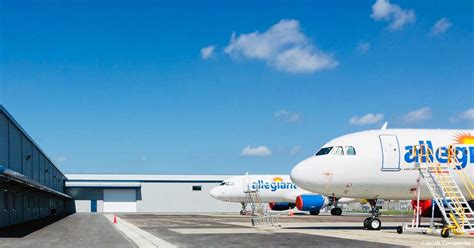
Events like the HTS engine failure challenge this operational philosophy. If reliability begins to erode in public perception, Allegiant may face scrutiny not only from regulators but also from cost-conscious passengers increasingly aware of the trade-offs between low fares and aircraft reliability.
Conclusion: A Critical Moment for Allegiant and A320 Operators
The June 2nd engine failure highlights more than just a single incident. It underscores the broader vulnerabilities associated with the Airbus A320ceo, especially within ULCC fleets reliant on high aircraft utilization. While the safe outcome of the flight reflects strong procedural discipline, it also raises urgent questions about maintenance cycles, engine integrity, and fleet modernization strategies.
Allegiant’s next steps — whether increasing inspection frequency, accelerating aircraft replacements, or revisiting supplier contracts — will serve as a case study in how ULCCs balance cost and safety in an era of aging aircraft and increasing mechanical scrutiny.