Allegiant Air has engineered one of the most unconventional yet quietly effective network strategies in the U.S. airline industry, and nowhere is that blueprint more visible than in Florida. While legacy carriers concentrate power at mega-hubs and global gateways, Allegiant has built a lattice of secondary airports, leisure corridors, and underserved city pairs that funnel vacation traffic into the Sunshine State with surgical precision. The result is a decentralized but highly resilient operating system anchored by six Florida bases—each with a distinct strategic function, demand profile, and competitive landscape.
Florida is not merely another region in Allegiant’s route map; it is the gravitational center of the airline’s business model. The carrier’s ultra-low-cost structure, point-to-point scheduling, and seasonal capacity flexibility align perfectly with the state’s tourism economy. Beaches, cruise ports, retirement communities, golf resorts, and theme parks generate year-round demand that can be stimulated further through low fares and nonstop access from mid-sized cities.
Recent performance metrics reinforce the strength of this design. Allegiant posted a 99.89% controllable completion rate in 2025, ranked first in the industry for fewest cancellations, and led U.S. airlines in baggage handling reliability. Industry recognition—from Skytrax and The Wall Street Journal alike—signals that its operational discipline is matching its network ingenuity.
Destin–Fort Walton Beach Airport: Commanding the Emerald Coast
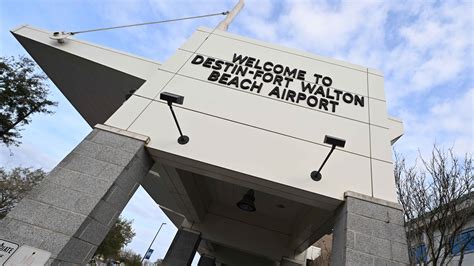
Destin–Fort Walton Beach Airport (VPS) represents Allegiant’s precision targeting of high-value leisure micro-markets. Situated within Eglin Air Force Base, this joint-use facility offers one of the most unusual commercial aviation environments in the United States. Civilian airliners share runway space with military aircraft, producing a surreal juxtaposition of vacation travelers and fighter jets.
Operationally, VPS is Allegiant’s smallest Florida base—but strategic importance is not measured purely in scale. The Emerald Coast is one of the fastest-growing beach destinations in North America, and Allegiant has entrenched itself as the dominant access provider.
The airline controls roughly 31% market share, operating more than 5,700 annual flights to 33 destinations. Its dedicated Concourse C expansion, opened in 2022, signaled a long-term infrastructure commitment rarely seen in secondary leisure airports.
Growth here is fueled by connectivity to Midwestern feeder markets—regions where winter climates create strong outbound vacation demand. Routes such as Cincinnati, Indianapolis, and St. Louis function as seasonal demand pipelines, filling aircraft with travelers seeking Gulf Coast beaches.
Sarasota–Bradenton International Airport: Sun Coast Demand Engine
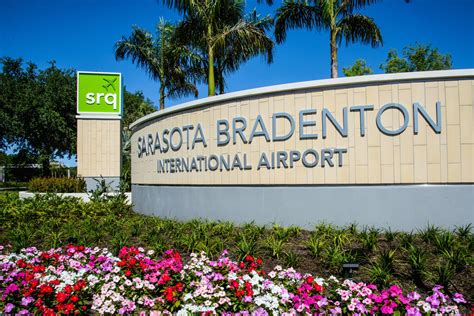
Further down Florida’s west coast sits Sarasota–Bradenton International Airport (SRQ), a market transformed by Allegiant’s entry in 2018. Traditionally a modest regional airport, SRQ has surged into a major leisure gateway, welcoming 4.5 million passengers in 2025—quadruple pre-pandemic traffic.
Allegiant’s role in that expansion is structural rather than incidental. By building a network of nonstop links to Midwestern and Northeastern cities, the airline unlocked latent demand that legacy hub-and-spoke systems had priced out or overcomplicated.
Its operational footprint includes:
- 36 destinations
- 7,140 annual flights
- Over 1.28 million seats
The opening of Concourse A in 2025, a $100 million facility with dedicated Allegiant operations, formalized the airport’s transformation into a scaled leisure base.
Yet success invites competition. Southwest Airlines remains a formidable presence, and Breeze Airways has begun probing similar Northeast corridors. What emerges is a classic aviation ecosystem dynamic: Allegiant pioneers a low-fare leisure market, demand materializes, competitors arrive, and pricing pressure intensifies.
Fort Lauderdale–Hollywood International Airport: Fighting in LCC Heavyweight Territory
If Allegiant’s other Florida bases resemble controlled ecosystems, Fort Lauderdale (FLL) is an open ocean teeming with predators. This airport functions as South Florida’s low-cost carrier coliseum, where Spirit, JetBlue, Southwest, and Delta battle for volume supremacy.
Allegiant’s market share—just 3%—appears modest, but its presence is strategically indispensable. South Florida is one of the densest leisure and cruise markets in the world, and network completeness demands a foothold.
Rather than confront incumbents head-on, Allegiant applies its familiar niche logic. It targets secondary origin cities underserved by competitors—places like Asheville, Concord, Knoxville, and Allentown—linking them nonstop to South Florida beaches and cruise ports.
This tactic avoids fare wars while still capturing high-margin leisure traffic. Nearly 1.5 million annual seats flow through this targeted network slice, proving that even in hyper-competitive terrain, specialization can carve profitable airspace.
Punta Gorda Airport: The Near-Private Allegiant Stronghold
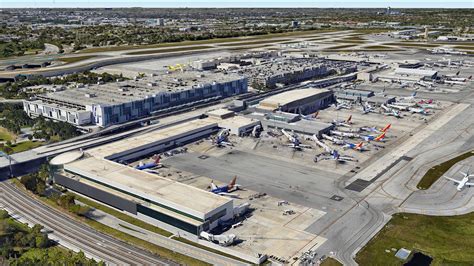
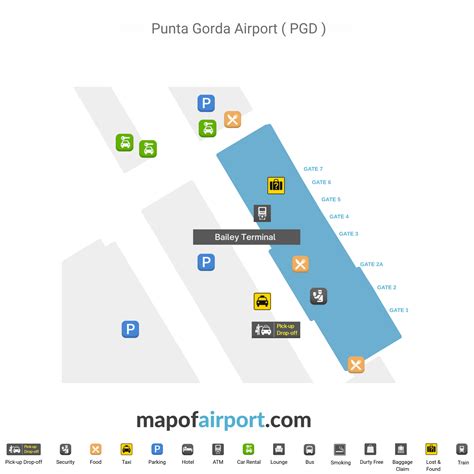
Punta Gorda (PGD) may be the purest expression of Allegiant’s operating philosophy. Located near Fort Myers yet far less congested, the airport offers travelers a friction-light alternative to major gateways.
Allegiant holds an astonishing 99% market share here. Operationally, that translates into near-total control of scheduling, pricing, and capacity deployment. With more than 1.88 million seats and 51 destinations, PGD functions less like a shared airport and more like a proprietary leisure terminal.
The passenger experience reinforces that boutique feel. The absence of jet bridges means travelers walk directly onto the tarmac—a nostalgic throwback that doubles as a cost-saving mechanism.
PGD’s growth—from a few hundred thousand passengers to over 2.3 million—illustrates how airline strategy can manufacture airport relevance almost from scratch.
Yet this base also hosts one of Allegiant’s most instructive miscalculations: the Sunseeker Resort Charlotte Harbor venture. Conceived as a vertically integrated travel ecosystem—airline feeding a proprietary resort—the project suffered pandemic delays, hurricane damage, and financial overruns. Ultimately sold at a loss, it stands as a reminder that airlines excel at transporting tourists, not necessarily housing them.
St. Pete–Clearwater International Airport: Tampa Bay’s Secondary Titan
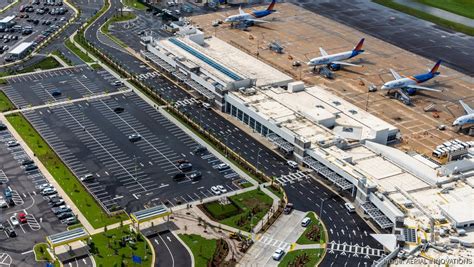
St. Pete–Clearwater (PIE) blends historical symbolism with modern low-cost scale. Located near the departure point of the world’s first commercial airline flight in 1914, the airport now hosts one of Allegiant’s largest operational footprints.
Marketed as “Tampa Bay The Easy Way,” PIE leverages simplicity as a competitive weapon. A single terminal, short walking distances, and rapid curb-to-gate times appeal strongly to leisure travelers.
Allegiant again commands 99% market share, operating:
- 62 destinations
- 18,828 annual flights
- 3.37 million seats
Passenger traffic has doubled since the pandemic, reaching 2.8 million travelers annually, with projections surpassing 3 million as new routes launch.
Strategically, PIE acts as a capacity release valve for the congested Tampa International Airport. By diverting leisure traffic to a secondary field, Allegiant avoids slot constraints and infrastructure bottlenecks while preserving proximity to Gulf Coast resorts.
Orlando Sanford International Airport: The Leisure Megabase
Orlando Sanford (SFB) is the crown jewel of Allegiant’s Florida system—its largest base in the state and one of the most dominant airline-airport relationships in North America.
While most carriers converge on Orlando International (MCO), Allegiant built its empire at this secondary field, transforming it into a leisure megabase with 99% market share.
Operational scale is immense:
- 68 destinations
- 20,986 annual flights
- 3.76 million seats
SFB’s identity is dual-layered. On one level, it is a tourist gateway feeding Disney, Universal, and cruise itineraries. On another, it is a global pilot-training hub, ranking among the world’s busiest airports by aircraft movements due to flight schools.
This creates a fascinating operational ecology: training aircraft performing touch-and-go maneuvers alongside fully loaded leisure jets bound for Midwestern cities.
Allegiant continues to expand here, adding routes to emerging secondary markets and even introducing its only network red-eye flight, linking Las Vegas to Orlando overnight—an operational deviation driven by aircraft utilization economics.
Network Architecture: Why Secondary Airports Win
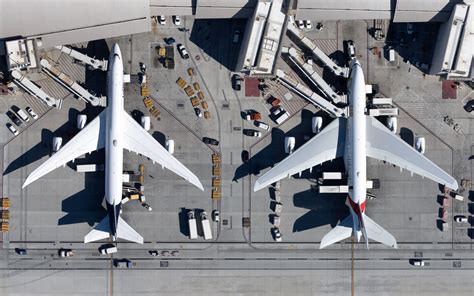
Across all six bases, a unifying strategic doctrine emerges: secondary airport dominance.
Primary hubs are expensive, congested, and slot-restricted. Secondary airports offer:
- Lower landing fees
- Faster turn times
- Incentive packages from local authorities
- Reduced competition
This environment allows Allegiant to maintain ultra-low fares while preserving margins. It also enhances operational reliability—fewer delays cascade through the network when aircraft are not queued behind dozens of legacy carriers.
There is also a psychological dimension. Leisure travelers value convenience over prestige. Parking close to the terminal and clearing security quickly often outweighs flying into a marquee airport.
Feeder Geography: The Midwest–Florida Supercorridor
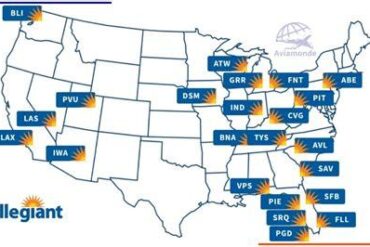
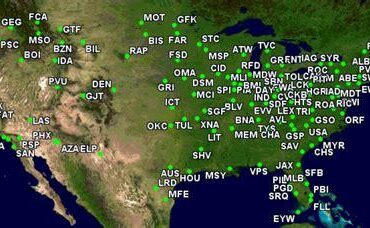
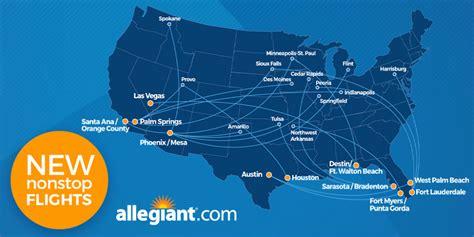
A glance at Allegiant’s route maps reveals a gravitational pattern: Midwestern origin cities feeding Florida leisure destinations.
Cold winters, aging populations, and strong vacation culture make cities like Cincinnati, Pittsburgh, Indianapolis, and Grand Rapids fertile demand generators. By offering nonstop service where competitors require connections, Allegiant converts time savings into booking decisions.
This corridor behaves like an atmospheric river of tourism—seasonally fluctuating but perpetually flowing southward.
Competitive Layering Across the Six Bases
Not all bases face the same competitive pressure.
- High-competition environment: Fort Lauderdale
- Moderate competition: Sarasota
- Low competition: Destin
- Near monopoly: Punta Gorda, St. Pete–Clearwater, Sanford
This layered exposure diversifies risk. If fare wars erupt in South Florida, revenue stability from monopoly strongholds cushions the impact.
It is portfolio theory applied to airport geography.
Fleet Growth and the Florida Multiplier Effect
Allegiant’s fleet expansion—paired with its evolving aircraft mix—feeds directly into Florida growth. Additional aircraft allow frequency increases on proven routes while unlocking new secondary city pairs.
Florida bases function as deployment anchors where new capacity can be absorbed quickly due to elastic leisure demand.
Aircraft utilization also benefits. Short-haul leisure flights enable multiple daily rotations, maximizing revenue hours while minimizing crew and maintenance complexity.
The Strategic Horizon
Looking forward, Allegiant’s Florida network is poised for further densification rather than geographic diversification. More destinations, higher frequencies, and deeper Midwest penetration are likely before any radical structural shifts.
The pending merger with Sun Country Airlines could amplify this trajectory, particularly in monopoly bases like Punta Gorda and St. Pete–Clearwater where overlapping leisure DNA exists.
Florida, in essence, is not just a market. It is Allegiant’s operational laboratory—a proving ground where secondary airports, low costs, and targeted demand synthesis converge into a repeatable growth engine.
And in the peculiar physics of airline networks, sometimes the smallest airports generate the largest strategic gravity.